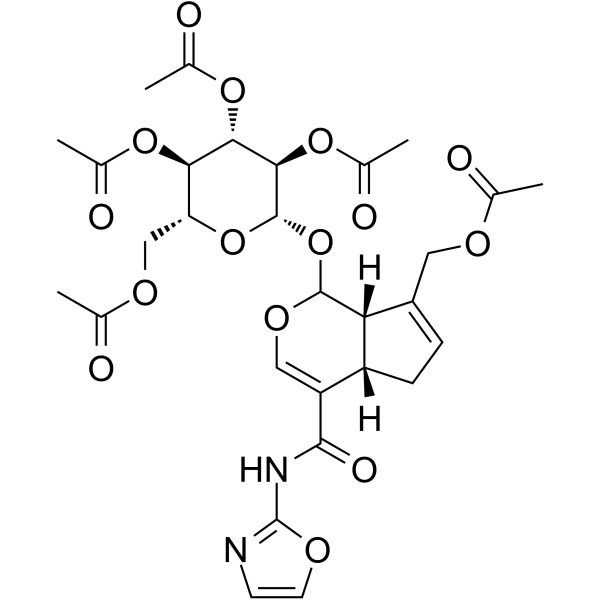
Physicochemical Properties
| Molecular Formula | C29H34N2O15 |
| Molecular Weight | 650.58 |
| Appearance | Typically exists as solid at room temperature |
| HS Tariff Code | 2934.99.9001 |
| Storage |
Powder-20°C 3 years 4°C 2 years In solvent -80°C 6 months -20°C 1 month |
| Shipping Condition | Room temperature (This product is stable at ambient temperature for a few days during ordinary shipping and time spent in Customs) |
Biological Activity
| ln Vitro | Compound 6c, or xanthine oxidase-IN-6, is a mixed-type XOD inhibitor that binds more selectively to the free enzyme than to the complex of the enzyme and substrate[1]. With a hydrolysis half-life of more than 4 hours, xanthine oxidase-IN-6 is stable under conditions similar to gastrointestinal digestion[1]. By lowering the levels of inflammatory factors (TNF-α, IL-1β, and TGF-β) in a dose-dependent manner, xanthine oxidase-IN-6 (0-100 µM) clearly shows anti-inflammatory properties[1]. When uric acid levels are high, HK-2 cell epithelial mesenchymal transition is inhibited by xanthine oxidase-IN-6 (0-100 µM, 48 h)[1]. |
| ln Vivo | Compound 6c, xanthine oxidase-IN-6, (0–20 mg/kg; ig; once daily for 2 weeks) mitigates renal damage, suppresses XOD activity in a dose-dependent manner, and has anti-hyperuricemic properties[1]. Reduced renal fibrosis and inflammation with xanthine oxidase-IN-6 (0–20 mg/kg; ig; once daily for 2 weeks) is a successful treatment[1]. |
| Cell Assay |
Western Blot Analysis[1] Cell Types: HK-2 cells Tested Concentrations: 12.5, 25, 50, and 100 µM Incubation Duration: 48 h Experimental Results: decreased the protein levels of α-SMA and Collagen I in a dose-dependent manner |
| Animal Protocol |
Animal/Disease Models: Kunming mice (male, weight 20 ± 2 g). Hyperuricemic mouse model established by administering 0.5% CMC-Na (10 mL/kg), adenine (200 mg/kg) and potassium oxonate (500 mg/kg); po (oral gavage) one time/day for 2 or 4 weeks[1]. Doses: 5, 10 and 20 mg/kg Route of Administration: Gavage, one time/day for 2 weeks Experimental Results: Effectively diminished the levels of SUA, Cr, and BUN, effectively inhibited XOD activity and urate accumulation in a dose-dependent manner. Remarkedly improved the morphologic lesions with less fibrosis in the interstitium. decreased the production of multiple cytokines (TNF-α, IL-8, and IL-1β). decreased the expression of α-SMA, collagen I, TLR4, NF-κB, IκBα and TNF-α. |
| References |
[1]. Synthesis and biological evaluation of geniposide derivatives as inhibitors of hyperuricemia, inflammatory and fibrosis. Eur J Med Chem. 2022 Apr 20;237:114379. |
Solubility Data
| Solubility (In Vitro) | May dissolve in DMSO (in most cases), if not, try other solvents such as H2O, Ethanol, or DMF with a minute amount of products to avoid loss of samples |
| Solubility (In Vivo) |
Note: Listed below are some common formulations that may be used to formulate products with low water solubility (e.g. < 1 mg/mL), you may test these formulations using a minute amount of products to avoid loss of samples. Injection Formulations (e.g. IP/IV/IM/SC) Injection Formulation 1: DMSO : Tween 80: Saline = 10 : 5 : 85 (i.e. 100 μL DMSO stock solution → 50 μL Tween 80 → 850 μL Saline) *Preparation of saline: Dissolve 0.9 g of sodium chloride in 100 mL ddH ₂ O to obtain a clear solution. Injection Formulation 2: DMSO : PEG300 :Tween 80 : Saline = 10 : 40 : 5 : 45 (i.e. 100 μL DMSO → 400 μLPEG300 → 50 μL Tween 80 → 450 μL Saline) Injection Formulation 3: DMSO : Corn oil = 10 : 90 (i.e. 100 μL DMSO → 900 μL Corn oil) Example: Take the Injection Formulation 3 (DMSO : Corn oil = 10 : 90) as an example, if 1 mL of 2.5 mg/mL working solution is to be prepared, you can take 100 μL 25 mg/mL DMSO stock solution and add to 900 μL corn oil, mix well to obtain a clear or suspension solution (2.5 mg/mL, ready for use in animals). Injection Formulation 4: DMSO : 20% SBE-β-CD in saline = 10 : 90 [i.e. 100 μL DMSO → 900 μL (20% SBE-β-CD in saline)] *Preparation of 20% SBE-β-CD in Saline (4°C,1 week): Dissolve 2 g SBE-β-CD in 10 mL saline to obtain a clear solution. Injection Formulation 5: 2-Hydroxypropyl-β-cyclodextrin : Saline = 50 : 50 (i.e. 500 μL 2-Hydroxypropyl-β-cyclodextrin → 500 μL Saline) Injection Formulation 6: DMSO : PEG300 : castor oil : Saline = 5 : 10 : 20 : 65 (i.e. 50 μL DMSO → 100 μLPEG300 → 200 μL castor oil → 650 μL Saline) Injection Formulation 7: Ethanol : Cremophor : Saline = 10: 10 : 80 (i.e. 100 μL Ethanol → 100 μL Cremophor → 800 μL Saline) Injection Formulation 8: Dissolve in Cremophor/Ethanol (50 : 50), then diluted by Saline Injection Formulation 9: EtOH : Corn oil = 10 : 90 (i.e. 100 μL EtOH → 900 μL Corn oil) Injection Formulation 10: EtOH : PEG300:Tween 80 : Saline = 10 : 40 : 5 : 45 (i.e. 100 μL EtOH → 400 μLPEG300 → 50 μL Tween 80 → 450 μL Saline) Oral Formulations Oral Formulation 1: Suspend in 0.5% CMC Na (carboxymethylcellulose sodium) Oral Formulation 2: Suspend in 0.5% Carboxymethyl cellulose Example: Take the Oral Formulation 1 (Suspend in 0.5% CMC Na) as an example, if 100 mL of 2.5 mg/mL working solution is to be prepared, you can first prepare 0.5% CMC Na solution by measuring 0.5 g CMC Na and dissolve it in 100 mL ddH2O to obtain a clear solution; then add 250 mg of the product to 100 mL 0.5% CMC Na solution, to make the suspension solution (2.5 mg/mL, ready for use in animals). Oral Formulation 3: Dissolved in PEG400 Oral Formulation 4: Suspend in 0.2% Carboxymethyl cellulose Oral Formulation 5: Dissolve in 0.25% Tween 80 and 0.5% Carboxymethyl cellulose Oral Formulation 6: Mixing with food powders Note: Please be aware that the above formulations are for reference only. InvivoChem strongly recommends customers to read literature methods/protocols carefully before determining which formulation you should use for in vivo studies, as different compounds have different solubility properties and have to be formulated differently. (Please use freshly prepared in vivo formulations for optimal results.) |
| Preparing Stock Solutions | 1 mg | 5 mg | 10 mg | |
| 1 mM | 1.5371 mL | 7.6854 mL | 15.3709 mL | |
| 5 mM | 0.3074 mL | 1.5371 mL | 3.0742 mL | |
| 10 mM | 0.1537 mL | 0.7685 mL | 1.5371 mL |