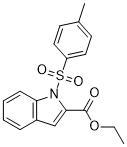
NOD-IN-1 is a novel and potent mixed inhibitor of nucleotide-binding oligomerization domain (NOD)-like receptors with IC50 of 5.74 μM and 6.45 μM for NOD1 and NOD2, respectively. In the low micromolar range, it exhibited balanced inhibitory activity against both targets. NOD1 and NOD2 are significant members of the family of pattern recognition receptors and are essential for innate immunity. But several diseases have also been linked to overactivation of NODs, particularly NOD1. Unexpectedly, NOD1 continues to be a largely untapped target in this regard.
Physicochemical Properties
| Molecular Formula | C18H17NO4S | |
| Molecular Weight | 343.40 | |
| Exact Mass | 343.087 | |
| Elemental Analysis | C, 62.96; H, 4.99; N, 4.08; O, 18.64; S, 9.34 | |
| CAS # | 132819-92-2 | |
| Related CAS # |
|
|
| PubChem CID | 14783456 | |
| Appearance | White to off-white solid powder | |
| Density | 1.3±0.1 g/cm3 | |
| Boiling Point | 523.3±52.0 °C at 760 mmHg | |
| Flash Point | 270.3±30.7 °C | |
| Vapour Pressure | 0.0±1.4 mmHg at 25°C | |
| Index of Refraction | 1.609 | |
| LogP | 4.68 | |
| Hydrogen Bond Donor Count | 0 | |
| Hydrogen Bond Acceptor Count | 4 | |
| Rotatable Bond Count | 5 | |
| Heavy Atom Count | 24 | |
| Complexity | 548 | |
| Defined Atom Stereocenter Count | 0 | |
| SMILES | S(C1C([H])=C([H])C(C([H])([H])[H])=C([H])C=1[H])(N1C(C(=O)OC([H])([H])C([H])([H])[H])=C([H])C2=C([H])C([H])=C([H])C([H])=C12)(=O)=O |
|
| InChi Key | OJMOGUKIYRAILM-UHFFFAOYSA-N | |
| InChi Code | InChI=1S/C18H17NO4S/c1-3-23-18(20)17-12-14-6-4-5-7-16(14)19(17)24(21,22)15-10-8-13(2)9-11-15/h4-12H,3H2,1-2H3 | |
| Chemical Name | ethyl 1-(4-methylphenyl)sulfonylindole-2-carboxylate | |
| Synonyms |
|
|
| HS Tariff Code | 2934.99.9001 | |
| Storage |
Powder-20°C 3 years 4°C 2 years In solvent -80°C 6 months -20°C 1 month |
|
| Shipping Condition | Room temperature (This product is stable at ambient temperature for a few days during ordinary shipping and time spent in Customs) |
Biological Activity
| Targets | NOD1; NOD2 | ||
| ln Vitro | NOD-IN-1 is a potent mixed inhibitor of nucleotide-binding oligomerization domain (NOD)-like receptors, NOD1 and NOD2 with IC50 of 5.74 μM and 6.45 μM, respectively. NOD1 and NOD2 are significant members of the family of pattern recognition receptors and are essential for innate immunity. But several diseases have also been linked to overactivation of NODs, particularly NOD1. Unexpectedly, NOD1 continues to be a largely untapped target in this regard. | ||
| ln Vivo |
|
||
| Enzyme Assay | NOD-IN-1 is a potent mixed inhibitor of nucleotide-binding oligomerization domain (NOD)-like receptors, NOD1 and NOD2 with IC50 of 5.74 μM and 6.45 μM, respectively. | ||
| Cell Assay | Noditinib-1 and the synthesized potential NOD1 inhibitor NOD-IN-1 are used to screen these compounds for potential cytotoxicity by measuring the proliferation rates of HEK-Blue NOD1 cells in the presence of these compounds. A compound of interest, up to a 25 M concentration, is applied to cells for 24 hours. Since the residual metabolic activities of the HEK-Blue NOD1 cells do not fall below 80% at the highest concentration tested, a comparison of the observed metabolic activities with those of the untreated control demonstrated that all compounds are well tolerated by HEK-Blue NOD1 cells[1]. | ||
| Animal Protocol |
|
||
| References |
[1]. Identification of indole scaffold-based dual inhibitors of NOD1 and NOD2. Bioorg Med Chem. 2016 Nov 1;24(21):5221-5234. |
Solubility Data
| Solubility (In Vitro) |
|
|||
| Solubility (In Vivo) |
Solubility in Formulation 1: ≥ 2.5 mg/mL (7.28 mM) (saturation unknown) in 10% DMSO + 40% PEG300 + 5% Tween80 + 45% Saline (add these co-solvents sequentially from left to right, and one by one), clear solution. For example, if 1 mL of working solution is to be prepared, you can add 100 μL of 25.0 mg/mL clear DMSO stock solution to 400 μL PEG300 and mix evenly; then add 50 μL Tween-80 to the above solution and mix evenly; then add 450 μL normal saline to adjust the volume to 1 mL. Preparation of saline: Dissolve 0.9 g of sodium chloride in 100 mL ddH₂ O to obtain a clear solution. Solubility in Formulation 2: ≥ 2.5 mg/mL (7.28 mM) (saturation unknown) in 10% DMSO + 90% (20% SBE-β-CD in Saline) (add these co-solvents sequentially from left to right, and one by one), clear solution. For example, if 1 mL of working solution is to be prepared, you can add 100 μL of 25.0 mg/mL clear DMSO stock solution to 900 μL of 20% SBE-β-CD physiological saline solution and mix evenly. Preparation of 20% SBE-β-CD in Saline (4°C,1 week): Dissolve 2 g SBE-β-CD in 10 mL saline to obtain a clear solution. Solubility in Formulation 3: ≥ 2.5 mg/mL (7.28 mM) (saturation unknown) in 10% DMSO + 90% Corn Oil (add these co-solvents sequentially from left to right, and one by one), clear solution. For example, if 1 mL of working solution is to be prepared, you can add 100 μL of 25.0 mg/mL clear DMSO stock solution to 900 μL of corn oil and mix evenly. (Please use freshly prepared in vivo formulations for optimal results.) |
| Preparing Stock Solutions | 1 mg | 5 mg | 10 mg | |
| 1 mM | 2.9121 mL | 14.5603 mL | 29.1206 mL | |
| 5 mM | 0.5824 mL | 2.9121 mL | 5.8241 mL | |
| 10 mM | 0.2912 mL | 1.4560 mL | 2.9121 mL |