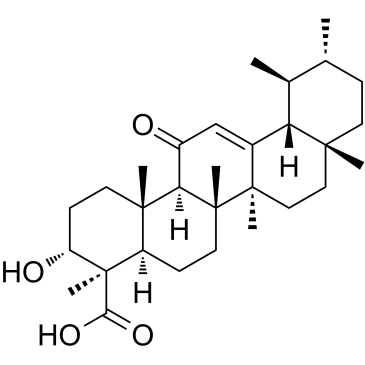
11-Keto-beta-boswellic acid (11-Keto-β-boswellic acid), a pentacyclic triterpenic acid of the oleogum resin, is a natural product isolated from the bark of the Boswellia serrate tree, popularly known as Indian Frankincense. The main reason that 11-Keto-beta-boswellic acid has anti-inflammatory properties is because it prevents the production of 5-lipoxygenase, leukotriene, nuclear factor-kappa B (NF-κB), and tumor necrosis factor alpha.
Physicochemical Properties
| Molecular Formula | C30H46O4 |
| Molecular Weight | 470.6838 |
| Exact Mass | 470.34 |
| CAS # | 17019-92-0 |
| Related CAS # | 17019-92-0 |
| PubChem CID | 9847548 |
| Appearance | White to off-white solid |
| Density | 1.14g/cm3 |
| Boiling Point | 591.8ºC at 760mmHg |
| Melting Point | 190 - 191 °C |
| Flash Point | 325.8ºC |
| Vapour Pressure | 0mmHg at 25°C |
| Index of Refraction | 1.561 |
| LogP | 6.268 |
| Hydrogen Bond Donor Count | 2 |
| Hydrogen Bond Acceptor Count | 4 |
| Rotatable Bond Count | 1 |
| Heavy Atom Count | 34 |
| Complexity | 954 |
| Defined Atom Stereocenter Count | 11 |
| SMILES | O([H])C1([H])C([H])([H])C([H])([H])[C@@]2(C([H])([H])[H])C([H])([C@]1(C(=O)O[H])C([H])([H])[H])C([H])([H])C([H])([H])[C@]1(C([H])([H])[H])C2([H])C(C([H])=C2C3([H])C([H])(C([H])([H])[H])C([H])(C([H])([H])[H])C([H])([H])C([H])([H])[C@]3(C([H])([H])[H])C([H])([H])C([H])([H])[C@@]12C([H])([H])[H])=O |
| InChi Key | YIMHGPSYDOGBPI-YZCVQEKWSA-N |
| InChi Code | InChI=1S/C30H46O4/c1-17-8-11-26(3)14-15-28(5)19(23(26)18(17)2)16-20(31)24-27(4)12-10-22(32)30(7,25(33)34)21(27)9-13-29(24,28)6/h16-18,21-24,32H,8-15H2,1-7H3,(H,33,34)/t17-,18+,21-,22-,23+,24-,26-,27+,28-,29-,30-/m1/s1 |
| Chemical Name | (3R,4R,4aR,6aR,6bS,8aR,11R,12S,12aR,14aR,14bS)-3-hydroxy-4,6a,6b,8a,11,12,14b-heptamethyl-14-oxo-1,2,3,4a,5,6,7,8,9,10,11,12,12a,14a-tetradecahydropicene-4-carboxylic acid |
| Synonyms | 11-Keto-beta-boswellic acid; 11-Keto-β-boswellic acid |
| HS Tariff Code | 2934.99.9001 |
| Storage |
Powder-20°C 3 years 4°C 2 years In solvent -80°C 6 months -20°C 1 month Note: This product requires protection from light (avoid light exposure) during transportation and storage. |
| Shipping Condition | Room temperature (This product is stable at ambient temperature for a few days during ordinary shipping and time spent in Customs) |
Biological Activity
| Targets |
NF-κB; 5-LOX 11-keto-beta-boswellic acid inhibits DPP-4 activity with an IC50 of 1.65 μM[2]. Inhibiting 4-inhibitor pyridine-stimulated amino acid trough release in hippocampal nerve terminals, 11-keto-beta-boswellic acid (10 minutes) (IC50: 31 μM) [3]. |
| ln Vitro | 11-keto-beta-boswellic acid inhibits DPP-4 activity with an IC50 of 1.65 μM[2]. Inhibiting 4-inhibitor pyridine-stimulated amino acid trough release in hippocampal nerve terminals, 11-keto-beta-boswellic acid (10 minutes) (IC50: 31 μM) [3]. |
| ln Vivo | In streptozotocin-induced diabetic signaling, 11-Keto-beta-boswellic acid (1–10 mg/kg, applied topically for 21 days) exhibits antidiabetic activity [2]. The excitotoxicity caused by kainic acid (15 mg/kg, i.p.) is prevented by boswellic acid (10 or 50 mg/kg, i.p.) [3]. |
| Enzyme Assay |
High-Performance Liquid Chromatography (HPLC) for quantification of KBA in supplements: A derived HPLC method was used to estimate KBA concentrations within market formulations. The mobile phase consisted of mobile phase A (water-methanol-orthophosphoric acid, 90:9.5:0.5, v/v) and mobile phase B (methanol-acetonitrile-water-orthophosphoric acid, 55:40:4.5:0.5, v/v). A gradient program was used: 0-10 min, 90% B and 10% A; 11–14 min, linear gradient change to 100% B; and 14–15 min, instant change to 90% B and 10% A. Analysis parameters were: 1.0 mL/min flow rate, 50 μL injection volume, and 250 nm detection wavelength. A LiChrospher RP-18 column was used. KBA standard solutions ranging from 10 to 100 μg/mL were prepared in methanol to create a calibration curve by plotting peak area against concentration. The retention time for KBA was 3.1 minutes. The method was validated for linearity (correlation coefficient R² = 0.9907), accuracy (mean recovery of 100.3±3.1% from spiked herbal samples), inter-assay precision (0.12–2.77% difference from the mean), intra-assay precision (0.11–2.87% difference from the mean), and limit of detection (0.11 μg/mL). [1] Sample Preparation for Supplement Analysis: For tablet formulations, tablets were finely powdered. For capsules, contents were emptied. Powder, powdered tablet, or capsule contents equivalent to 100 mg of claimed Boswellia serrata extract were accurately weighed, transferred to a volumetric flask, and 20 mL methanol was added. The mixture was sonicated for 30 minutes, diluted with an additional 30 mL methanol, then filtered through filter paper followed by ultrafiltration using a 0.45 μm syringe filter. Some samples required further dilution. The final sample solution (50 μL) was injected into the HPLC system in triplicate, and the mean peak area was used to estimate KBA quantity via the calibration curve. [1] |
| Animal Protocol |
Animal/Disease Models: Streptozotocin-induced diabetic rats [2] Doses: 1-10 mg/kg Route of Administration: Orally for 21 days Experimental Results: diminished blood glucose levels. Reduce serum SGPT, SGOT, ALP and serum creatinine levels. Serum MDA levels diminished and serum SOD levels increased. |
| Toxicity/Toxicokinetics | Not described for KBA specifically in the provided literature. The literature mentions that a concentrated AKBA product (Aflapin™) fed to rats had a no observed adverse effect level (NOAEL) greater than 2500 mg/kg body weight, but similar studies for KBA in dogs were noted as not having been performed. [1] |
| References |
[1]. Measurement of 3-acetyl-11-keto-beta-boswellic acid and 11-keto-beta-boswellic acid in Boswellia serrata Supplements Administered to Dogs. BMC Vet Res. 2019 Aug 1;15(1):270. |
| Additional Infomation |
11-Keto-beta-boswellic acid has been reported in Boswellia sacra, Boswellia serrata, and Boswellia papyrifera with data available. See also: Indian frankincense (part of). 11-keto-β-boswellic acid (KBA) is one of the primary active pentacyclic triterpenic acids in Boswellia serrata extracts (BSE) responsible for its anti-inflammatory effects. [1] The mean concentration of KBA across thirteen tested human and canine market formulations containing BSE was 5.2 mg/g on an as-fed basis, with a range from 0 to 24.8 mg/g. Four of the thirteen formulations contained an undetectable amount of KBA. None of the market formulations had a label claim for KBA concentration. [1] There is large variation in the concentration of active boswellic acids, including KBA, among different market formulations claiming to contain BSE. [1] Dosing regimens suggested by supplement manufacturers for BSE products are generally below the doses used in a human clinical study cited as effective, suggesting underdosing is likely in practice, though the potential for toxicity is considered low based on a related product's safety profile in rats. [1] |
Solubility Data
| Solubility (In Vitro) | DMSO: ~100 mg/mL (~212.5 mM) |
| Solubility (In Vivo) |
Solubility in Formulation 1: ≥ 2.5 mg/mL (5.31 mM) (saturation unknown) in 10% DMSO + 40% PEG300 + 5% Tween80 + 45% Saline (add these co-solvents sequentially from left to right, and one by one), clear solution. For example, if 1 mL of working solution is to be prepared, you can add 100 μL of 25.0 mg/mL clear DMSO stock solution to 400 μL PEG300 and mix evenly; then add 50 μL Tween-80 to the above solution and mix evenly; then add 450 μL normal saline to adjust the volume to 1 mL. Preparation of saline: Dissolve 0.9 g of sodium chloride in 100 mL ddH₂ O to obtain a clear solution. Solubility in Formulation 2: 2.5 mg/mL (5.31 mM) in 10% DMSO + 90% (20% SBE-β-CD in Saline) (add these co-solvents sequentially from left to right, and one by one), suspension solution; with ultrasonication. For example, if 1 mL of working solution is to be prepared, you can add 100 μL of 25.0 mg/mL clear DMSO stock solution to 900 μL of 20% SBE-β-CD physiological saline solution and mix evenly. Preparation of 20% SBE-β-CD in Saline (4°C,1 week): Dissolve 2 g SBE-β-CD in 10 mL saline to obtain a clear solution. Solubility in Formulation 3: ≥ 2.5 mg/mL (5.31 mM) (saturation unknown) in 10% DMSO + 90% Corn Oil (add these co-solvents sequentially from left to right, and one by one), clear solution. For example, if 1 mL of working solution is to be prepared, you can add 100 μL of 25.0 mg/mL clear DMSO stock solution to 900 μL of corn oil and mix evenly. (Please use freshly prepared in vivo formulations for optimal results.) |
| Preparing Stock Solutions | 1 mg | 5 mg | 10 mg | |
| 1 mM | 2.1246 mL | 10.6229 mL | 21.2459 mL | |
| 5 mM | 0.4249 mL | 2.1246 mL | 4.2492 mL | |
| 10 mM | 0.2125 mL | 1.0623 mL | 2.1246 mL |