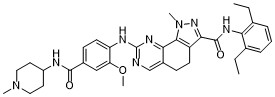
NMS-P715 analog, the de-fluorinated form of NMSP715, is a novel, potent, selective and orally bioavailable MPS1 inhibitor with anticancer activity. It selectively reduces cancer cell proliferation, leaving normal cells almost unaffected. NMS-P715 accelerates mitosis and affects kinetochore components localization causing massive aneuploidy and cell death in a variety of tumorally bioavailable cell lines and inhibits tumor growth in preclinical cancer models. Inhibiting the SAC could represent a promising new approach to selectively target cancer cells.
Physicochemical Properties
| Molecular Formula | C35H42N8O3 |
| Molecular Weight | 622.759787082672 |
| Exact Mass | 622.338 |
| Elemental Analysis | C, 67.50; H, 6.80; N, 17.99; O, 7.71 |
| CAS # | 1202055-34-2 |
| Related CAS # | 1202055-34-2 |
| PubChem CID | 44556163 |
| Appearance | White to off-white solid powder |
| Density | 1.3±0.1 g/cm3 |
| Index of Refraction | 1.676 |
| LogP | 3.69 |
| Hydrogen Bond Donor Count | 3 |
| Hydrogen Bond Acceptor Count | 8 |
| Rotatable Bond Count | 9 |
| Heavy Atom Count | 46 |
| Complexity | 1010 |
| Defined Atom Stereocenter Count | 0 |
| SMILES | O=C(C1C=CC(=C(C=1)OC)NC1=NC=C2C(C3=C(C(C(NC4C(=CC=CC=4CC)CC)=O)=NN3C)CC2)=N1)NC1CCN(C)CC1 |
| InChi Key | WGZYFFJOGZFXBF-UHFFFAOYSA-N |
| InChi Code | InChI=1S/C35H42N8O3/c1-6-21-9-8-10-22(7-2)29(21)39-34(45)31-26-13-11-24-20-36-35(40-30(24)32(26)43(4)41-31)38-27-14-12-23(19-28(27)46-5)33(44)37-25-15-17-42(3)18-16-25/h8-10,12,14,19-20,25H,6-7,11,13,15-18H2,1-5H3,(H,37,44)(H,39,45)(H,36,38,40) |
| Chemical Name | N-(2,6-diethylphenyl)-8-[2-methoxy-4-[(1-methylpiperidin-4-yl)carbamoyl]anilino]-1-methyl-4,5-dihydropyrazolo[4,3-h]quinazoline-3-carboxamide |
| Synonyms | CHEMBL1808340; N-(2,6-diethylphenyl)-8-[2-methoxy-4-[(1-methylpiperidin-4-yl)carbamoyl]anilino]-1-methyl-4,5-dihydropyrazolo[4,3-h]quinazoline-3-carboxamide; Desfluoro-NMS-P715; NMSP-715; SCHEMBL1559206; |
| HS Tariff Code | 2934.99.9001 |
| Storage |
Powder-20°C 3 years 4°C 2 years In solvent -80°C 6 months -20°C 1 month |
| Shipping Condition | Room temperature (This product is stable at ambient temperature for a few days during ordinary shipping and time spent in Customs) |
Biological Activity
| Targets | Mps1 (IC50 = 182 nM); CK2 (IC50 = 5.7 μM); MELK (IC50 = 6.01 μM); NEK6 (IC50 = 6.02 μM) |
| ln Vitro | NMS-P715 has an IC50 of 182 nM, making it a selective inhibitor of MPS1. With IC50 values less than 5 μM, NMS-P715 does not inhibit any other kinases and is extremely selective for MPS1. Only three kinases—MELK, NEK6, and CK2—have inhibition at IC50 values smaller than 10 μM. With an EC50 of 65 nM, NMS-P715 facilitates extensive spindle assembly checkpoint (SAC) coverage. NMS-P715 (1 μM) causes aneuploidy, speeds up mitosis, and prevents HCT116 cells from proliferating in U2OS cells that overexpress YFP-α-tubulin. NMS-P715 (0.5, 1 μM) influences the ubiquitination of CDC20 and the stability of the mitotic checkpoint complex (MCC) [1]. NMS-P715 (1 μM) in pancreatic ductal adenocarcinoma (PDAC) cell lines causes apoptosis and bypasses the spindle assembly checkpoint. Additionally, NMS-P715 (0-25 μM) specifically prevents PDAC cell proliferation [2]. |
| ln Vivo | In nude mice implanted subcutaneously with human tumor cell xenografts, NMS-P715 (10 mg/kg) showed good pharmacokinetic characteristics and 37% oral bioavailability. In the A2780 ovarian cancer xenograft model, NMS-P715 (90 mg/kg, oral) was well tolerated; there were no indications of weight loss or any overt harm. Oral NMS-P715 (100 mg/kg) reduces tumor growth in the A375 melanoma xenograft model by about 43% [1]. |
| References |
[1]. Targeting the mitotic checkpoint for cancer therapy with NMS-P715, an inhibitor of MPS1 kinase. Cancer Res. 2010 Dec 15;70(24):10255-64. [2]. Selective inhibition of pancreatic ductal adenocarcinoma cell growth by the mitotic MPS1 kinase inhibitor NMS-P715. Mol Cancer Ther. 2014 Feb;13(2):307-315 |
| Additional Infomation |
MPS1 kinase is a key regulator of the spindle assembly checkpoint (SAC), a mitotic mechanism specifically required for proper chromosomal alignment and segregation. It has been found aberrantly overexpressed in a wide range of human tumors and is necessary for tumoral cell proliferation. Here we report the identification and characterization of NMS-P715, a selective and orally bioavailable MPS1 small-molecule inhibitor, which selectively reduces cancer cell proliferation, leaving normal cells almost unaffected. NMS-P715 accelerates mitosis and affects kinetochore components localization causing massive aneuploidy and cell death in a variety of tumoral cell lines and inhibits tumor growth in preclinical cancer models. Inhibiting the SAC could represent a promising new approach to selectively target cancer cells. [1] Most solid tumors, including pancreatic ductal adenocarcinoma (PDAC), exhibit structural and numerical chromosome instability (CIN). Although often implicated as a driver of tumor progression and drug resistance, CIN also reduces cell fitness and poses a vulnerability that can be exploited therapeutically. The spindle assembly checkpoint (SAC) ensures correct chromosome-microtubule attachment, thereby minimizing chromosome segregation errors. Many tumors exhibit upregulation of SAC components such as MPS1, which may help contain CIN within survivable limits. Prior studies showed that MPS1 inhibition with the small molecule NMS-P715 limits tumor growth in xenograft models. In cancer cell lines, NMS-P715 causes cell death associated with impaired SAC function and increased chromosome missegregation. Although normal cells appeared more resistant, effects on stem cells, which are the dose-limiting toxicity of most chemotherapeutics, were not examined. Elevated expression of 70 genes (CIN70), including MPS1, provides a surrogate measure of CIN and predicts poor patient survival in multiple tumor types. Our new findings show that the degree of CIN70 upregulation varies considerably among PDAC tumors, with higher CIN70 gene expression predictive of poor outcome. We identified a 25 gene subset (PDAC CIN25) whose overexpression was most strongly correlated with poor survival and included MPS1. In vitro, growth of human and murine PDAC cells is inhibited by NMS-P715 treatment, whereas adipose-derived human mesenchymal stem cells are relatively resistant and maintain chromosome stability upon exposure to NMS-P715. These studies suggest that NMS-P715 could have a favorable therapeutic index and warrant further investigation of MPS1 inhibition as a new PDAC treatment strategy. [2] |
Solubility Data
| Solubility (In Vitro) | DMSO : ~2 mg/mL (~2.96 mM) |
| Solubility (In Vivo) |
Solubility in Formulation 1: 3.33 mg/mL (4.92 mM) in 0.5% CMC/saline water (add these co-solvents sequentially from left to right, and one by one), suspension solution; with sonication. Preparation of saline: Dissolve 0.9 g of sodium chloride in 100 mL ddH₂ O to obtain a clear solution. (Please use freshly prepared in vivo formulations for optimal results.) |
| Preparing Stock Solutions | 1 mg | 5 mg | 10 mg | |
| 1 mM | 1.6058 mL | 8.0288 mL | 16.0576 mL | |
| 5 mM | 0.3212 mL | 1.6058 mL | 3.2115 mL | |
| 10 mM | 0.1606 mL | 0.8029 mL | 1.6058 mL |