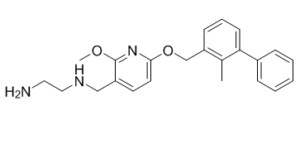
N-deacetylated BMS-202, the deacetylated product of BMS-202 (also known as PD1-PDL1 inhibitor 2, BMS 202, BMS202), is a inhibitor of the PD-1 (Programmed death- 1)/PD-Ll (Programmed death-ligand 1) protein/protein interaction with potential anticancer activities. BMS-202 inhibits the interaction between PD-1/PD-Ll and may improve the therapeutic immune response to a variety of tumors with different histologies. Antibodies against PD-Ll have been shown to restore and enhance T cell activation in numerous systems by blocking the PD-1/PD-Ll ligation. The compound BMS-202, which binds to and causes the dimerization of PD-L1, serves as an example of the structural basis for small molecules' ability to block the PD-1/PD-L1 interaction.
Physicochemical Properties
| Molecular Formula | C23H27N3O2 |
| Molecular Weight | 377.48 |
| Exact Mass | 377.21032711 |
| CAS # | 2310135-18-1 |
| Related CAS # | BMS-202;1675203-84-5 |
| PubChem CID | 126843234 |
| Appearance | White to off-white solid |
| Density | 1.127±0.06 g/cm3(Predicted) |
| Boiling Point | 529.1±45.0 °C(Predicted) |
| LogP | 3.4 |
| Hydrogen Bond Donor Count | 2 |
| Hydrogen Bond Acceptor Count | 5 |
| Rotatable Bond Count | 9 |
| Heavy Atom Count | 28 |
| Complexity | 430 |
| Defined Atom Stereocenter Count | 0 |
| SMILES | O(C1C=CC(=C(N=1)OC)CNCCN)CC1C=CC=C(C2C=CC=CC=2)C=1C |
| InChi Key | IVGJGWNPAKJGGB-UHFFFAOYSA-N |
| InChi Code | InChI=1S/C23H27N3O2/c1-17-20(9-6-10-21(17)18-7-4-3-5-8-18)16-28-22-12-11-19(15-25-14-13-24)23(26-22)27-2/h3-12,25H,13-16,24H2,1-2H3 |
| Chemical Name | N'-[[2-methoxy-6-[(2-methyl-3-phenylphenyl)methoxy]pyridin-3-yl]methyl]ethane-1,2-diamine |
| Synonyms | 2310135-18-1; N'-[[2-methoxy-6-[(2-methyl-3-phenylphenyl)methoxy]pyridin-3-yl]methyl]ethane-1,2-diamine; N1-((2-Methoxy-6-((2-methyl-[1,1'-biphenyl]-3-yl)methoxy)pyridin-3-yl)methyl)ethane-1,2-diamine; EX-A4442; N-deacetylated BMS-202 |
| HS Tariff Code | 2934.99.9001 |
| Storage |
Powder-20°C 3 years 4°C 2 years In solvent -80°C 6 months -20°C 1 month |
| Shipping Condition | Room temperature (This product is stable at ambient temperature for a few days during ordinary shipping and time spent in Customs) |
Biological Activity
| Targets | PD-1/PD-L1 interaction | ||
| ln Vitro | N-deacetylated BMS-202, also known as PD1-PDL1 inhibitor 2, BMS 202, or BMS202, is a protein/protein interaction inhibitor with potential anticancer properties. It inhibits the PD-1 (Programmed Death-1)/PD-Ll (Programmed Death-ligand 1) protein/protein interaction. BMS-202 blocks the interaction between PD-1/PD-Ll and may improve the therapeutic immune response to various tumors with different histologies. Antibodies to PD-Ll have been shown to restore and enhance T cell activation in numerous systems by blocking the PD-1/PD-Ll ligation. | ||
| Enzyme Assay | In an HTRF assay buffer, which consists of dPBS supplemented with 0.1% (with v) bovine serum albumin and 0.05% (v/v) Tween-20, all binding studies are carried out. In the PD-l-Ig/PD-Ll-His binding assay, the inhibitors are first pre-incubated with PD-Ll-His (10 nM final) for 15 m in 4 μL of assay buffer, and then PD-l-Ig (20 nM final) is added in 1 L of assay buffer and further incubated for 15 m. It is possible to use PD-L1 from mice, cyno, or humans. Allophycocyanin (APC) labeled anti-His (20 nM final) and anti-Ig (1 nM final) labeled with europium crypate are used to detect HTRF. HTRF detection buffer is used to dilute the antibodies, and 5 μL is dispensed on top of the binding reaction. After 30 minutes of equilibration, the reaction mixture is given another chance to settle, and an En Vision fluorometer is used to measure the signal (665 nm/620 nm ratio). Additional binding assays have been established between CD80-His/PD-Ll-Ig (100, 10 nM, respectively), CD80-His/CTLA4-Ig (10, 5 nM, respectively), and PD-1-Ig/PD-L2-His (20, 5 nM, respectively). | ||
| Cell Assay | Particularly in a tumor microenvironment, the programmed death-1/programmed death-ligand 1 (PD-1/PD-L1) interaction dominates the suppression of T cell responses, preventing tumor cells from being lysed. With an IC50 value of 18 nM, PD-1/PD-L1 inhibitor 2 is said to prevent PD-L1 and PD-1 interaction. | ||
| Animal Protocol |
|
||
| References |
[1]. WO2015034820 A1 |
Solubility Data
| Solubility (In Vitro) | DMSO: >33 mg/mL |
| Solubility (In Vivo) |
Solubility in Formulation 1: ≥ 2.5 mg/mL (6.62 mM) (saturation unknown) in 10% DMSO + 40% PEG300 + 5% Tween80 + 45% Saline (add these co-solvents sequentially from left to right, and one by one), clear solution. For example, if 1 mL of working solution is to be prepared, you can add 100 μL of 25.0 mg/mL clear DMSO stock solution to 400 μL PEG300 and mix evenly; then add 50 μL Tween-80 to the above solution and mix evenly; then add 450 μL normal saline to adjust the volume to 1 mL. Preparation of saline: Dissolve 0.9 g of sodium chloride in 100 mL ddH₂ O to obtain a clear solution. Solubility in Formulation 2: ≥ 2.5 mg/mL (6.62 mM) (saturation unknown) in 10% DMSO + 90% (20% SBE-β-CD in Saline) (add these co-solvents sequentially from left to right, and one by one), clear solution. For example, if 1 mL of working solution is to be prepared, you can add 100 μL of 25.0 mg/mL clear DMSO stock solution to 900 μL of 20% SBE-β-CD physiological saline solution and mix evenly. Preparation of 20% SBE-β-CD in Saline (4°C,1 week): Dissolve 2 g SBE-β-CD in 10 mL saline to obtain a clear solution. Solubility in Formulation 3: ≥ 2.5 mg/mL (6.62 mM) (saturation unknown) in 10% DMSO + 90% Corn Oil (add these co-solvents sequentially from left to right, and one by one), clear solution. For example, if 1 mL of working solution is to be prepared, you can add 100 μL of 25.0 mg/mL clear DMSO stock solution to 900 μL of corn oil and mix evenly. (Please use freshly prepared in vivo formulations for optimal results.) |
| Preparing Stock Solutions | 1 mg | 5 mg | 10 mg | |
| 1 mM | 2.6491 mL | 13.2457 mL | 26.4915 mL | |
| 5 mM | 0.5298 mL | 2.6491 mL | 5.2983 mL | |
| 10 mM | 0.2649 mL | 1.3246 mL | 2.6491 mL |