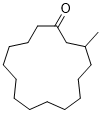
Muscone is a main active ingredient and monomer from traditional Chinese medicine musk, acting as a novel and potent inhibitor of the fas pathway. It is found in the chinese medication Tongqiaohuoxue decoction (TQHXD) with neuroprotective effects. Muscone exhibits anti-inflammatory activity by inhibiting NF-κB and NLRP3 inflammasome activation, and decreasing the levels of inflammatory cytokines (IL-1β, TNF-α and IL-6).
Physicochemical Properties
| Molecular Formula | C16H30O |
| Molecular Weight | 238.4088 |
| Exact Mass | 238.229 |
| CAS # | 541-91-3 |
| PubChem CID | 10947 |
| Appearance | Colorless to light yellow liquid |
| Density | 0.8±0.1 g/cm3 |
| Boiling Point | 329.5±10.0 °C at 760 mmHg |
| Melting Point | 33ºC |
| Flash Point | 145.3±11.3 °C |
| Vapour Pressure | 0.0±0.7 mmHg at 25°C |
| Index of Refraction | 1.437 |
| LogP | 6.33 |
| Hydrogen Bond Donor Count | 0 |
| Hydrogen Bond Acceptor Count | 1 |
| Rotatable Bond Count | 0 |
| Heavy Atom Count | 17 |
| Complexity | 198 |
| Defined Atom Stereocenter Count | 0 |
| SMILES | O=C1C([H])([H])C([H])([H])C([H])([H])C([H])([H])C([H])([H])C([H])([H])C([H])([H])C([H])([H])C([H])([H])C([H])([H])C([H])([H])C([H])([H])C([H])(C([H])([H])[H])C1([H])[H] |
| InChi Key | ALHUZKCOMYUFRB-UHFFFAOYSA-N |
| InChi Code | InChI=1S/C16H30O/c1-15-12-10-8-6-4-2-3-5-7-9-11-13-16(17)14-15/h15H,2-14H2,1H3 |
| Chemical Name | 3-methylcyclopentadecan-1-one |
| HS Tariff Code | 2934.99.9001 |
| Storage |
Powder-20°C 3 years 4°C 2 years In solvent -80°C 6 months -20°C 1 month |
| Shipping Condition | Room temperature (This product is stable at ambient temperature for a few days during ordinary shipping and time spent in Customs) |
Biological Activity
| Targets |
Inhibition of NF-κB and NLRP3 inflammasome activation in macrophages. [1] |
| ln Vitro |
In bone marrow-derived macrophages (BMDM), muscone markedly lowers LPS-induced inflammatory cytokine levels and suppresses NF-κB and NLRP3 inflammasome activation. A promising and successful medication for the treatment of myocardial infarction (MI) is muscone [1]. Muscone (6 µg/mL) significantly reduced the levels of lipopolysaccharide (LPS)-induced inflammatory cytokines (IL-1β, TNF-α, IL-6) in bone marrow-derived macrophages (BMDMs) at both protein and mRNA levels, as determined by western blot, ELISA, and qRT-PCR. Muscone inhibited LPS-induced activation of the NF-κB pathway in BMDMs, evidenced by decreased phosphorylation of IκB-α and p65. Muscone suppressed LPS-induced activation of the NLRP3 inflammasome in BMDMs, shown by reduced levels of NLRP3 and cleaved caspase-1. Muscone reduced intracellular reactive oxygen species (ROS) levels in LPS-induced BMDMs, as measured by DCFH-DA staining and flow cytometry. Muscone increased the expression of antioxidant enzymes (SOD1, SOD2, Gpx1, CAT) at both protein and mRNA levels in LPS-induced BMDMs. [1] |
| ln Vivo |
In a mouse model of myocardial infarction (MI), muscone (2 mg/kg/day, orally, starting from day 7 post-MI for 3 weeks) improved survival rate at the 4th week post-MI compared to the MI-only group. Muscone improved cardiac function in MI mice, as shown by increased left ventricular ejection fraction (LVEF) and left ventricular fractional shortening (LVFS), and decreased serum brain natriuretic peptide (BNP) levels at the 4th week post-MI. Muscone reduced inflammatory cell infiltration in heart tissue of MI mice, as observed in hematoxylin-eosin (HE) stained sections. Muscone decreased the expression and secretion of inflammatory cytokines (IL-1β, TNF-α, IL-6) in heart tissue of MI mice, as shown by immunohistochemistry, qRT-PCR, and immunofluorescence co-localization with macrophage marker F4/80. Muscone inhibited the activation of NF-κB (reduced p-p65) and NLRP3 inflammasome in heart tissue of MI mice, as demonstrated by western blot and immunohistochemistry. Muscone exhibited antioxidant effects in MI mice by increasing total superoxide dismutase (T-SOD) and glutathione peroxidase (GSH-Px) activities, and decreasing malondialdehyde (MDA) levels in cardiac tissue homogenates. [1] |
| Cell Assay |
BMDM Culture and Treatment: Bone marrow-derived macrophages (BMDMs) were isolated from C57BL/6J mice and cultured in medium containing macrophage colony-stimulating factor. After 7 days, adherent cells were used as BMDMs. Cells were starved for 12 hours, then treated with LPS (1 µg/mL) in the absence or presence of muscone (6 µg/mL) for 24 hours. Cell Viability Assay: BMDMs were treated with muscone at various concentrations (0, 1.5, 3, 6, 12, 24 µg/mL) for 24 hours. Cell viability was assessed using an enhanced CCK-8 kit by measuring absorbance at 450 nm. No cytotoxicity was observed up to 24 µg/mL. Intracellular ROS Detection: BMDMs were incubated with DCFH-DA (10 µM) for 30 minutes after treatment. ROS levels were measured by flow cytometry and fluorescence microscopy. ELISA: IL-1β levels in cell culture supernatants were quantified using an ELISA kit. Western Blotting: Total protein was extracted from BMDMs, separated by SDS-PAGE, transferred to PVDF membranes, and probed with specific primary antibodies followed by HRP-conjugated secondary antibodies. Bands were visualized using an ECL system. qRT-PCR: Total RNA was extracted from BMDMs, reverse transcribed, and amplified using SYBR Green Master Mix on a real-time PCR system. Gene expression was normalized to GAPDH. [1] |
| Animal Protocol |
Animals: Male C57BL/6J mice (7-8 weeks old) were used. Myocardial Infarction Model: MI was induced by permanent ligation of the left anterior descending coronary artery under anesthesia and mechanical ventilation. Drug Administration: Muscone was diluted in normal saline to 0.5 mg/mL. Mice were randomly divided into sham, MI, and MI+muscone groups. Starting from the 7th day post-MI (to avoid acute phase interference), mice in the MI+muscone group received muscone (2 mg/kg/day) by oral gavage for 3 consecutive weeks. Sham and MI groups received an equivalent volume of saline. Echocardiography: Cardiac function (LVEF, LVFS) was assessed at the 4th week post-MI using an ultrasound system. Sample Collection: Mice were sacrificed at the 4th week post-MI. Blood and heart tissues were collected for further analysis. [1] |
| References |
[1]. Muscone improves cardiac function in mice after myocardial infarction by alleviating cardiac macrophage-mediated chronic inflammation through inhibition of NF-κB and NLRP3 inflammasome. Am J Transl Res. 2018 Dec 15;10(12):4235-4246. |
| Additional Infomation |
Muscone is the main active monomer of traditional Chinese medicine musk. This study demonstrates that muscone alleviates cardiac macrophage-mediated chronic inflammation after myocardial infarction by inhibiting NF-κB and NLRP3 inflammasome activation, and its anti-inflammatory effect may be related to ROS scavenging. Muscone is suggested as a promising candidate for post-MI treatment. [1] |
Solubility Data
| Solubility (In Vitro) |
DMSO : ~100 mg/mL (~419.45 mM) H2O : < 0.1 mg/mL |
| Solubility (In Vivo) |
Solubility in Formulation 1: ≥ 2.5 mg/mL (10.49 mM) (saturation unknown) in 10% DMSO + 40% PEG300 + 5% Tween80 + 45% Saline (add these co-solvents sequentially from left to right, and one by one), clear solution. For example, if 1 mL of working solution is to be prepared, you can add 100 μL of 25.0 mg/mL clear DMSO stock solution to 400 μL PEG300 and mix evenly; then add 50 μL Tween-80 to the above solution and mix evenly; then add 450 μL normal saline to adjust the volume to 1 mL. Preparation of saline: Dissolve 0.9 g of sodium chloride in 100 mL ddH₂ O to obtain a clear solution. Solubility in Formulation 2: ≥ 2.5 mg/mL (10.49 mM) (saturation unknown) in 10% DMSO + 90% (20% SBE-β-CD in Saline) (add these co-solvents sequentially from left to right, and one by one), clear solution. For example, if 1 mL of working solution is to be prepared, you can add 100 μL of 25.0 mg/mL clear DMSO stock solution to 900 μL of 20% SBE-β-CD physiological saline solution and mix evenly. Preparation of 20% SBE-β-CD in Saline (4°C,1 week): Dissolve 2 g SBE-β-CD in 10 mL saline to obtain a clear solution. Solubility in Formulation 3: ≥ 2.5 mg/mL (10.49 mM) (saturation unknown) in 10% DMSO + 90% Corn Oil (add these co-solvents sequentially from left to right, and one by one), clear solution. For example, if 1 mL of working solution is to be prepared, you can add 100 μL of 25.0 mg/mL clear DMSO stock solution to 900 μL of corn oil and mix evenly. (Please use freshly prepared in vivo formulations for optimal results.) |
| Preparing Stock Solutions | 1 mg | 5 mg | 10 mg | |
| 1 mM | 4.1945 mL | 20.9723 mL | 41.9445 mL | |
| 5 mM | 0.8389 mL | 4.1945 mL | 8.3889 mL | |
| 10 mM | 0.4194 mL | 2.0972 mL | 4.1945 mL |