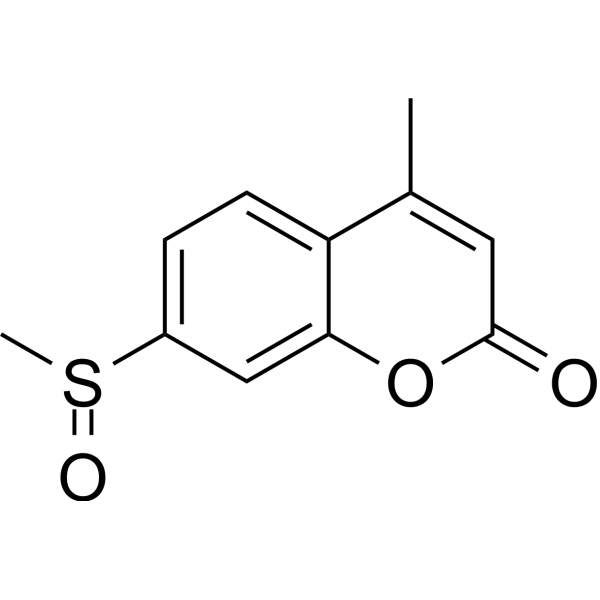
Physicochemical Properties
| CAS # | 2966537-39-1 |
| PubChem CID | 162642075 |
| Appearance | White to yellow solid powder |
| Hydrogen Bond Acceptor Count | 4 |
| Rotatable Bond Count | 1 |
| Heavy Atom Count | 15 |
| Complexity | 335 |
| Defined Atom Stereocenter Count | 0 |
| HS Tariff Code | 2934.99.9001 |
| Storage |
Powder-20°C 3 years 4°C 2 years In solvent -80°C 6 months -20°C 1 month Note: This product requires protection from light (avoid light exposure) during transportation and storage. |
| Shipping Condition | Room temperature (This product is stable at ambient temperature for a few days during ordinary shipping and time spent in Customs) |
Biological Activity
| ln Vitro | Methionine sulfoxide reductase A (Msr A) activates Msr-blue, which releases blue fluorescence. More than a 100-fold increase in emission is seen when Msr-blue is exposed to Msr A, and this response is time- and dose-dependent. Either the purified Msr A or a cell lysate catalyzes the conversion of Msr-blue to its corresponding sulfide (15′)[1]. Msr-blue is used to examine the function of Msrs in 6-OHDA-treated PC12 cells, which are used as a cellular model of Parkinson's disease (PD). The Msr activity in a PD model was shown to be declining for the first time with the help of Msr-blue[1]. |
| References |
[1]. A specific fluorescent probe reveals compromised activity of methionine sulfoxide reductases in Parkinson's disease. Chem Sci. 2017 Apr 1;8(4):2966-2972. |
Solubility Data
| Solubility (In Vitro) | DMSO: 25 mg/mL (112.48 mM) |
| Solubility (In Vivo) |
Solubility in Formulation 1: ≥ 2.5 mg/mL (11.25 mM) (saturation unknown) in 10% DMSO + 40% PEG300 + 5% Tween80 + 45% Saline (add these co-solvents sequentially from left to right, and one by one), clear solution. For example, if 1 mL of working solution is to be prepared, you can add 100 μL of 25.0 mg/mL clear DMSO stock solution to 400 μL PEG300 and mix evenly; then add 50 μL Tween-80 to the above solution and mix evenly; then add 450 μL normal saline to adjust the volume to 1 mL. Preparation of saline: Dissolve 0.9 g of sodium chloride in 100 mL ddH₂ O to obtain a clear solution. Solubility in Formulation 2: 2.5 mg/mL (11.25 mM) in 10% DMSO + 90% (20% SBE-β-CD in Saline) (add these co-solvents sequentially from left to right, and one by one), suspension solution; with ultrasonication. For example, if 1 mL of working solution is to be prepared, you can add 100 μL of 25.0 mg/mL clear DMSO stock solution to 900 μL of 20% SBE-β-CD physiological saline solution and mix evenly. Preparation of 20% SBE-β-CD in Saline (4°C,1 week): Dissolve 2 g SBE-β-CD in 10 mL saline to obtain a clear solution. Solubility in Formulation 3: ≥ 2.5 mg/mL (11.25 mM) (saturation unknown) in 10% DMSO + 90% Corn Oil (add these co-solvents sequentially from left to right, and one by one), clear solution. For example, if 1 mL of working solution is to be prepared, you can add 100 μL of 25.0 mg/mL clear DMSO stock solution to 900 μL of corn oil and mix evenly. (Please use freshly prepared in vivo formulations for optimal results.) |