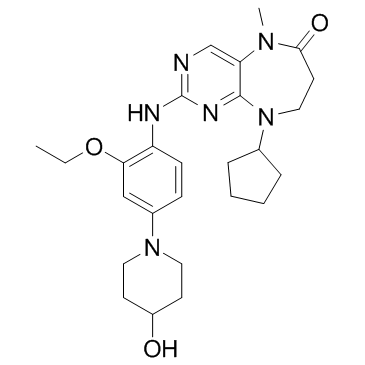
Mps1-IN-2 is a novel, ATP-competitive and potent Mps1 (monopolar spindle)/Plk1 (Polo Like Kinase 1) inhibitor with potential anticancer activity. Its IC50 and Kd values for MPS1/Plk1 are 145 nM and 12 nM, respectively, for Mps1 and 61 nM for Plk1, respectively.
Physicochemical Properties
| Molecular Formula | C26H36N6O3 |
| Molecular Weight | 480.6024 |
| Exact Mass | 480.284 |
| Elemental Analysis | C, 64.98; H, 7.55; N, 17.49; O, 9.99 |
| CAS # | 1228817-38-6 |
| Related CAS # | 1228817-38-6 |
| PubChem CID | 44968267 |
| Appearance | Light brown to brown solid powder |
| Density | 1.3±0.1 g/cm3 |
| Boiling Point | 772.7±70.0 °C at 760 mmHg |
| Flash Point | 421.1±35.7 °C |
| Vapour Pressure | 0.0±2.8 mmHg at 25°C |
| Index of Refraction | 1.633 |
| LogP | 2.05 |
| Hydrogen Bond Donor Count | 2 |
| Hydrogen Bond Acceptor Count | 8 |
| Rotatable Bond Count | 6 |
| Heavy Atom Count | 35 |
| Complexity | 699 |
| Defined Atom Stereocenter Count | 0 |
| SMILES | O([H])C1([H])C([H])([H])C([H])([H])N(C2C([H])=C([H])C(=C(C=2[H])OC([H])([H])C([H])([H])[H])N([H])C2=NC([H])=C3C(=N2)N(C([H])([H])C([H])([H])C(N3C([H])([H])[H])=O)C2([H])C([H])([H])C([H])([H])C([H])([H])C2([H])[H])C([H])([H])C1([H])[H] |
| InChi Key | WELBJLUKWAJOQV-UHFFFAOYSA-N |
| InChi Code | InChI=1S/C26H36N6O3/c1-3-35-23-16-19(31-13-10-20(33)11-14-31)8-9-21(23)28-26-27-17-22-25(29-26)32(18-6-4-5-7-18)15-12-24(34)30(22)2/h8-9,16-18,20,33H,3-7,10-15H2,1-2H3,(H,27,28,29) |
| Chemical Name | 9-cyclopentyl-2-[2-ethoxy-4-(4-hydroxypiperidin-1-yl)anilino]-5-methyl-7,8-dihydropyrimido[4,5-b][1,4]diazepin-6-one |
| Synonyms | Mps1-IN-2 |
| HS Tariff Code | 2934.99.9001 |
| Storage |
Powder-20°C 3 years 4°C 2 years In solvent -80°C 6 months -20°C 1 month |
| Shipping Condition | Room temperature (This product is stable at ambient temperature for a few days during ordinary shipping and time spent in Customs) |
Biological Activity
| Targets | Mps1 (Kd = 12 nM); GAK (Kd = 140 nM); CLK4 (IC50 = 15 nM) |
| ln Vitro | Mps1-IN-2 is an ATP-competitive, potent, and selective Mps1 kinase inhibitor with IC50 and Kd values of 145 nM and 12 nM, respectively. Mps1-IN-2 exhibits little to no inhibition on the remaining 352 member kinases, but it demonstrates strong affinity for PLK1 and GAK, with Kds of 61 and 140 nM, respectively. Mps1-IN-2 has the ability to cause U2OS cells to bypass a checkpoint-mediated mitotic arrest[1]. |
| Animal Protocol | The ATP site-directed kinase inhibitor Kinase Tracer 236 is fluorescently labeled, and its displacement from the kinase active site is monitored in the kinase binding assay to evaluate compound binding to TTK. In every 15 μL assay, there are five different concentrations of the test compound (Mps1-IN-2), 30 nM Kinase Tracer 236; 2 nM Eu-anti-GST Antibody; and 1% DMSO (which is the leftover from the compound dilution) in Kinase Buffer A, which also contains 50 mM HEPES pH 7.5, 10 mM MgCl2, 1 mM EGTA, and 0.01% Brij-35. The procedure for starting binding assays involves adding 5 μL of the test compound (from the 2-fold dilution series) to 5 μL of a kinase/antibody mixture, and then adding 5 μL of the antibody. Standard Eu-based TR-FRET settings are used to read assay plates, with excitation occurring at 340 nm and emission being observed at 615 nm (donor) and 665 nm (acceptor). A 100 µs post-excitation delay is followed by a 200 µs window for measuring emission intensities[1]. |
| References |
[1]. Small-molecule kinase inhibitors provide insight into Mps1 cell cycle function. Nat Chem Biol. 2010 May;6(5):359-68. |
| Additional Infomation | Mps1-IN-2 is a member of piperidines. |
Solubility Data
| Solubility (In Vitro) | DMSO: ~13.3 mg/mL (~27.7 mM) |
| Solubility (In Vivo) |
Solubility in Formulation 1: ≥ 1.33 mg/mL (2.77 mM) (saturation unknown) in 10% DMSO + 40% PEG300 + 5% Tween80 + 45% Saline (add these co-solvents sequentially from left to right, and one by one), clear solution. For example, if 1 mL of working solution is to be prepared, you can add 100 μL of 13.3 mg/mL clear DMSO stock solution to 400 μL PEG300 and mix evenly; then add 50 μL Tween-80 to the above solution and mix evenly; then add 450 μL normal saline to adjust the volume to 1 mL. Preparation of saline: Dissolve 0.9 g of sodium chloride in 100 mL ddH₂ O to obtain a clear solution. Solubility in Formulation 2: ≥ 1.33 mg/mL (2.77 mM) (saturation unknown) in 10% DMSO + 90% (20% SBE-β-CD in Saline) (add these co-solvents sequentially from left to right, and one by one), clear solution. For example, if 1 mL of working solution is to be prepared, you can add 100 μL of 13.3 mg/mL clear DMSO stock solution to 900 μL of 20% SBE-β-CD physiological saline solution and mix evenly. Preparation of 20% SBE-β-CD in Saline (4°C,1 week): Dissolve 2 g SBE-β-CD in 10 mL saline to obtain a clear solution. Solubility in Formulation 3: ≥ 1.33 mg/mL (2.77 mM) (saturation unknown) in 10% DMSO + 90% Corn Oil (add these co-solvents sequentially from left to right, and one by one), clear solution. For example, if 1 mL of working solution is to be prepared, you can add 100 μL of 13.3 mg/mL clear DMSO stock solution to 900 μL of corn oil and mix evenly. (Please use freshly prepared in vivo formulations for optimal results.) |
| Preparing Stock Solutions | 1 mg | 5 mg | 10 mg | |
| 1 mM | 2.0807 mL | 10.4037 mL | 20.8073 mL | |
| 5 mM | 0.4161 mL | 2.0807 mL | 4.1615 mL | |
| 10 mM | 0.2081 mL | 1.0404 mL | 2.0807 mL |