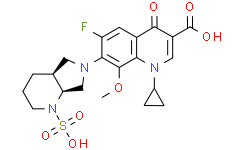
Physicochemical Properties
| Molecular Formula | C21H24FN3O7S |
| Molecular Weight | 481.494567871094 |
| Exact Mass | 481.131899 |
| Elemental Analysis | C, 48.00; H, 4.22; F, 3.62; N, 8.00; Na, 8.75; O, 21.31; S, 6.10 |
| CAS # | 234080-64-9 |
| PubChem CID | 71750858 |
| Appearance | Typically exists as solid at room temperature |
| LogP | 2.1 |
| Hydrogen Bond Donor Count | 2 |
| Hydrogen Bond Acceptor Count | 11 |
| Rotatable Bond Count | 5 |
| Heavy Atom Count | 33 |
| Complexity | 965 |
| Defined Atom Stereocenter Count | 2 |
| SMILES | S(N1CCC[C@H]2CN(C3C(=CC4C(C(C(=O)O)=CN(C=4C=3OC)C3CC3)=O)F)C[C@@H]12)(=O)(=O)O |
| InChi Key | NOSMZVFHCRCXNK-MEDUHNTESA-N |
| InChi Code | InChI=1S/C21H24FN3O7S/c1-32-20-17-13(19(26)14(21(27)28)9-24(17)12-4-5-12)7-15(22)18(20)23-8-11-3-2-6-25(16(11)10-23)33(29,30)31/h7,9,11-12,16H,2-6,8,10H2,1H3,(H,27,28)(H,29,30,31)/t11-,16+/m0/s1 |
| Chemical Name | 7-[(4aS,7aS)-1-sulfo-3,4,4a,5,7,7a-hexahydro-2H-pyrrolo[3,4-b]pyridin-6-yl]-1-cyclopropyl-6-fluoro-8-methoxy-4-oxoquinoline-3-carboxylic acid |
| Synonyms | Moxifloxacin N-sulfate; 234080-64-9; UNII-9EI1SIA8XV; 9EI1SIA8XV; 7-[(4aS,7aS)-1-sulfo-3,4,4a,5,7,7a-hexahydro-2H-pyrrolo[3,4-b]pyridin-6-yl]-1-cyclopropyl-6-fluoro-8-methoxy-4-oxoquinoline-3-carboxylic acid; 1-Cyclopropyl-6-fluoro-8-methoxy-4-oxo-7-((4aS,7aS)-1-sulfooctahydro-6H-pyrrolo[3,4-b]pyridin-6-yl)-1,4-dihydroquinoline-3-carboxylic acid; Moxifloxacin N-Sulfate (sodium salt); Moxifloxacin-N-sulfate; |
| HS Tariff Code | 2934.99.9001 |
| Storage |
Powder-20°C 3 years 4°C 2 years In solvent -80°C 6 months -20°C 1 month |
| Shipping Condition | Room temperature (This product is stable at ambient temperature for a few days during ordinary shipping and time spent in Customs) |
Biological Activity
| Targets | Metabolite of moxifloxacin; Topoisomerase |
| ln Vitro | Moxifloxacin N-sulfate is one of the main metabolites of moxifloxacin in phase II metabolism mediated by sulfotransferases. In this study, a simple, rapid, and sensitive LC/MS/MS method with one-step protein precipitation with methanol was developed and validated to quantify the concentration of moxifloxacin N-sulfate in rat plasma. The chromatographic separation was accomplished by using an Agilent Extend C18 column (4.6×250 mm; 5 μm) with a mobile phase consisting of acetonitrile and distilled water (30:70, v/v) containing 5 mM ammonium formate (pH=8.82 adjusted by ammonia) at a flow rate of 1.0 mL/min. A triple quadrupole tandem mass spectrometer with electrospray ionization source was used as a detector operated by multiple reaction monitoring in the negative-ion mode with m/z 480.2/436.3. The calibration curve was linear ranging from 2 to 200 ng/mL. The intraday and interday precision values (RSD) were less than 7.10%, and the intraday and interday accuracy values (relative error) were within -0.40 to 4.99%. Stabilities of all QC samples were within general assay acceptability criteria according to the U.S. Food and Drug Administration guidelines. No considerable matrix effect was found. A pharmacokinetic study of moxifloxacin N-sulfate after a single oral dose of moxifloxacin in rats was carried out using this new method.[2] |
| ln Vivo |
1. Metabolic Origin and Excretion (Human Data):
Moxifloxacin N-sulfate is identified as a minor urinary metabolite of moxifloxacin in humans. After a single oral dose of moxifloxacin (400 mg), it accounts for approximately 3–5% of the total drug-related material excreted in urine within 72 hours. This metabolite is not detected in feces, indicating that urinary excretion is its primary elimination route [1] 2. Pharmacokinetic Parameters in Rats: - Male Sprague-Dawley rats (250–280 g) were administered moxifloxacin (10 mg/kg, intravenous injection). Moxifloxacin N-sulfate was detected in plasma, with the following pharmacokinetic parameters: - Peak plasma concentration (Cmax) = 0.85 ± 0.12 μg/mL; - Time to reach Cmax (Tmax) = 0.5 ± 0.1 hours; - Area under the plasma concentration-time curve from time 0 to infinity (AUC₀–∞) = 1.2 ± 0.15 μg·h/mL; - Elimination half-life (t₁/₂) = 1.8 ± 0.2 hours [2] - The metabolite’s AUC₀–∞ is approximately 8% of moxifloxacin’s AUC₀–∞ in rats, confirming it as a minor metabolite in this species [2] |
| Animal Protocol |
1. Rat Pharmacokinetic Study for Moxifloxacin N-sulfate Detection:
- Animal Selection: Male Sprague-Dawley rats (250–280 g, n=6) were acclimated for 7 days before the experiment, with free access to food and water.
- Dosing: Moxifloxacin was dissolved in 0.9% physiological saline; administered as a single intravenous injection at a dose of 10 mg/kg (injection volume: 2 mL/kg).
- Sample Collection: Blood samples (0.3 mL each) were collected from the retro-orbital venous plexus at 0.083, 0.25, 0.5, 1, 2, 4, 6, 8, and 12 hours post-dosing. Blood was centrifuged at 3000×g for 10 minutes to separate plasma, which was stored at -80°C until analysis.
- Analysis: Plasma concentrations of moxifloxacin N-sulfate were determined using a validated LC/MS/MS method [2] |
| References |
[1]. Pharmacokinetics and metabolism of moxifloxacin. Drugs Today (Barc). 2000 Apr;36(4):229-44. [2]. A Simple LC/MS/MS Method for the Determination of Moxifloxacin N-Sulfate in Rat Plasma and Its Application in a Pharmacokinetic Study. J AOAC Int. 2015 Jul-Aug;98(4):921-6. |
| Additional Infomation |
1. Metabolic Pathway Insight:
Moxifloxacin N-sulfate is formed via sulfation of the secondary amine group in moxifloxacin’s piperazine ring. This reaction is catalyzed by hepatic sulfotransferase enzymes (SULTs), but specific SULT isoforms involved are not identified in the literature [1] 2. Analytical Method for Detection: - A LC/MS/MS method was developed for quantifying moxifloxacin N-sulfate in rat plasma: - Chromatographic column: C18 column (150 × 4.6 mm, 5 μm); - Mobile phase: Acetonitrile-0.1% formic acid in water (35:65, v/v), isocratic elution; - Flow rate: 1.0 mL/min; - Mass spectrometry: Electrospray ionization (ESI) in positive ion mode, multiple reaction monitoring (MRM) with transition of m/z 438.2 → 360.1 (for moxifloxacin N-sulfate) and m/z 402.2 → 324.1 (for internal standard, moxifloxacin-d4); - Limit of quantification (LOQ): 0.01 μg/mL; - Recovery: 85.2–92.3% (at concentrations of 0.05, 0.5, and 5 μg/mL); - Intra-day and inter-day precision (RSD): <8% [2] 3. Metabolite Selectivity: Moxifloxacin N-sulfate is not detected in in vitro liver microsome incubations (human, rat, or dog), suggesting that sulfation occurs primarily in vivo rather than in microsomal systems [1] Moxifloxacin is a recently developed fluoroquinolone antibiotic. It is rapidly absorbed following oral administration, reaching a mean peak drug plasma concentration (C(max)) of approximately 3.56 mg/l within 2 h after a 400 mg dose. The rate and extent of absorption are not significantly affected by food or elevated gastric pH. Moxifloxacin binds weakly to plasma proteins and penetrates well into most tissue and fluid compartments, with generally higher drug concentrations in tissue and fluid compartments than those observed in plasma. Moxifloxacin is metabolized to an N-sulfate conjugate and an acyl glucuronide in humans. The N-sulfate and the unchanged moxifloxacin are detected in plasma, urine and feces. The acyl-glucuronide is detected in plasma and urine, but not in feces. The plasma elimination half-life ranges from 8.2-15.1 h in healthy individuals. The urinary excretion of the unchanged drug accounts for 19-22% of the given dose. Neither renal nor hepatic impairment significantly affect the pharmacokinetics of moxifloxacin. [1] Moxifloxacin N-sulfate is one of the main metabolites of moxifloxacin in phase II metabolism mediated by sulfotransferases. In this study, a simple, rapid, and sensitive LC/MS/MS method with one-step protein precipitation with methanol was developed and validated to quantify the concentration of moxifloxacin N-sulfate in rat plasma. The chromatographic separation was accomplished by using an Agilent Extend C18 column (4.6×250 mm; 5 μm) with a mobile phase consisting of acetonitrile and distilled water (30:70, v/v) containing 5 mM ammonium formate (pH=8.82 adjusted by ammonia) at a flow rate of 1.0 mL/min. A triple quadrupole tandem mass spectrometer with electrospray ionization source was used as a detector operated by multiple reaction monitoring in the negative-ion mode with m/z 480.2/436.3. The calibration curve was linear ranging from 2 to 200 ng/mL. The intraday and interday precision values (RSD) were less than 7.10%, and the intraday and interday accuracy values (relative error) were within -0.40 to 4.99%. Stabilities of all QC samples were within general assay acceptability criteria according to the U.S. Food and Drug Administration guidelines. No considerable matrix effect was found. A pharmacokinetic study of moxifloxacin N-sulfate after a single oral dose of moxifloxacin in rats was carried out using this new method.[2] |
Solubility Data
| Solubility (In Vitro) | May dissolve in DMSO (in most cases), if not, try other solvents such as H2O, Ethanol, or DMF with a minute amount of products to avoid loss of samples |
| Solubility (In Vivo) |
Note: Listed below are some common formulations that may be used to formulate products with low water solubility (e.g. < 1 mg/mL), you may test these formulations using a minute amount of products to avoid loss of samples. Injection Formulations (e.g. IP/IV/IM/SC) Injection Formulation 1: DMSO : Tween 80: Saline = 10 : 5 : 85 (i.e. 100 μL DMSO stock solution → 50 μL Tween 80 → 850 μL Saline) *Preparation of saline: Dissolve 0.9 g of sodium chloride in 100 mL ddH ₂ O to obtain a clear solution. Injection Formulation 2: DMSO : PEG300 :Tween 80 : Saline = 10 : 40 : 5 : 45 (i.e. 100 μL DMSO → 400 μLPEG300 → 50 μL Tween 80 → 450 μL Saline) Injection Formulation 3: DMSO : Corn oil = 10 : 90 (i.e. 100 μL DMSO → 900 μL Corn oil) Example: Take the Injection Formulation 3 (DMSO : Corn oil = 10 : 90) as an example, if 1 mL of 2.5 mg/mL working solution is to be prepared, you can take 100 μL 25 mg/mL DMSO stock solution and add to 900 μL corn oil, mix well to obtain a clear or suspension solution (2.5 mg/mL, ready for use in animals). Injection Formulation 4: DMSO : 20% SBE-β-CD in saline = 10 : 90 [i.e. 100 μL DMSO → 900 μL (20% SBE-β-CD in saline)] *Preparation of 20% SBE-β-CD in Saline (4°C,1 week): Dissolve 2 g SBE-β-CD in 10 mL saline to obtain a clear solution. Injection Formulation 5: 2-Hydroxypropyl-β-cyclodextrin : Saline = 50 : 50 (i.e. 500 μL 2-Hydroxypropyl-β-cyclodextrin → 500 μL Saline) Injection Formulation 6: DMSO : PEG300 : castor oil : Saline = 5 : 10 : 20 : 65 (i.e. 50 μL DMSO → 100 μLPEG300 → 200 μL castor oil → 650 μL Saline) Injection Formulation 7: Ethanol : Cremophor : Saline = 10: 10 : 80 (i.e. 100 μL Ethanol → 100 μL Cremophor → 800 μL Saline) Injection Formulation 8: Dissolve in Cremophor/Ethanol (50 : 50), then diluted by Saline Injection Formulation 9: EtOH : Corn oil = 10 : 90 (i.e. 100 μL EtOH → 900 μL Corn oil) Injection Formulation 10: EtOH : PEG300:Tween 80 : Saline = 10 : 40 : 5 : 45 (i.e. 100 μL EtOH → 400 μLPEG300 → 50 μL Tween 80 → 450 μL Saline) Oral Formulations Oral Formulation 1: Suspend in 0.5% CMC Na (carboxymethylcellulose sodium) Oral Formulation 2: Suspend in 0.5% Carboxymethyl cellulose Example: Take the Oral Formulation 1 (Suspend in 0.5% CMC Na) as an example, if 100 mL of 2.5 mg/mL working solution is to be prepared, you can first prepare 0.5% CMC Na solution by measuring 0.5 g CMC Na and dissolve it in 100 mL ddH2O to obtain a clear solution; then add 250 mg of the product to 100 mL 0.5% CMC Na solution, to make the suspension solution (2.5 mg/mL, ready for use in animals). Oral Formulation 3: Dissolved in PEG400 Oral Formulation 4: Suspend in 0.2% Carboxymethyl cellulose Oral Formulation 5: Dissolve in 0.25% Tween 80 and 0.5% Carboxymethyl cellulose Oral Formulation 6: Mixing with food powders Note: Please be aware that the above formulations are for reference only. InvivoChem strongly recommends customers to read literature methods/protocols carefully before determining which formulation you should use for in vivo studies, as different compounds have different solubility properties and have to be formulated differently. (Please use freshly prepared in vivo formulations for optimal results.) |
| Preparing Stock Solutions | 1 mg | 5 mg | 10 mg | |
| 1 mM | 2.0769 mL | 10.3844 mL | 20.7689 mL | |
| 5 mM | 0.4154 mL | 2.0769 mL | 4.1538 mL | |
| 10 mM | 0.2077 mL | 1.0384 mL | 2.0769 mL |