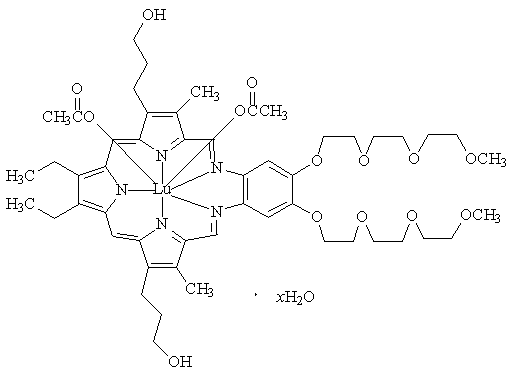
Motexafin lutetium hydrate (PCI-0123; Antrin; PCI0123; Lu texaphyrin; PCI 0123; LuTex; Lutetium texaphyrin; Lutrin; Optrin), the hydrated form of Motexafin lutetium, is a pentadentate aromatic metallotexaphyrin with photosensitizing properties. It is a photosensitiser used in photodynamic therapy to treat skin conditions and superficial cancers. It has also been tested for use in photoangioplasty (photodynamic treatment of diseased arteries). It is photoactivated by 732 nm light which allows greater depth of penetration.
Physicochemical Properties
| Molecular Formula | C52H74LUN5O15 |
| Molecular Weight | 1166.12 |
| Exact Mass | 1165.45 |
| CAS # | 156436-90-7 |
| Related CAS # | 156436-90-7 (lutetium hydrate);246252-06-2 (gadolinium);189752-49-6 (free); |
| PubChem CID | 3081907 |
| Appearance | Typically exists as solid at room temperature |
| Boiling Point | 1059.6ºC at 760mmHg |
| Flash Point | 594.6ºC |
| Vapour Pressure | 0mmHg at 25°C |
| LogP | 4.598 |
| Hydrogen Bond Donor Count | 3 |
| Hydrogen Bond Acceptor Count | 20 |
| Rotatable Bond Count | 28 |
| Heavy Atom Count | 73 |
| Complexity | 1900 |
| Defined Atom Stereocenter Count | 0 |
| SMILES | O.[Lu].CC(=O)O.CC(=O)O.COCCOCCOCCOC1=CC2=NC=C3N=C(C=C4[N-]C(=CC5=NC(=CN=C2C=C1OCCOCCOCCOC)C(C)=C5CCCO)C(CC)=C4CC)C(CCCO)=C3C |c:21,t:34| |
| InChi Key | WIQKYZYFTAEWBF-UHFFFAOYSA-L |
| InChi Code | InChI=1S/C48H66N5O10.2C2H4O2.Lu.H2O/c1-7-35-36(8-2)40-28-42-38(12-10-14-55)34(4)46(53-42)32-50-44-30-48(63-26-24-61-22-20-59-18-16-57-6)47(62-25-23-60-21-19-58-17-15-56-5)29-43(44)49-31-45-33(3)37(11-9-13-54)41(52-45)27-39(35)51-40;2*1-2(3)4;;/h27-32,54-55H,7-26H2,1-6H3;2*1H3,(H,3,4);;1H2/q-1;;;+3;/p-2 |
| Chemical Name | [PB-7-11-233'2'4]-Bis[acetato-κO][9,10-diethyl-20,21-bis[2-[2-[2-methoxy-ethoxy]ethoxy]ethoxy]-4,15-dimethyl-8,11-imino-3,6:16,13-dinitrilo-1,18-benzodiazacycloeicosine-5,14-dipropanolato-κN1,κN18,κN23,κN24,κN25]-lutetium hydrate |
| Synonyms | PCI-0123; Lutetium texaphyrin; Lu texaphyrin; PCI 0123; Lutrin; Optrin; PCI0123; LuTex; trade name: Antrin. |
| HS Tariff Code | 2934.99.9001 |
| Storage |
Powder-20°C 3 years 4°C 2 years In solvent -80°C 6 months -20°C 1 month |
| Shipping Condition | Room temperature (This product is stable at ambient temperature for a few days during ordinary shipping and time spent in Customs) |
Biological Activity
| References | Clinical Cancer Research. 2008,14(15): 4869–76. |
| Additional Infomation |
Motexafin lutetium (MLu) is a second-generation photosensitizer for photodynamic therapy (PDT) of cancer. It belongs to the family of drugs called metallotexaphyrins. Also called lutetium texaphyrin. Motexafin lutetium is a pentadentate aromatic metallotexaphyrin with photosensitizing properties. Motexafin Lutetium is a pentadentate aromatic metallotexaphyrin with photosensitizing properties. Motexafin lutetium preferentially accumulates in tumor cells due to their increased rates of metabolism and absorbs light, forming an extended high energy conformational state that produces high quantum yields of singlet oxygen, resulting in local cytotoxic effects. (NCI04) Drug Indication Investigated for use/treatment in brain cancer, breast cancer, cervical dysplasia/cancer, prostate cancer, cancer/tumors (unspecified), coronary artery disease, macular degeneration, and peripheral vascular disease. Mechanism of Action Motexafin lutetium has the potential to combine the features of selective localization, ability to be activated by deeply penetrating far-red light, low incidence of skin photosensitization and water solubility. The product is in clinical development as a treatment for several types of solid tumors (as Lutrin), age-related macular degeneration (as Optrin), atherosclerosis and prevention of restenosis (as Antrin). Motexafin lutetium preferentially accumulates in tumor cells due to their increased rates of metabolism and absorbs light, forming an extended high energy conformational state that produces high quantum yields of singlet oxygen, resulting in local cytotoxic effects. |
Solubility Data
| Solubility (In Vitro) |
|
|||
| Solubility (In Vivo) |
Note: Listed below are some common formulations that may be used to formulate products with low water solubility (e.g. < 1 mg/mL), you may test these formulations using a minute amount of products to avoid loss of samples. Injection Formulations (e.g. IP/IV/IM/SC) Injection Formulation 1: DMSO : Tween 80: Saline = 10 : 5 : 85 (i.e. 100 μL DMSO stock solution → 50 μL Tween 80 → 850 μL Saline) *Preparation of saline: Dissolve 0.9 g of sodium chloride in 100 mL ddH ₂ O to obtain a clear solution. Injection Formulation 2: DMSO : PEG300 :Tween 80 : Saline = 10 : 40 : 5 : 45 (i.e. 100 μL DMSO → 400 μLPEG300 → 50 μL Tween 80 → 450 μL Saline) Injection Formulation 3: DMSO : Corn oil = 10 : 90 (i.e. 100 μL DMSO → 900 μL Corn oil) Example: Take the Injection Formulation 3 (DMSO : Corn oil = 10 : 90) as an example, if 1 mL of 2.5 mg/mL working solution is to be prepared, you can take 100 μL 25 mg/mL DMSO stock solution and add to 900 μL corn oil, mix well to obtain a clear or suspension solution (2.5 mg/mL, ready for use in animals). Injection Formulation 4: DMSO : 20% SBE-β-CD in saline = 10 : 90 [i.e. 100 μL DMSO → 900 μL (20% SBE-β-CD in saline)] *Preparation of 20% SBE-β-CD in Saline (4°C,1 week): Dissolve 2 g SBE-β-CD in 10 mL saline to obtain a clear solution. Injection Formulation 5: 2-Hydroxypropyl-β-cyclodextrin : Saline = 50 : 50 (i.e. 500 μL 2-Hydroxypropyl-β-cyclodextrin → 500 μL Saline) Injection Formulation 6: DMSO : PEG300 : castor oil : Saline = 5 : 10 : 20 : 65 (i.e. 50 μL DMSO → 100 μLPEG300 → 200 μL castor oil → 650 μL Saline) Injection Formulation 7: Ethanol : Cremophor : Saline = 10: 10 : 80 (i.e. 100 μL Ethanol → 100 μL Cremophor → 800 μL Saline) Injection Formulation 8: Dissolve in Cremophor/Ethanol (50 : 50), then diluted by Saline Injection Formulation 9: EtOH : Corn oil = 10 : 90 (i.e. 100 μL EtOH → 900 μL Corn oil) Injection Formulation 10: EtOH : PEG300:Tween 80 : Saline = 10 : 40 : 5 : 45 (i.e. 100 μL EtOH → 400 μLPEG300 → 50 μL Tween 80 → 450 μL Saline) Oral Formulations Oral Formulation 1: Suspend in 0.5% CMC Na (carboxymethylcellulose sodium) Oral Formulation 2: Suspend in 0.5% Carboxymethyl cellulose Example: Take the Oral Formulation 1 (Suspend in 0.5% CMC Na) as an example, if 100 mL of 2.5 mg/mL working solution is to be prepared, you can first prepare 0.5% CMC Na solution by measuring 0.5 g CMC Na and dissolve it in 100 mL ddH2O to obtain a clear solution; then add 250 mg of the product to 100 mL 0.5% CMC Na solution, to make the suspension solution (2.5 mg/mL, ready for use in animals). Oral Formulation 3: Dissolved in PEG400 Oral Formulation 4: Suspend in 0.2% Carboxymethyl cellulose Oral Formulation 5: Dissolve in 0.25% Tween 80 and 0.5% Carboxymethyl cellulose Oral Formulation 6: Mixing with food powders Note: Please be aware that the above formulations are for reference only. InvivoChem strongly recommends customers to read literature methods/protocols carefully before determining which formulation you should use for in vivo studies, as different compounds have different solubility properties and have to be formulated differently. (Please use freshly prepared in vivo formulations for optimal results.) |
| Preparing Stock Solutions | 1 mg | 5 mg | 10 mg | |
| 1 mM | 0.8575 mL | 4.2877 mL | 8.5754 mL | |
| 5 mM | 0.1715 mL | 0.8575 mL | 1.7151 mL | |
| 10 mM | 0.0858 mL | 0.4288 mL | 0.8575 mL |