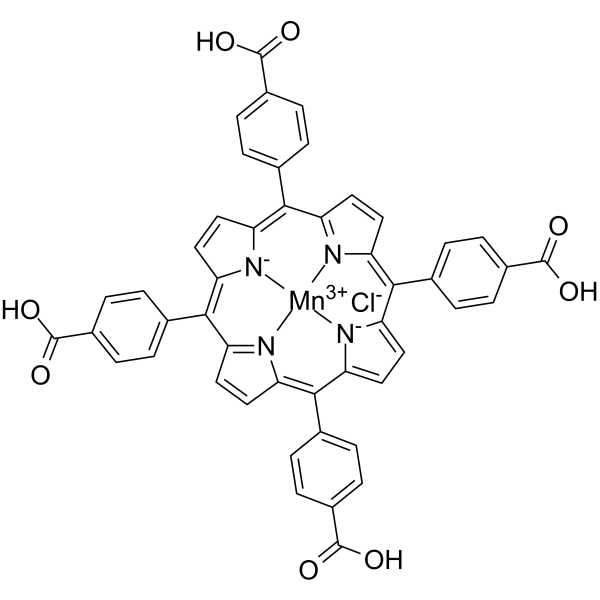
Physicochemical Properties
| Exact Mass | 878.098 |
| CAS # | 55266-18-7 |
| Appearance | Brown to black solid powder |
| LogP | 3.42 |
| HS Tariff Code | 2934.99.9001 |
| Storage |
Powder-20°C 3 years 4°C 2 years In solvent -80°C 6 months -20°C 1 month Note: Please store this product in a sealed and protected environment, avoid exposure to moisture. |
| Shipping Condition | Room temperature (This product is stable at ambient temperature for a few days during ordinary shipping and time spent in Customs) |
Biological Activity
| ln Vitro | In immortalized mouse proximal tubule cells (mPTC), MnTBAP chloride (pretreatment with 1.14 μM before 10 ng/mL TGF-β1) diminished α-α expression and partially but significantly reversed E-cadherin decrease. -Induction of vimentin and SMA [1]. MnTBAP chloride (50 μM; 6 h) did not alter BMPR-II protein expression in HUVECs throughout a 16-hour time course, although it did raise BMPR-II mRNA 1.3-fold at 2 h. Smad 1/5 is phosphorylated more when MnTBAP chloride is present, suggesting that the BMP signaling pathway is regulated [2]. |
| ln Vivo | In 5/6 Nx mice, MnTBAP chloride (10 mg/kg; i.p.; three times weekly for 12 weeks) decreases renal fibrosis [1]. |
| Animal Protocol |
Animal/Disease Models: C57BL/6J mice with 5/6 nephrectomy (Nx)[1] Doses: 10 mg/kg Route of Administration: IP; three times per week for twelve weeks Experimental Results: Attenuated renal fibrosis in 5/6 Nx mice and decreased protein expressions of fibronectin, collagen III in remnant kidneys. |
| References |
[1]. MnTBAP Therapy Attenuates Renal Fibrosis in Mice With 5/6 Nephrectomy. Oxid Med Cell Longev. 2016;2016:7496930. [2]. MnTBAP Increases BMPR-II Expression in Endothelial Cells and Attenuates Vascular Inflammation. Vascul Pharmacol. 2016 Sep;84:67-73. |
Solubility Data
| Solubility (In Vitro) |
DMSO : ~100 mg/mL (~113.75 mM) 0.5 M NaOH : 20 mg/mL (~22.75 mM) 1M NaOH : 10 mg/mL (~11.37 mM) |
| Solubility (In Vivo) |
Solubility in Formulation 1: ≥ 4.17 mg/mL (4.74 mM) (saturation unknown) in 10% DMSO + 40% PEG300 + 5% Tween80 + 45% Saline (add these co-solvents sequentially from left to right, and one by one), clear solution. For example, if 1 mL of working solution is to be prepared, you can add 100 μL of 41.7 mg/mL clear DMSO stock solution to 400 μL PEG300 and mix evenly; then add 50 μL Tween-80 to the above solution and mix evenly; then add 450 μL normal saline to adjust the volume to 1 mL. Preparation of saline: Dissolve 0.9 g of sodium chloride in 100 mL ddH₂ O to obtain a clear solution. Solubility in Formulation 2: ≥ 4.17 mg/mL (4.74 mM) (saturation unknown) in 10% DMSO + 90% (20% SBE-β-CD in Saline) (add these co-solvents sequentially from left to right, and one by one), clear solution. For example, if 1 mL of working solution is to be prepared, you can add 100 μL of 41.7 mg/mL clear DMSO stock solution to 900 μL of 20% SBE-β-CD physiological saline solution and mix evenly. Preparation of 20% SBE-β-CD in Saline (4°C,1 week): Dissolve 2 g SBE-β-CD in 10 mL saline to obtain a clear solution. (Please use freshly prepared in vivo formulations for optimal results.) |