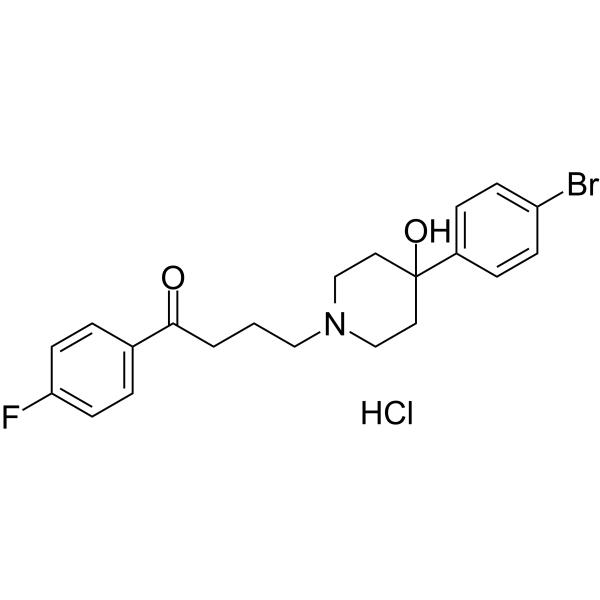
Physicochemical Properties
| Molecular Formula | C21H24BRCLFNO2 |
| Molecular Weight | 456.78 |
| Exact Mass | 455.066 |
| CAS # | 59453-24-6 |
| Related CAS # | Bromperidol;10457-90-6 |
| PubChem CID | 164517260 |
| Appearance | White to off-white solid powder |
| Hydrogen Bond Donor Count | 2 |
| Hydrogen Bond Acceptor Count | 4 |
| Rotatable Bond Count | 6 |
| Heavy Atom Count | 27 |
| Complexity | 451 |
| Defined Atom Stereocenter Count | 0 |
| InChi Key | XAYXCUZHMISKSM-UHFFFAOYSA-N |
| InChi Code | InChI=1S/C21H23BrFNO2.ClH/c22-18-7-5-17(6-8-18)21(26)11-14-24(15-12-21)13-1-2-20(25)16-3-9-19(23)10-4-16;/h3-10,26H,1-2,11-15H2;1H |
| Chemical Name | 4-[4-(4-bromophenyl)-4-hydroxypiperidin-1-yl]-1-(4-fluorophenyl)butan-1-one;hydrochloride |
| HS Tariff Code | 2934.99.9001 |
| Storage |
Powder-20°C 3 years 4°C 2 years In solvent -80°C 6 months -20°C 1 month Note: Please store this product in a sealed and protected environment, avoid exposure to moisture. |
| Shipping Condition | Room temperature (This product is stable at ambient temperature for a few days during ordinary shipping and time spent in Customs) |
Biological Activity
| ln Vivo | In addition to inhibiting conditioned responses and learnt intracranial self-stimulation in rats, bromoperidol hydrochloride can counteract stereotyped behaviors and agitation brought on by apomorphine or amphetamine [1]. In dogs, apomorphine-induced vomiting can be countered and the conditioned avoidance response can be inhibited by bromperidol hydrochloride [1]. |
| References |
[1]. Benfield P, et al. Bromperidol. A preliminary review of its pharmacodynamic and pharmacokinetic properties, and therapeutic efficacy in psychoses. Drugs. 1988 Jun;35(6):670-84. [2]. Ramón-García S, et al. Synergistic drug combinations for tuberculosis therapy identified by a novel high-throughput screen. Antimicrob Agents Chemother. 2011 Aug;55(8):3861-9. |
Solubility Data
| Solubility (In Vitro) | DMSO : ≥ 100 mg/mL (~218.92 mM) |
| Solubility (In Vivo) |
Solubility in Formulation 1: ≥ 2.5 mg/mL (5.47 mM) (saturation unknown) in 10% DMSO + 90% Corn Oil (add these co-solvents sequentially from left to right, and one by one), clear solution. For example, if 1 mL of working solution is to be prepared, you can add 100 μL of 25.0 mg/mL clear DMSO stock solution to 900 μL of corn oil and mix evenly. (Please use freshly prepared in vivo formulations for optimal results.) |
| Preparing Stock Solutions | 1 mg | 5 mg | 10 mg | |
| 1 mM | 2.1892 mL | 10.9462 mL | 21.8924 mL | |
| 5 mM | 0.4378 mL | 2.1892 mL | 4.3785 mL | |
| 10 mM | 0.2189 mL | 1.0946 mL | 2.1892 mL |