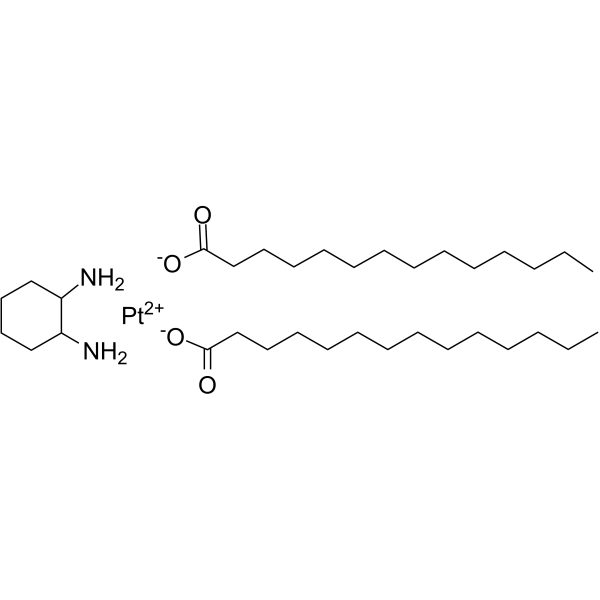
Physicochemical Properties
| Molecular Formula | 2[C14H27O2-].C6H14N2.PT+4 |
| Molecular Weight | 763.992720000001 |
| Exact Mass | 763.482 |
| CAS # | 141977-79-9 |
| Related CAS # | Miriplatin (hydrate);250159-48-9 |
| PubChem CID | 9832045 |
| Appearance | White to off-white solid powder |
| LogP | 8.487 |
| Hydrogen Bond Donor Count | 2 |
| Hydrogen Bond Acceptor Count | 6 |
| Rotatable Bond Count | 22 |
| Heavy Atom Count | 41 |
| Complexity | 212 |
| Defined Atom Stereocenter Count | 2 |
| HS Tariff Code | 2934.99.9001 |
| Storage |
Powder-20°C 3 years 4°C 2 years In solvent -80°C 6 months -20°C 1 month |
| Shipping Condition | Room temperature (This product is stable at ambient temperature for a few days during ordinary shipping and time spent in Customs) |
Biological Activity
| ln Vitro | Suspended in LPD (mireplatin/LPD, 100 μg/mL), mireplatin (SM-11355) can cause apoptosis, form platinum-DNA adducts, and stop the growth of AH109A cells [2]. |
| ln Vivo |
In rats with AH109A tumor cells, the dose-dependent reduction of tumor growth rate is shown with meplatin (SM-11355) in lipiodol (0.02-0.4 mg/20 μL) [1]. Rats harboring AH109A cells showed a substantial reduction in tumor growth when treated with mireplatin/LPD (400 μg/head) [2]. In a slowly-growing rat hepatic tumor model (AH109A cells transplanted into the liver), intra-hepatic arterial administration of SM-11355 suspended in Lipiodol (SM-11355/Lipiodol) showed significant antitumor effects. Tumor growth rates one week after administration of 20 µl Lipiodol containing 0.02, 0.04, 0.1, 0.2, or 0.4 mg of SM-11355 were 86%, 110%, 81%, 51%, and 40%, respectively, compared to 244% for the Lipiodol-only control. Massive necrosis was observed in tumors treated with 0.2 and 0.4 mg doses at one week. Four weeks after administration, tumors in groups treated with 0.2 mg and 0.4 mg of SM-11355/Lipiodol had almost disappeared, with scar tissue observed at the tumor site. The tumor treated with 0.1 mg did not grow from day 0 to week 4. The antitumor effect of 0.2 mg SM-11355/Lipiodol was comparable to that of 0.4 mg CDDP/Lipiodol. [1] |
| Animal Protocol |
A slowly-growing hepatic tumor model was established in Donryu male rats by successive transplantation of AH109A ascites hepatoma cells into the liver parenchyma. Approximately twenty days after tumor implantation, when the tumor size reached about 5-20 mm in its major axis, the drug was administered. Under laparotomy and anesthesia, a catheter was inserted into the gastroduodenal artery and advanced to the branching point of the common and proper hepatic arteries. A volume of 20 µl of SM-11355 suspended in Lipiodol (preparation method: mixing SM-11355 with Lipiodol to form a stable colloidal suspension) was injected into the proper hepatic artery via the catheter. Tumor size (major and minor axes) was measured on the day of administration (day 0), and at 1 week and 4 weeks post-administration to evaluate antitumor effects. [1] For hepatic toxicity evaluation, the same intra-hepatic arterial administration procedure was performed on normal rats (without tumors). Blood samples were collected one day after drug administration, and serum GOT and GPT levels were measured using a commercial test kit. [1] |
| ADME/Pharmacokinetics |
The article describes SM-11355/Lipiodol as a stable colloidal suspension and a sustained-release preparation. It is suggested that active platinum compounds are slowly released from SM-11355/Lipiodol, leading to prolonged localization in tumor blood vessels and the extracapillary space of tumor tissue compared to CDDP/Lipiodol. No specific PK parameters (e.g., half-life, AUC) are provided for SM-11355 in this article. [1] |
| Toxicity/Toxicokinetics |
Hepatic toxicity was assessed by measuring serum glutamic-oxaloacetic transaminase (GOT) and glutamic-pyruvic transaminase (GPT) levels one day after intra-hepatic arterial administration. The minimum dose of SM-11355/Lipiodol that caused a significant elevation in serum GOT and GPT levels compared to Lipiodol alone was 0.2 mg (GPT) and 0.4 mg (GOT), respectively. At a dose of 0.1 mg, SM-11355/Lipiodol inhibited tumor growth until 4 weeks without showing significant hepatic toxicity. No mortality or other overt signs of toxicity are reported for the tested doses within the 48-hour observation period mentioned in the context. [1] |
| References |
[1]. Antitumor effects of a novel lipophilic platinum complex (SM-11355) against a slowly-growing rat hepatic tumor after intra-hepatic arterial administration. Biol Pharm Bull. 2000 Mar;23(3):344-8. [2]. Intra-hepatic arterial administration with miriplatin suspended in an oily lymphographic agent inhibits the growth of tumors implanted in rat livers by inducing platinum-DNA adducts to form and massive apoptosis. Cancer Chemother Pharmaco. |
| Additional Infomation |
SM-11355 is a lipophilic platinum complex, specifically cis-[(1R,2R)-1,2-cyclohexanediamine-N,N']bis(myristato)] platinum(II). It was developed for intra-hepatic arterial chemotherapy using Lipiodol as a carrier. Its key feature is forming a stable, colloidal suspension in Lipiodol, acting as a sustained-release formulation, unlike the unstable suspension of water-soluble cisplatin (CDDP) in Lipiodol. [1] The study concludes that SM-11355/Lipiodol showed greater antitumor activity and less hepatic toxicity than CDDP/Lipiodol in this rat model. The article states that SM-11355 was under clinical investigation at the time of publication. [1] |
Solubility Data
| Solubility (In Vitro) |
Acetone :< 1 mg/mL DMF :< 1 mg/mL H2O : < 0.1 mg/mL |
| Solubility (In Vivo) |
Note: Listed below are some common formulations that may be used to formulate products with low water solubility (e.g. < 1 mg/mL), you may test these formulations using a minute amount of products to avoid loss of samples. Injection Formulations (e.g. IP/IV/IM/SC) Injection Formulation 1: DMSO : Tween 80: Saline = 10 : 5 : 85 (i.e. 100 μL DMSO stock solution → 50 μL Tween 80 → 850 μL Saline) *Preparation of saline: Dissolve 0.9 g of sodium chloride in 100 mL ddH ₂ O to obtain a clear solution. Injection Formulation 2: DMSO : PEG300 :Tween 80 : Saline = 10 : 40 : 5 : 45 (i.e. 100 μL DMSO → 400 μLPEG300 → 50 μL Tween 80 → 450 μL Saline) Injection Formulation 3: DMSO : Corn oil = 10 : 90 (i.e. 100 μL DMSO → 900 μL Corn oil) Example: Take the Injection Formulation 3 (DMSO : Corn oil = 10 : 90) as an example, if 1 mL of 2.5 mg/mL working solution is to be prepared, you can take 100 μL 25 mg/mL DMSO stock solution and add to 900 μL corn oil, mix well to obtain a clear or suspension solution (2.5 mg/mL, ready for use in animals). Injection Formulation 4: DMSO : 20% SBE-β-CD in saline = 10 : 90 [i.e. 100 μL DMSO → 900 μL (20% SBE-β-CD in saline)] *Preparation of 20% SBE-β-CD in Saline (4°C,1 week): Dissolve 2 g SBE-β-CD in 10 mL saline to obtain a clear solution. Injection Formulation 5: 2-Hydroxypropyl-β-cyclodextrin : Saline = 50 : 50 (i.e. 500 μL 2-Hydroxypropyl-β-cyclodextrin → 500 μL Saline) Injection Formulation 6: DMSO : PEG300 : castor oil : Saline = 5 : 10 : 20 : 65 (i.e. 50 μL DMSO → 100 μLPEG300 → 200 μL castor oil → 650 μL Saline) Injection Formulation 7: Ethanol : Cremophor : Saline = 10: 10 : 80 (i.e. 100 μL Ethanol → 100 μL Cremophor → 800 μL Saline) Injection Formulation 8: Dissolve in Cremophor/Ethanol (50 : 50), then diluted by Saline Injection Formulation 9: EtOH : Corn oil = 10 : 90 (i.e. 100 μL EtOH → 900 μL Corn oil) Injection Formulation 10: EtOH : PEG300:Tween 80 : Saline = 10 : 40 : 5 : 45 (i.e. 100 μL EtOH → 400 μLPEG300 → 50 μL Tween 80 → 450 μL Saline) Oral Formulations Oral Formulation 1: Suspend in 0.5% CMC Na (carboxymethylcellulose sodium) Oral Formulation 2: Suspend in 0.5% Carboxymethyl cellulose Example: Take the Oral Formulation 1 (Suspend in 0.5% CMC Na) as an example, if 100 mL of 2.5 mg/mL working solution is to be prepared, you can first prepare 0.5% CMC Na solution by measuring 0.5 g CMC Na and dissolve it in 100 mL ddH2O to obtain a clear solution; then add 250 mg of the product to 100 mL 0.5% CMC Na solution, to make the suspension solution (2.5 mg/mL, ready for use in animals). Oral Formulation 3: Dissolved in PEG400 Oral Formulation 4: Suspend in 0.2% Carboxymethyl cellulose Oral Formulation 5: Dissolve in 0.25% Tween 80 and 0.5% Carboxymethyl cellulose Oral Formulation 6: Mixing with food powders Note: Please be aware that the above formulations are for reference only. InvivoChem strongly recommends customers to read literature methods/protocols carefully before determining which formulation you should use for in vivo studies, as different compounds have different solubility properties and have to be formulated differently. (Please use freshly prepared in vivo formulations for optimal results.) |
| Preparing Stock Solutions | 1 mg | 5 mg | 10 mg | |
| 1 mM | 1.3089 mL | 6.5446 mL | 13.0892 mL | |
| 5 mM | 0.2618 mL | 1.3089 mL | 2.6178 mL | |
| 10 mM | 0.1309 mL | 0.6545 mL | 1.3089 mL |