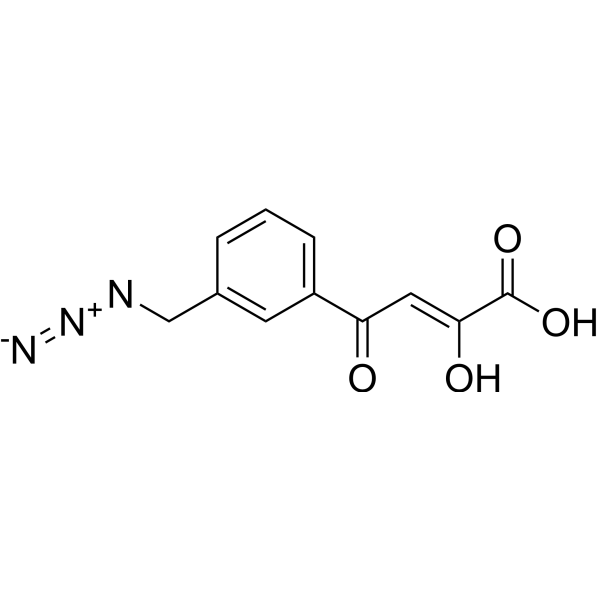
Physicochemical Properties
| Molecular Formula | C11H9N3O4 |
| Molecular Weight | 247.20686 |
| Exact Mass | 247.059 |
| CAS # | 544467-07-4 |
| Related CAS # | LEDGIN6;957890-42-5 |
| PubChem CID | 5496124 |
| Appearance | Light yellow to yellow solid powder |
| LogP | 1.658 |
| Hydrogen Bond Donor Count | 2 |
| Hydrogen Bond Acceptor Count | 6 |
| Rotatable Bond Count | 5 |
| Heavy Atom Count | 18 |
| Complexity | 413 |
| Defined Atom Stereocenter Count | 0 |
| HS Tariff Code | 2934.99.9001 |
| Storage |
Powder-20°C 3 years 4°C 2 years In solvent -80°C 6 months -20°C 1 month |
| Shipping Condition | Room temperature (This product is stable at ambient temperature for a few days during ordinary shipping and time spent in Customs) |
Biological Activity
| References |
[1]. Hobaika, Z.; Zargarian, L.; Maroun, R. G.; Mauffret, O.; Burke, T. R., Jr.; Fermandjian, S. HIV-1 Integrase and Virus and Cell DNAs: Complex Formation and Perturbation by Inhibitors of Integration. Neurochemical Research (2010), 35(6), 888-893. [2]. Loizidou, Eriketi Z.; Zeinalipour-Yazdi, Constantinos D.; Christofides, Tasos; Kostrikis, Leondios G. Analysis of binding parameters of HIV-1 integrase inhibitors: Correlates of drug inhibition and resistance. Bioorganic & Medicinal Chemistry (2009), 17(13), 4806-4818. [3]. Kawasuji T.Carbamoyl Pyridone HIV-1 Integrase Inhibitors. 1. Molecular Design and Establishment of an Advanced Two-Metal Binding Pharmacophore.J Med Chem. 2012 Sep 10. [4]. Yan A, Xuan S, Hu X.Classification of Active and Weakly Active ST Inhibitors of HIV-1 Integrase Using a Support Vector Machine.Comb Chem High Throughput Screen. 2012 Aug 28. [5]. Yu S, Zhao G.Development of Polyphenols as HIV-1 Integrase Inhibitors: A Summary and Perspective.Curr Med Chem. 2012 Aug 27. |
Solubility Data
| Solubility (In Vitro) | DMSO : ≥ 100 mg/mL (~404.51 mM) |
| Solubility (In Vivo) |
Solubility in Formulation 1: ≥ 2.5 mg/mL (10.11 mM) (saturation unknown) in 10% DMSO + 40% PEG300 + 5% Tween80 + 45% Saline (add these co-solvents sequentially from left to right, and one by one), clear solution. For example, if 1 mL of working solution is to be prepared, you can add 100 μL of 25.0 mg/mL clear DMSO stock solution to 400 μL PEG300 and mix evenly; then add 50 μL Tween-80 to the above solution and mix evenly; then add 450 μL normal saline to adjust the volume to 1 mL. Preparation of saline: Dissolve 0.9 g of sodium chloride in 100 mL ddH₂ O to obtain a clear solution. Solubility in Formulation 2: ≥ 2.5 mg/mL (10.11 mM) (saturation unknown) in 10% DMSO + 90% Corn Oil (add these co-solvents sequentially from left to right, and one by one), clear solution. For example, if 1 mL of working solution is to be prepared, you can add 100 μL of 25.0 mg/mL clear DMSO stock solution to 900 μL of corn oil and mix evenly. (Please use freshly prepared in vivo formulations for optimal results.) |
| Preparing Stock Solutions | 1 mg | 5 mg | 10 mg | |
| 1 mM | 4.0451 mL | 20.2257 mL | 40.4514 mL | |
| 5 mM | 0.8090 mL | 4.0451 mL | 8.0903 mL | |
| 10 mM | 0.4045 mL | 2.0226 mL | 4.0451 mL |