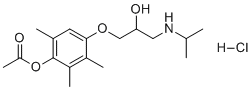
Metipranolol is a potent non-selective beta blocker (β adrenergic receptor antagonist) used in eye drops to treat glaucoma. It breaks down quickly to produce desacetylmetipranolol.
Physicochemical Properties
| Molecular Formula | C17H28CLNO4 |
| Molecular Weight | 345.86152 |
| Exact Mass | 345.171 |
| Elemental Analysis | C, 59.04; H, 8.16; Cl, 10.25; N, 4.05; O, 18.50 |
| CAS # | 36592-77-5 |
| Related CAS # |
22664-55-7 |
| PubChem CID | 656682 |
| Appearance | Solid powder |
| Boiling Point | 484.5ºC at 760 mmHg |
| Flash Point | 246.8ºC |
| LogP | 3.467 |
| Hydrogen Bond Donor Count | 3 |
| Hydrogen Bond Acceptor Count | 5 |
| Rotatable Bond Count | 8 |
| Heavy Atom Count | 23 |
| Complexity | 348 |
| Defined Atom Stereocenter Count | 0 |
| SMILES | CC1=C(OC(C)=O)C(C)=C(C)C(OCC(O)CNC(C)C)=C1.[H]Cl |
| InChi Key | BLWNYSZZZWQCKO-UHFFFAOYSA-N |
| InChi Code | InChI=1S/C17H27NO4.ClH/c1-10(2)18-8-15(20)9-21-16-7-11(3)17(22-14(6)19)13(5)12(16)4;/h7,10,15,18,20H,8-9H2,1-6H3;1H |
| Chemical Name | [4-[2-hydroxy-3-(propan-2-ylamino)propoxy]-2,3,6-trimethylphenyl] acetate;hydrochloride |
| Synonyms | Metipranolol hydrochloride; OptiPranolol; Metipranolol; Metipranolol HCl |
| HS Tariff Code | 2934.99.9001 |
| Storage |
Powder-20°C 3 years 4°C 2 years In solvent -80°C 6 months -20°C 1 month Note: Please store this product in a sealed and protected environment, avoid exposure to moisture. |
| Shipping Condition | Room temperature (This product is stable at ambient temperature for a few days during ordinary shipping and time spent in Customs) |
Biological Activity
| Targets | β adrenergic receptor |
| ln Vitro | Metipranolol is applied topically to treat glaucoma and systemically to treat arterial hypertension[1]. |
| Toxicity/Toxicokinetics |
Effects During Pregnancy and Lactation ◉ Summary of Use during Lactation Based on its physicochemical properties and its ophthalmic route of administration, metipranolol eye drops would not be expected to cause any adverse effects in breastfed infants. Some guidelines state that gel formulations are preferred over solutions. To substantially diminish the amount of drug that reaches the breastmilk after using eye drops, place pressure over the tear duct by the corner of the eye for 1 minute or more, then remove the excess solution with an absorbent tissue. ◉ Effects in Breastfed Infants Relevant published information on metipranolol was not found as of the revision date. A study of mothers taking beta-blockers during nursing found a numerically, but not statistically significant increased number of adverse reactions in those taking any beta-blocker. Although the ages of infants were matched to control infants, the ages of the affected infants were not stated. None of the mothers were taking metipranolol. ◉ Effects on Lactation and Breastmilk Relevant published information on the effects of beta-blockade or metipranolol during normal lactation was not found as of the revision date. A study in 6 patients with hyperprolactinemia and galactorrhea found no changes in serum prolactin levels following beta-adrenergic blockade with propranolol. |
| References |
[1]. Acute effect of metipranolol on the retinal circulation. Br J Ophthalmol. 1998 Aug;82(8):892-6. |
Solubility Data
| Solubility (In Vitro) |
DMSO: ~100 mg/mL (~289.1 mM) H2O: ≥ 100 mg/mL (~289.1 mM) |
| Solubility (In Vivo) |
Solubility in Formulation 1: ≥ 2.5 mg/mL (7.23 mM) (saturation unknown) in 10% DMSO + 40% PEG300 + 5% Tween80 + 45% Saline (add these co-solvents sequentially from left to right, and one by one), clear solution. For example, if 1 mL of working solution is to be prepared, you can add 100 μL of 25.0 mg/mL clear DMSO stock solution to 400 μL PEG300 and mix evenly; then add 50 μL Tween-80 to the above solution and mix evenly; then add 450 μL normal saline to adjust the volume to 1 mL. Preparation of saline: Dissolve 0.9 g of sodium chloride in 100 mL ddH₂ O to obtain a clear solution. Solubility in Formulation 2: ≥ 2.5 mg/mL (7.23 mM) (saturation unknown) in 10% DMSO + 90% (20% SBE-β-CD in Saline) (add these co-solvents sequentially from left to right, and one by one), clear solution. For example, if 1 mL of working solution is to be prepared, you can add 100 μL of 25.0 mg/mL clear DMSO stock solution to 900 μL of 20% SBE-β-CD physiological saline solution and mix evenly. Preparation of 20% SBE-β-CD in Saline (4°C,1 week): Dissolve 2 g SBE-β-CD in 10 mL saline to obtain a clear solution. Solubility in Formulation 3: ≥ 2.5 mg/mL (7.23 mM) (saturation unknown) in 10% DMSO + 90% Corn Oil (add these co-solvents sequentially from left to right, and one by one), clear solution. For example, if 1 mL of working solution is to be prepared, you can add 100 μL of 25.0 mg/mL clear DMSO stock solution to 900 μL of corn oil and mix evenly. Solubility in Formulation 4: 100 mg/mL (289.13 mM) in PBS (add these co-solvents sequentially from left to right, and one by one), clear solution; with ultrasonication. (Please use freshly prepared in vivo formulations for optimal results.) |
| Preparing Stock Solutions | 1 mg | 5 mg | 10 mg | |
| 1 mM | 2.8913 mL | 14.4567 mL | 28.9134 mL | |
| 5 mM | 0.5783 mL | 2.8913 mL | 5.7827 mL | |
| 10 mM | 0.2891 mL | 1.4457 mL | 2.8913 mL |