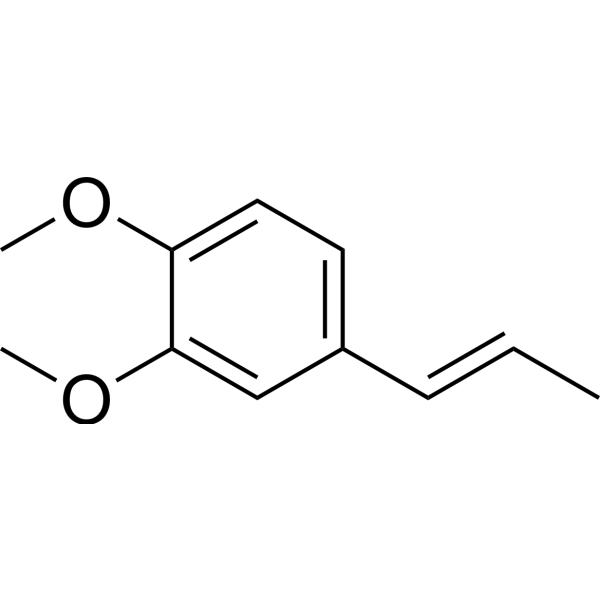
Physicochemical Properties
| Molecular Formula | C11H14O2 |
| Molecular Weight | 178.2277 |
| Exact Mass | 178.099 |
| CAS # | 93-16-3 |
| PubChem CID | 637776 |
| Appearance | Colorless to light yellow liquid |
| Density | 1.0±0.1 g/cm3 |
| Boiling Point | 271.1±20.0 °C at 760 mmHg |
| Melting Point | 98-100 °C(lit.) |
| Flash Point | 104.5±21.3 °C |
| Vapour Pressure | 0.0±0.5 mmHg at 25°C |
| Index of Refraction | 1.534 |
| LogP | 3.05 |
| Hydrogen Bond Donor Count | 0 |
| Hydrogen Bond Acceptor Count | 2 |
| Rotatable Bond Count | 3 |
| Heavy Atom Count | 13 |
| Complexity | 166 |
| Defined Atom Stereocenter Count | 0 |
| SMILES | O(C)C1C(OC)=CC(C=CC)=CC=1 |
| InChi Key | NNWHUJCUHAELCL-SNAWJCMRSA-N |
| InChi Code | InChI=1S/C11H14O2/c1-4-5-9-6-7-10(12-2)11(8-9)13-3/h4-8H,1-3H3/b5-4+ |
| Chemical Name | 1,2-dimethoxy-4-[(E)-prop-1-enyl]benzene |
| Synonyms | Methylisoeugenol; 93-16-3; trans-Methylisoeugenol; Methyl isoeugenol; Isomethyleugenol; Isoeugenol methyl ether; Isohomogenol; 4-Propenylveratrole; |
| HS Tariff Code | 2934.99.9001 |
| Storage |
Powder-20°C 3 years 4°C 2 years In solvent -80°C 6 months -20°C 1 month |
| Shipping Condition | Room temperature (This product is stable at ambient temperature for a few days during ordinary shipping and time spent in Customs) |
Biological Activity
| Targets | Natural product; Flavoring Agent; food flavour; anxiolytic (anti-anxiety) and antidepressant |
| ln Vivo | (E)-methyl isoeugenol (MIE) is a natural food flavour that constitutes 93.7% of an essential oil from Pimenta pseudocaryophyllus leaf. The leaf extracts of this species are used as a calming agent. As a ubiquitous food additive, the application of MIE for treating mood disorders appears to be globally attractive. Hence, we sought to evaluate general pharmacological activities, anticonvulsant, anxiolytic and antidepressant effects and the possible mechanisms of MIE actions. Administration of MIE was carried out prior to the exposure of a male Swiss mice to general behavioural tests, barbiturate sleep, PTZ-induced convulsion, light dark box (LDB), elevated plus maze (EPM), wire hanging, open field (OF) and forced swimming test (FST). The involvement of monoamine system was studied by mice pretreatment with WAY100635 (antagonist of 5-HT1A), α-methyl-p-tyrosine (AMPT; depletor of catecholamine) or p-chlorophenylalanine (PCPA; depletor of serotonin storage). There was no record of neurotoxic effect or animal's death during the course of general pharmacological tests. MIE at 250 and 500 mg kg(-1) potentiated the hypnotic effect of sodium pentobarbital. However, MIE did not protect against PTZ-induced convulsion. Except for MIE at 500 mg kg(-1), parameters evaluated in the LDB, EPM and OF demonstrated an anxiolytic like property of MIE. This effect was blocked by WAY100635 pretreatment. MIE at 500 mg kg(-1) elicited a reduction in locomotor activity of the mice in the OF. Anti-immobility effect of MIE 250 mg kg(-1) in the FST suggested an antidepressive like property. Unlike AMPT, pretreatment with PCPA reversed the antidepressant like effect of MIE. Our findings demonstrated anxiolytic and antidepressant like properties of (E)-methyl isoeugenol and suggested the participation of serotonergic pathways [1]. |
| Toxicity/Toxicokinetics |
mouse LD50 intraperitoneal 350 mg/kg BEHAVIORAL: SOMNOLENCE (GENERAL DEPRESSED ACTIVITY); BEHAVIORAL: COMA Comptes Rendus Hebdomadaires des Seances, Academie des Sciences., 250(1148), 1960 [PMID:13808522] Isohomogenol Toxicity AVIAN Red-winged blackbird Oral LD50 (Lethal Dose 50) > 316 mg/kg Isohomogenol Repellency AVIAN Red-winged blackbird Oral R50 (Repellency 50) > 1 % |
| References |
[1]. Anxiolytic and antidepressant like effects of natural food flavour (E)-methyl isoeugenol. Food Funct. 2014 Aug;5(8):1819-28. |
| Additional Infomation |
Isomethyleugenol is a phenylpropanoid, an olefinic compound and a dimethoxybenzene. Methylisoeugenol has been reported in Perilla frutescens, Punica granatum, and other organisms with data available. |
Solubility Data
| Solubility (In Vitro) | DMSO : ~100 mg/mL (~561.07 mM) |
| Solubility (In Vivo) |
Note: Listed below are some common formulations that may be used to formulate products with low water solubility (e.g. < 1 mg/mL), you may test these formulations using a minute amount of products to avoid loss of samples. Injection Formulations (e.g. IP/IV/IM/SC) Injection Formulation 1: DMSO : Tween 80: Saline = 10 : 5 : 85 (i.e. 100 μL DMSO stock solution → 50 μL Tween 80 → 850 μL Saline) *Preparation of saline: Dissolve 0.9 g of sodium chloride in 100 mL ddH ₂ O to obtain a clear solution. Injection Formulation 2: DMSO : PEG300 :Tween 80 : Saline = 10 : 40 : 5 : 45 (i.e. 100 μL DMSO → 400 μLPEG300 → 50 μL Tween 80 → 450 μL Saline) Injection Formulation 3: DMSO : Corn oil = 10 : 90 (i.e. 100 μL DMSO → 900 μL Corn oil) Example: Take the Injection Formulation 3 (DMSO : Corn oil = 10 : 90) as an example, if 1 mL of 2.5 mg/mL working solution is to be prepared, you can take 100 μL 25 mg/mL DMSO stock solution and add to 900 μL corn oil, mix well to obtain a clear or suspension solution (2.5 mg/mL, ready for use in animals). Injection Formulation 4: DMSO : 20% SBE-β-CD in saline = 10 : 90 [i.e. 100 μL DMSO → 900 μL (20% SBE-β-CD in saline)] *Preparation of 20% SBE-β-CD in Saline (4°C,1 week): Dissolve 2 g SBE-β-CD in 10 mL saline to obtain a clear solution. Injection Formulation 5: 2-Hydroxypropyl-β-cyclodextrin : Saline = 50 : 50 (i.e. 500 μL 2-Hydroxypropyl-β-cyclodextrin → 500 μL Saline) Injection Formulation 6: DMSO : PEG300 : castor oil : Saline = 5 : 10 : 20 : 65 (i.e. 50 μL DMSO → 100 μLPEG300 → 200 μL castor oil → 650 μL Saline) Injection Formulation 7: Ethanol : Cremophor : Saline = 10: 10 : 80 (i.e. 100 μL Ethanol → 100 μL Cremophor → 800 μL Saline) Injection Formulation 8: Dissolve in Cremophor/Ethanol (50 : 50), then diluted by Saline Injection Formulation 9: EtOH : Corn oil = 10 : 90 (i.e. 100 μL EtOH → 900 μL Corn oil) Injection Formulation 10: EtOH : PEG300:Tween 80 : Saline = 10 : 40 : 5 : 45 (i.e. 100 μL EtOH → 400 μLPEG300 → 50 μL Tween 80 → 450 μL Saline) Oral Formulations Oral Formulation 1: Suspend in 0.5% CMC Na (carboxymethylcellulose sodium) Oral Formulation 2: Suspend in 0.5% Carboxymethyl cellulose Example: Take the Oral Formulation 1 (Suspend in 0.5% CMC Na) as an example, if 100 mL of 2.5 mg/mL working solution is to be prepared, you can first prepare 0.5% CMC Na solution by measuring 0.5 g CMC Na and dissolve it in 100 mL ddH2O to obtain a clear solution; then add 250 mg of the product to 100 mL 0.5% CMC Na solution, to make the suspension solution (2.5 mg/mL, ready for use in animals). Oral Formulation 3: Dissolved in PEG400 Oral Formulation 4: Suspend in 0.2% Carboxymethyl cellulose Oral Formulation 5: Dissolve in 0.25% Tween 80 and 0.5% Carboxymethyl cellulose Oral Formulation 6: Mixing with food powders Note: Please be aware that the above formulations are for reference only. InvivoChem strongly recommends customers to read literature methods/protocols carefully before determining which formulation you should use for in vivo studies, as different compounds have different solubility properties and have to be formulated differently. (Please use freshly prepared in vivo formulations for optimal results.) |
| Preparing Stock Solutions | 1 mg | 5 mg | 10 mg | |
| 1 mM | 5.6107 mL | 28.0536 mL | 56.1073 mL | |
| 5 mM | 1.1221 mL | 5.6107 mL | 11.2215 mL | |
| 10 mM | 0.5611 mL | 2.8054 mL | 5.6107 mL |