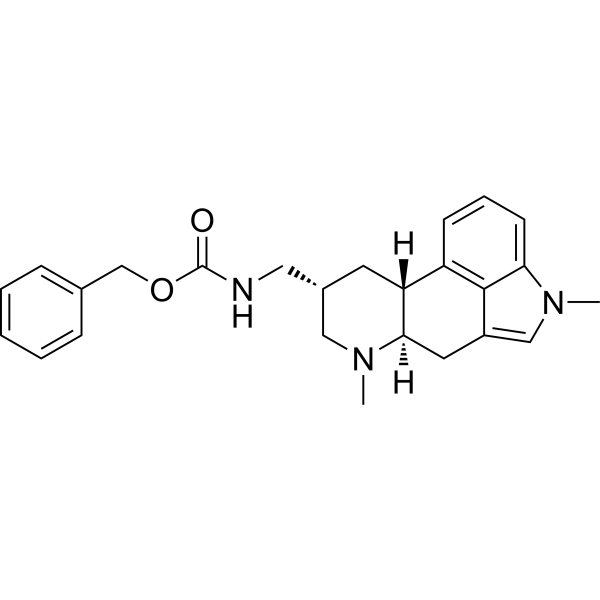
Physicochemical Properties
| Molecular Formula | C25H29N3O2 |
| Molecular Weight | 403.517 |
| Exact Mass | 403.226 |
| CAS # | 17692-51-2 |
| PubChem CID | 28693 |
| Appearance | White to off-white solid powder |
| Density | 1.25g/cm3 |
| Boiling Point | 612.5ºC at 760mmHg |
| Melting Point | 148-150 °C(lit.) |
| Flash Point | 324.2ºC |
| Vapour Pressure | 0mmHg at 25°C |
| LogP | 4.393 |
| Hydrogen Bond Donor Count | 1 |
| Hydrogen Bond Acceptor Count | 3 |
| Rotatable Bond Count | 5 |
| Heavy Atom Count | 30 |
| Complexity | 607 |
| Defined Atom Stereocenter Count | 3 |
| SMILES | CN1C[C@@H](C[C@H]2[C@H]1CC3=CN(C4=CC=CC2=C34)C)CNC(=O)OCC5=CC=CC=C5 |
| InChi Key | WZHJKEUHNJHDLS-QTGUNEKASA-N |
| InChi Code | InChI=1S/C25H29N3O2/c1-27-14-18(13-26-25(29)30-16-17-7-4-3-5-8-17)11-21-20-9-6-10-22-24(20)19(12-23(21)27)15-28(22)2/h3-10,15,18,21,23H,11-14,16H2,1-2H3,(H,26,29)/t18-,21+,23+/m0/s1 |
| Chemical Name | benzyl N-[[(6aR,9S,10aR)-4,7-dimethyl-6,6a,8,9,10,10a-hexahydroindolo[4,3-fg]quinolin-9-yl]methyl]carbamate |
| HS Tariff Code | 2934.99.9001 |
| Storage |
Powder-20°C 3 years 4°C 2 years In solvent -80°C 6 months -20°C 1 month |
| Shipping Condition | Room temperature (This product is stable at ambient temperature for a few days during ordinary shipping and time spent in Customs) |
Biological Activity
| ln Vitro | The activation curve of the Na+ current waveform shifts by 6.8±1.2 mV at 3 μM of metgoline, whereas the deactivation curve remains unchanged [3]. |
| ln Vivo | Complete expansion of ergoline (5 mg/kg; ip) in response to intrathecal administration of 5-HT (2 μg) [4]. |
| Animal Protocol |
Animal/Disease Models: Male albino mouse (25-40 g) [4] Doses: 5 mg/kg Route of Administration: intraperitoneal (ip) injection Experimental Results: Inhibition of bites or scratches caused by 5-HT (2 μg). |
| References |
[1]. Pharmacological characterisation of the agonist radioligand binding site of 5-HT(2A), 5-HT(2B) and 5-HT(2C) receptors. Naunyn Schmiedebergs Arch Pharmacol. 2004 Aug;370(2):114-23. [2]. Pharmacological Analysis of the Novel, Rapid, and Potent Inactivation of the Human 5-Hydroxytryptamine7 Receptor by Risperidone, 9-OH-Risperidone, and Other Inactivating Antagonists. Mol Pharmacol. 2009 Feb; 75(2): 374-380. [3]. Metergoline inhibits the neuronal Nav1.2 voltage-dependent Na+ channels expressed in Xenopus oocytes. Acta Pharmacol Sin. 2014 Jul; 35(7): 862-868. [4]. The behavioural response to intrathecal serotonin is changed by acute but not by repeated treatment with zimelidine or metergoline. Pharmacol Toxicol. 1991 Nov;69(5):361-4. |
| Additional Infomation |
Metergoline is an ergoline alkaloid that is the N-benzyloxycarbonyl derivative of lysergamine. A 5-HT2 antagonist. Also 5-HT1 antagonist and 5-HT1D ligand. Has moderate affinity for 5-HT6 and high affinity for 5-HT7. It has a role as a serotonergic antagonist, a dopamine agonist and a geroprotector. It is an ergoline alkaloid and a carbamate ester. Metergoline is an ergot-derived psychoactive drug that acts as a ligand for serotonin and dopamine receptors. Metergoline is an antagonist at various 5-HT receptor subtypes at a relatively low concentration and agonist at dopamine receptors. Its use has been studied in various clinical settings such as a treatment for seasonal affective disorder, prolactin hormone regulation due to its inhibitory effect on prolactin release, premenstrual dysphoric disorder in women and antianxiety treatment. A dopamine agonist and serotonin antagonist. It has been used similarly to BROMOCRIPTINE as a dopamine agonist and also for MIGRAINE DISORDERS therapy. |
Solubility Data
| Solubility (In Vitro) | DMSO : ~66.67 mg/mL (~165.22 mM) |
| Solubility (In Vivo) |
Solubility in Formulation 1: ≥ 2.08 mg/mL (5.15 mM) (saturation unknown) in 10% DMSO + 40% PEG300 + 5% Tween80 + 45% Saline (add these co-solvents sequentially from left to right, and one by one), clear solution. For example, if 1 mL of working solution is to be prepared, you can add 100 μL of 20.8 mg/mL clear DMSO stock solution to 400 μL PEG300 and mix evenly; then add 50 μL Tween-80 to the above solution and mix evenly; then add 450 μL normal saline to adjust the volume to 1 mL. Preparation of saline: Dissolve 0.9 g of sodium chloride in 100 mL ddH₂ O to obtain a clear solution. Solubility in Formulation 2: ≥ 2.08 mg/mL (5.15 mM) (saturation unknown) in 10% DMSO + 90% (20% SBE-β-CD in Saline) (add these co-solvents sequentially from left to right, and one by one), clear solution. For example, if 1 mL of working solution is to be prepared, you can add 100 μL of 20.8 mg/mL clear DMSO stock solution to 900 μL of 20% SBE-β-CD physiological saline solution and mix evenly. Preparation of 20% SBE-β-CD in Saline (4°C,1 week): Dissolve 2 g SBE-β-CD in 10 mL saline to obtain a clear solution. Solubility in Formulation 3: ≥ 2.08 mg/mL (5.15 mM) (saturation unknown) in 10% DMSO + 90% Corn Oil (add these co-solvents sequentially from left to right, and one by one), clear solution. For example, if 1 mL of working solution is to be prepared, you can add 100 μL of 20.8 mg/mL clear DMSO stock solution to 900 μL of corn oil and mix evenly. (Please use freshly prepared in vivo formulations for optimal results.) |
| Preparing Stock Solutions | 1 mg | 5 mg | 10 mg | |
| 1 mM | 2.4782 mL | 12.3910 mL | 24.7819 mL | |
| 5 mM | 0.4956 mL | 2.4782 mL | 4.9564 mL | |
| 10 mM | 0.2478 mL | 1.2391 mL | 2.4782 mL |