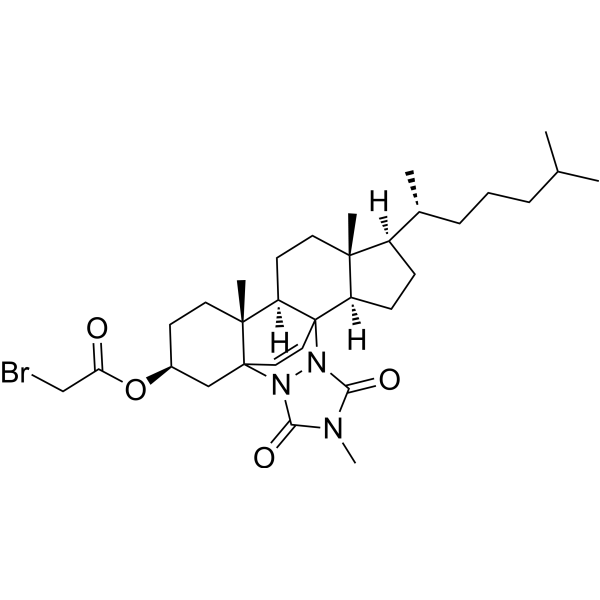
Physicochemical Properties
| Molecular Formula | C32H48BRN3O4 |
| Molecular Weight | 618.645228385925 |
| Exact Mass | 617.282 |
| CAS # | 1817841-22-7 |
| PubChem CID | 165437232 |
| Appearance | White to off-white solid powder |
| LogP | 8 |
| Hydrogen Bond Donor Count | 0 |
| Hydrogen Bond Acceptor Count | 4 |
| Rotatable Bond Count | 8 |
| Heavy Atom Count | 40 |
| Complexity | 1130 |
| Defined Atom Stereocenter Count | 7 |
| SMILES | BrCC(=O)O[C@H]1CC[C@@]2(C)C3(C1)C=CC1([C@@H]4CC[C@H]([C@H](C)CCCC(C)C)[C@@]4(C)CC[C@@H]12)N1C(N(C)C(N13)=O)=O |
| InChi Key | LBFDLJSQMPCWKK-YMNKQYQVSA-N |
| InChi Code | InChI=1S/C32H48BrN3O4/c1-20(2)8-7-9-21(3)23-10-11-24-29(23,4)14-13-25-30(5)15-12-22(40-26(37)19-33)18-31(30)16-17-32(24,25)36-28(39)34(6)27(38)35(31)36/h16-17,20-25H,7-15,18-19H2,1-6H3/t21-,22+,23-,24-,25-,29-,30-,31?,32?/m1/s1 |
| Chemical Name | [(2R,5R,6R,9R,10R,13S)-6,10,18-trimethyl-5-[(2R)-6-methylheptan-2-yl]-17,19-dioxo-16,18,20-triazahexacyclo[13.5.2.01,9.02,6.010,15.016,20]docos-21-en-13-yl] 2-bromoacetate |
| HS Tariff Code | 2934.99.9001 |
| Storage |
Powder-20°C 3 years 4°C 2 years In solvent -80°C 6 months -20°C 1 month |
| Shipping Condition | Room temperature (This product is stable at ambient temperature for a few days during ordinary shipping and time spent in Customs) |
Biological Activity
| Targets | IC50: 2.9 μM (VDR)[1]. |
| ln Vitro | MeTC7 (compound 5) has an IC50 value of 2.9 μM, indicating strong VDR inhibitory activity[1]. The VDR-Ligand-binding domain in Silico is disrupted by MeTC7[1]. In the ovarian cancer cell-line, MeTC7 (250 nM; 18 h) decreases the expressions of Importin-4 and RXRα[1]. MeTC7 (250 nM; 18 h) causes PARP1 cleavage and reduces the viability of ovarian cancer cells[1]. |
| ln Vivo | MeTC7 (compound 5) (meTC7; 10 mg/kg) inhibits the growth of xenografts and spontaneous transgenic TH-MYCN neuroblastoma in vivo[1]. |
| Cell Assay |
Western Blot Analysis[1] Cell Types: 2008 cells Tested Tested Concentrations: 250 nM Incubation Duration: 18, 12 h Experimental Results: diminished the expression of RXR-α, Importin-4 and increased cleaved PARP1 expression in 2008 cells. Cell Viability Assay[1] Cell Types: SKOV-3, IGROV-1, CAOV-3, OVCAR-3, OVCAR-8, and 2008 ovarian cancer cell-lines Tested Tested Concentrations: 0, 0.25, 0.5, 0.75, 1.0, 1.25 μM Incubation Duration: 24 h Experimental Results: diminished the viability of SKOV-3, IGROV-1, CAOV- 3, OVCAR-3, OVCAR-8, and 2008 ovarian cancer cell-lines. |
| Animal Protocol |
Animal/Disease Models: Mice[1] Doses: 10 mg/kg Route of Administration: IP Experimental Results: decreased the growth of xenografts derived from ovarian cancer, medulloblastoma, and pancreatic cancer cells. Inhibited the growth of neuroblastoma cells and Xenografts. decreased MYCN expression and blocked the growth of TH-MYCN transgene-driven spontaneous neuroblastoma. |
| References |
[1]. Identification of a Vitamin-D Receptor Antagonist, MeTC7, which Inhibits the Growth of Xenograft and Transgenic Tumors In Vivo. J Med Chem. |
Solubility Data
| Solubility (In Vitro) | DMSO: 16.67 mg/mL (26.95 mM) |
| Solubility (In Vivo) |
Solubility in Formulation 1: ≥ 1.67 mg/mL (2.70 mM) (saturation unknown) in 10% DMSO + 90% Corn Oil (add these co-solvents sequentially from left to right, and one by one), clear solution. For example, if 1 mL of working solution is to be prepared, you can add 100 μL of 16.7 mg/mL clear DMSO stock solution to 900 μL of corn oil and mix evenly. (Please use freshly prepared in vivo formulations for optimal results.) |
| Preparing Stock Solutions | 1 mg | 5 mg | 10 mg | |
| 1 mM | 1.6164 mL | 8.0821 mL | 16.1642 mL | |
| 5 mM | 0.3233 mL | 1.6164 mL | 3.2328 mL | |
| 10 mM | 0.1616 mL | 0.8082 mL | 1.6164 mL |