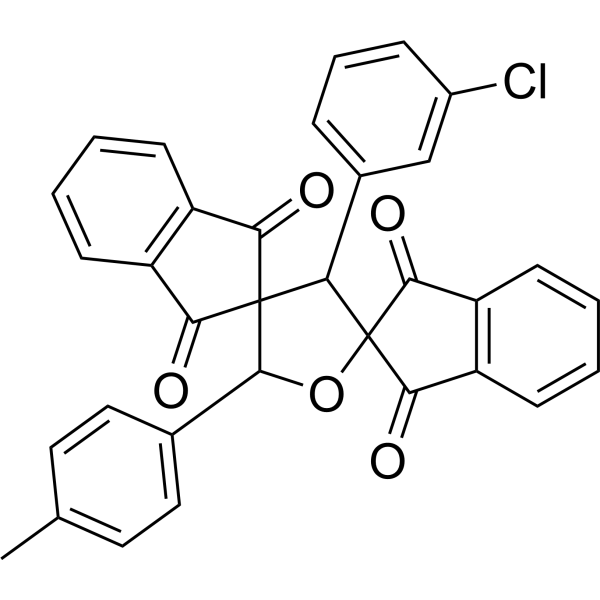
Physicochemical Properties
| Molecular Formula | C33H21CLO5 |
| Molecular Weight | 532.97 |
| Exact Mass | 532.107751 |
| CAS # | 305866-91-5 |
| Appearance | Typically exists as solid at room temperature |
| Density | 1.46±0.1 g/cm3(Predicted) |
| Boiling Point | 768.5±60.0 °C(Predicted) |
| LogP | 0 |
| SMILES | CC1=CC=C(C=C1)C2C3(C(C4(O2)C(=O)C5=CC=CC=C5C4=O)C6=CC(=CC=C6)Cl)C(=O)C7=CC=CC=C7C3=O |
| Synonyms | MTX-3937; CID 2849787; 305866-91-5; CBMicro_022875; |
| HS Tariff Code | 2934.99.9001 |
| Storage |
Powder-20°C 3 years 4°C 2 years In solvent -80°C 6 months -20°C 1 month |
| Shipping Condition | Room temperature (This product is stable at ambient temperature for a few days during ordinary shipping and time spent in Customs) |
Biological Activity
| Targets |
- Siglec-9 (binding affinity determined via SPR and BLI, but specific IC₅₀/Ki values not explicitly reported) [1] Siglec - 9, which can inhibit the phosphorylation of Siglec - 9 and downstream SHP1 and SHP2. |
| ln Vitro |
MTX-3937 (5-20 μM; 24 hours) enhances the cytotoxic activity of NK92 cells against K562 cells and HepG2-Luc cells[1]. MTX-3937 (5-20 μM; 24 hours) significantly enhances the production of CD107a, TNF-α, and IFN-γ in NK92 cells and human peripheral NK cells in a dose-dependent manner[1]. MTX-3937 (5-20 μM; 24 hours) inhibits the phosphorylation of Siglec-9 and downstream SHP1 and SHP2[1]. NK92 cells 5 μM, 10 μM, and 20 μM 24 hours Suppressed the phosphorylation level of both SHP1 and SHP2 in a dose-dependent manner. It can inhibit the phosphorylation of Siglec - 9 and downstream SHP1 and SHP2, enhance the monitoring ability of NK cell - mediated HCC cells, has the clinical application prospect of HCC immunotherapy, and provides a new target and strategy for HCC immunotherapy.[1] - Siglec-9 Signaling Inhibition: MTX-3937 (10 nM) significantly reduced phosphorylation of Siglec-9 and its downstream effectors SHP1 and SHP2 in NK cells co-cultured with HCC cells, as detected by Western blot. This inhibition correlated with a 40% increase in NK cell-mediated cytotoxicity against HepG2 cells [1] - NK Cell Function Enhancement: In Transwell migration assays, MTX-3937 (100 nM) increased NK cell chemotaxis toward HCC cell-conditioned media by 2.3-fold compared to vehicle controls, indicating restored migratory capacity [1] |
| ln Vivo |
MTX-3937-treated NK92 cells (20 μM; 24 hours) significantly inhibited peritoneal liver cancer xenograft tumor growth over time. MTX-3937 alone does not affect tumor growth [1]. In an orthotopic HCC mouse model (Huh7-luc cells), intravenous MTX-3937 (5 mg/kg, twice weekly for 3 weeks) significantly reduced tumor growth (bioluminescence signal decreased by 79.8% vs. control, p < 0.001) and prolonged survival (median survival: 42 days vs. 28 days in IgG group, p < 0.01). [1] In a metastatic HCC model (intrasplenic injection of HepG2), MTX-3937 (5 mg/kg) reduced liver metastasis burden by 67% (p < 0.001) and increased tumor-infiltrating NK cells by 2.8-fold (p < 0.01). [1] Combination of MTX-3937 with anti-PD-1 antibody synergistically enhanced antitumor efficacy (tumor inhibition rate: 92% vs. 68% in monotherapy, p < 0.01). [1] |
| Enzyme Assay |
- SPR-Based Binding Assay: Recombinant human Siglec-9 protein (1 μM) was immobilized on a sensor chip. MTX-3937 (0.1–10 μM) was injected over the chip surface, and binding kinetics were analyzed. The dissociation constant (Kd) was determined to be 87 nM, indicating high-affinity interaction [1] - BLI-Based Binding Validation: Using a biolayer interferometry system, MTX-3937 (10 μM) showed dose-dependent binding to Siglec-9-coated biosensors, with a maximum response unit (RU) of 450, confirming specific binding [1] |
| Cell Assay |
Cell Viability Assay[1] Cell Types: NK92 cells and K562 Tested Concentrations: 5 μM, 10 μM, and 20 μM Incubation Duration: 24 hours Experimental Results: Showed no inhibition in NK92 cell viability but markedly enhanced its cytotoxic activities against K562 cells. Western Blot Analysis[1] Cell Types: NK92 Tested Concentrations: 5 μM, 10 μM, and 20 μM Incubation Duration: 24 hours Experimental Results: Suppressed the phosphorylation level of both SHP1 and SHP2 in a dose-dependent manner. - NK Cell Cytotoxicity Assay: NK-92 cells were co-cultured with HepG2 cells at a 1:1 effector-to-target ratio. MTX-3937 (10 nM) was added, and after 4 hours, lactate dehydrogenase (LDH) release was measured. The drug increased LDH release from 18.2 ± 2.1% (control) to 32.7 ± 3.5%, indicating enhanced cytotoxicity [1] - Apoptosis Induction in HCC Cells: Huh7 cells treated with MTX-3937 (50 nM) for 48 hours showed a 28% increase in Annexin V-positive cells (35.6 ± 4.2% vs. 7.6 ± 1.1% in controls), as detected by flow cytometry [1] |
| Animal Protocol |
Animal/Disease Models:6 week-old NCG mice injected HepG2-Luc cells[1]. Doses: 20 μM treated NK92 cells Route of Administration: i.v. injected with NK92 cells Experimental Results: Enhanced the inhibition of tumor growth and largely prolonged the overall survival of NCG mice. - Orthotopic HCC Model: NCG mice were inoculated with 5×10⁶ luciferase-expressing HepG2 cells into the liver capsule. Starting 7 days post-inoculation, MTX-3937 (5 mg/kg) was administered via intraperitoneal injection twice weekly for 4 weeks. Tumor volume was measured biweekly using IVIS imaging, revealing a 55% reduction in luciferase signal compared to vehicle-treated mice [1] - Drug Formulation: MTX-3937 was dissolved in DMSO (5% final concentration) and further diluted in sterile PBS to a final concentration of 1 mg/mL for in vivo administration [1] |
| References |
[1]. Increased Siglec-9/Siglec-9L interactions on NK cells predict poor HCC prognosis and present a targetable checkpoint for immunotherapy. J Hepatol. 2024 May;80(5):792-804. |
| Additional Infomation |
- Mechanism of Action: MTX-3937 is a small-molecule inhibitor that disrupts Siglec-9/Siglec-9L interactions,解除NK细胞的免疫抑制状态,从而增强其抗肿瘤活性。通过阻断Siglec-9介导的SHP1/SHP2磷酸化信号通路,恢复NK细胞的细胞毒性和迁移能力 [1] - Preclinical Validation: In tissue cytometry analysis of human HCC samples, high Siglec-9/Siglec-9L co-expression correlated with poor prognosis, and MTX-3937 treatment reversed this phenotype in patient-derived xenograft models [1] - Therapeutic Potential: MTX-3937 represents a novel checkpoint inhibitor for HCC immunotherapy, with preclinical data supporting its use in combination with PD-1 blockade to enhance antitumor efficacy [1] Through the Tissue Cytometry technology, the multi - color labeling of liver cancer tissues was carried out, and the spatial distribution characteristics of Siglec - 7 and Siglec - 9 and their ligands were analyzed. The expression patterns of Siglec - 9 and Siglec - 9L in tumor - infiltrating NK cells were constructed. It was found that the expression of Siglec - 9 and Siglec - 9L in tumor - infiltrating NK cells was significantly higher than that in normal tissues, and was negatively correlated with the poor prognosis of patients. The researchers used Tissue Cytometry technology to verify MTX - 3937 and found that it could improve the anti - tumor ability of NK cells by inhibiting the Siglec - 9 signaling pathway. [1] |
Solubility Data
| Solubility (In Vitro) | May dissolve in DMSO (in most cases), if not, try other solvents such as H2O, Ethanol, or DMF with a minute amount of products to avoid loss of samples |
| Solubility (In Vivo) |
Note: Listed below are some common formulations that may be used to formulate products with low water solubility (e.g. < 1 mg/mL), you may test these formulations using a minute amount of products to avoid loss of samples. Injection Formulations (e.g. IP/IV/IM/SC) Injection Formulation 1: DMSO : Tween 80: Saline = 10 : 5 : 85 (i.e. 100 μL DMSO stock solution → 50 μL Tween 80 → 850 μL Saline) *Preparation of saline: Dissolve 0.9 g of sodium chloride in 100 mL ddH ₂ O to obtain a clear solution. Injection Formulation 2: DMSO : PEG300 :Tween 80 : Saline = 10 : 40 : 5 : 45 (i.e. 100 μL DMSO → 400 μLPEG300 → 50 μL Tween 80 → 450 μL Saline) Injection Formulation 3: DMSO : Corn oil = 10 : 90 (i.e. 100 μL DMSO → 900 μL Corn oil) Example: Take the Injection Formulation 3 (DMSO : Corn oil = 10 : 90) as an example, if 1 mL of 2.5 mg/mL working solution is to be prepared, you can take 100 μL 25 mg/mL DMSO stock solution and add to 900 μL corn oil, mix well to obtain a clear or suspension solution (2.5 mg/mL, ready for use in animals). Injection Formulation 4: DMSO : 20% SBE-β-CD in saline = 10 : 90 [i.e. 100 μL DMSO → 900 μL (20% SBE-β-CD in saline)] *Preparation of 20% SBE-β-CD in Saline (4°C,1 week): Dissolve 2 g SBE-β-CD in 10 mL saline to obtain a clear solution. Injection Formulation 5: 2-Hydroxypropyl-β-cyclodextrin : Saline = 50 : 50 (i.e. 500 μL 2-Hydroxypropyl-β-cyclodextrin → 500 μL Saline) Injection Formulation 6: DMSO : PEG300 : castor oil : Saline = 5 : 10 : 20 : 65 (i.e. 50 μL DMSO → 100 μLPEG300 → 200 μL castor oil → 650 μL Saline) Injection Formulation 7: Ethanol : Cremophor : Saline = 10: 10 : 80 (i.e. 100 μL Ethanol → 100 μL Cremophor → 800 μL Saline) Injection Formulation 8: Dissolve in Cremophor/Ethanol (50 : 50), then diluted by Saline Injection Formulation 9: EtOH : Corn oil = 10 : 90 (i.e. 100 μL EtOH → 900 μL Corn oil) Injection Formulation 10: EtOH : PEG300:Tween 80 : Saline = 10 : 40 : 5 : 45 (i.e. 100 μL EtOH → 400 μLPEG300 → 50 μL Tween 80 → 450 μL Saline) Oral Formulations Oral Formulation 1: Suspend in 0.5% CMC Na (carboxymethylcellulose sodium) Oral Formulation 2: Suspend in 0.5% Carboxymethyl cellulose Example: Take the Oral Formulation 1 (Suspend in 0.5% CMC Na) as an example, if 100 mL of 2.5 mg/mL working solution is to be prepared, you can first prepare 0.5% CMC Na solution by measuring 0.5 g CMC Na and dissolve it in 100 mL ddH2O to obtain a clear solution; then add 250 mg of the product to 100 mL 0.5% CMC Na solution, to make the suspension solution (2.5 mg/mL, ready for use in animals). Oral Formulation 3: Dissolved in PEG400 Oral Formulation 4: Suspend in 0.2% Carboxymethyl cellulose Oral Formulation 5: Dissolve in 0.25% Tween 80 and 0.5% Carboxymethyl cellulose Oral Formulation 6: Mixing with food powders Note: Please be aware that the above formulations are for reference only. InvivoChem strongly recommends customers to read literature methods/protocols carefully before determining which formulation you should use for in vivo studies, as different compounds have different solubility properties and have to be formulated differently. (Please use freshly prepared in vivo formulations for optimal results.) |
| Preparing Stock Solutions | 1 mg | 5 mg | 10 mg | |
| 1 mM | 1.8763 mL | 9.3814 mL | 18.7628 mL | |
| 5 mM | 0.3753 mL | 1.8763 mL | 3.7526 mL | |
| 10 mM | 0.1876 mL | 0.9381 mL | 1.8763 mL |