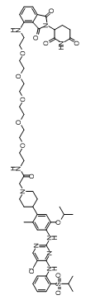
MS4077 is a potent PROTAC degrader of anaplastic lymphoma kinase (ALK) with a Kd of 37 nM for binding affinity to ALK. MS4077 and MS4078 potently decreased cellular levels of oncogenic active ALK fusion proteins in a concentration- and time-dependent manner in SU-DHL-1 lymphoma and NCI-H2228 lung cancer cells. The ALK protein degradation induced by compounds 5 and 6 was cereblon and proteasome dependent. In addition, MS4077 and MS4078 potently inhibited proliferation of SU-DHL-1 cells. Furthermore, compound 6 displayed good plasma exposure in a mouse pharmacokinetic study, thus is suitable for in vivo efficacy studies. This study paved the way for developing the next generation of ALK PROTACs.
Physicochemical Properties
| Molecular Formula | C55H72CLN9O13S |
| Molecular Weight | 1134.73 |
| Exact Mass | 1133.465 |
| CAS # | 2230077-10-6 |
| PubChem CID | 137628669 |
| Appearance | Yellow to green solid powder |
| LogP | 5.9 |
| Hydrogen Bond Donor Count | 5 |
| Hydrogen Bond Acceptor Count | 19 |
| Rotatable Bond Count | 31 |
| Heavy Atom Count | 79 |
| Complexity | 2050 |
| Defined Atom Stereocenter Count | 0 |
| SMILES | N1(CC(NCCOCCOCCOCCOCCOCCNC2=CC=CC3=C2C(=O)N(C2CCC(=O)NC2=O)C3=O)=O)CCC(C2=CC(OC(C)C)=C(NC3=NC=C(Cl)C(NC4=CC=CC=C4S(C(C)C)(=O)=O)=N3)C=C2C)CC1 |
| InChi Key | VEKJQNCZEPLNJF-UHFFFAOYSA-N |
| InChi Code | InChI=1S/C55H72ClN9O13S/c1-35(2)78-46-32-40(37(5)31-44(46)61-55-59-33-41(56)51(63-55)60-42-10-6-7-12-47(42)79(71,72)36(3)4)38-15-19-64(20-16-38)34-49(67)58-18-22-74-24-26-76-28-30-77-29-27-75-25-23-73-21-17-57-43-11-8-9-39-50(43)54(70)65(53(39)69)45-13-14-48(66)62-52(45)68/h6-12,31-33,35-36,38,45,57H,13-30,34H2,1-5H3,(H,58,67)(H,62,66,68)(H2,59,60,61,63) |
| Chemical Name | 2-[4-[4-[[5-chloro-4-(2-propan-2-ylsulfonylanilino)pyrimidin-2-yl]amino]-2-methyl-5-propan-2-yloxyphenyl]piperidin-1-yl]-N-[2-[2-[2-[2-[2-[2-[[2-(2,6-dioxopiperidin-3-yl)-1,3-dioxoisoindol-4-yl]amino]ethoxy]ethoxy]ethoxy]ethoxy]ethoxy]ethyl]acetamide |
| Synonyms | MS-4078; MS4078; MS 4078 |
| HS Tariff Code | 2934.99.9001 |
| Storage |
Powder-20°C 3 years 4°C 2 years In solvent -80°C 6 months -20°C 1 month Note: Please store this product in a sealed and protected environment (e.g. under nitrogen), avoid exposure to moisture and light. |
| Shipping Condition | Room temperature (This product is stable at ambient temperature for a few days during ordinary shipping and time spent in Customs) |
Biological Activity
| ln Vitro | Suspension is effectively suspended by MS4077. The IC50 for SU-DHL-1 cell resuspension at a concentration of MS4077 (10-3-1 μM; 3 days) is 46 ± 4 nM. NCI-H2228 cells respond to MS4077 with a lower fat body mass (10-2-100.5 μM; 3 days) than SU-DHL-1 cells [1]. In SU-DHL-1 and NCI-H2228, MS4077 efficiently lowers the levels of ALK fusion protein and suppresses ALK autophosphorylation as well as downstream STAT3 phosphorylation-dependent way. After 16 hours of treatment, MS4077 decreased the levels of NPM-ALK protein in SU-DHL-1 cells, with a DC50 (50% phosphorylation) value of 3±1 nM. The phosphorylation of STAT3 Y705 and ALK Y1507 is inhibited at a rate greater than 90% at 100 nM. After 16 hours, MS4077 treatment decreased EML4-ALK protein levels in NCI-H2228 cells with a comparable DC50 of 34±9 nM. Assay for cell viability at a dose of 100 nM [1] |
| Cell Assay |
Cell Viability Assay[1] Cell Types: SU-DHL-1 and NCI-H2228 Cell Tested Concentrations: 10-3, 10-2.5, 10, NCI-H2228 cells diminished EML4-ALK protein by more than 90% level[1]. SU-DHL-1 cells were -2, 10-1.5, 10-1, 10-0.5 and 1 μM; NCI-H2228 cells were incubated at 10-2, 10-1.5, 10-1, 10-0.5, 1, 100.5 μM Incubation Duration: 3 days Experimental Results: Inhibits SU-DHL-1 cell proliferation (IC50=46 ± 4 nM). NCI-H2228 cells were less sensitive to proliferation than SU-DHL-1 cells. Western Blot Analysis[1] Cell Types: SU-DHL-1 and NCI-H2228 Cell Tested Concentrations: 1, 3, 10, 30 and 100 μM for SU-DHL-1 cells; 3, 10, 30, 100 μM for NCI-H2228 cells 60 and 100 μM Incubation Duration: 16 hrs (hours) Experimental Results: NPM-ALK protein levels were diminished in SU-DHL-1 cells with DC50 as high as 3 ± 1 nM. diminished EML4-ALK protein levels in NCI-H2228 cells with a similar DC50 of 34 ± 9 nM. |
| References |
[1]. Proteolysis Targeting Chimeras (PROTACs) of Anaplastic Lymphoma Kinase (ALK). Eur J Med Chem. 2018 May 10;151:304-314. |
Solubility Data
| Solubility (In Vitro) | DMSO : ~110 mg/mL (~96.94 mM) |
| Solubility (In Vivo) |
Solubility in Formulation 1: 6 mg/mL (5.29 mM) in 10% DMSO + 40% PEG300 + 5% Tween80 + 45% Saline (add these co-solvents sequentially from left to right, and one by one), suspension solution; with sonication. For example, if 1 mL of working solution is to be prepared, you can add 100 μL of 60.0 mg/mL clear DMSO stock solution to 400 μL PEG300 and mix evenly; then add 50 μL Tween-80 to the above solution and mix evenly; then add 450 μL normal saline to adjust the volume to 1 mL. Preparation of saline: Dissolve 0.9 g of sodium chloride in 100 mL ddH₂ O to obtain a clear solution. Solubility in Formulation 2: ≥ 6 mg/mL (5.29 mM) (saturation unknown) in 10% DMSO + 90% (20% SBE-β-CD in Saline) (add these co-solvents sequentially from left to right, and one by one), clear solution. For example, if 1 mL of working solution is to be prepared, you can add 100 μL of 60.0 mg/mL clear DMSO stock solution to 900 μL of 20% SBE-β-CD physiological saline solution and mix evenly. Preparation of 20% SBE-β-CD in Saline (4°C,1 week): Dissolve 2 g SBE-β-CD in 10 mL saline to obtain a clear solution. (Please use freshly prepared in vivo formulations for optimal results.) |
| Preparing Stock Solutions | 1 mg | 5 mg | 10 mg | |
| 1 mM | 0.8813 mL | 4.4063 mL | 8.8127 mL | |
| 5 mM | 0.1763 mL | 0.8813 mL | 1.7625 mL | |
| 10 mM | 0.0881 mL | 0.4406 mL | 0.8813 mL |