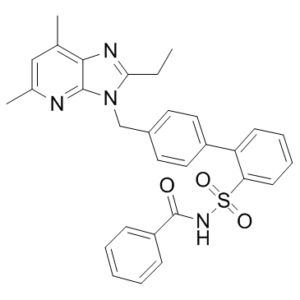
MK-996 is a novel, potent, orally bioactive, highly selective, nonpeptide angiotensin II (AII) receptor antagonist with anti-hypertensive activity. MK-996 prevents the pressor response to intravenous AII in the conscious rat, dog, and rhesus monkey (ED50, mg/kg; oral/intravenous = 0.067/0.014, 0.035/0.017, and 0.1/0.036, respectively). In the anesthetized chimpanzee, MK-996 (1 mg/kg, iv) produces 100% (peak) inhibition of the AII pressor response and is still active (52%) at 24 h. To our knowledge this pharmacologic profile in the rat, dog, rhesus monkey, and chimpanzee presents the least species variability of any AII receptor antagonist yet described. Responses to methoxamine and arginine vasopressin are not affected by MK-996. In aortic coarcted (high renin) rats, MK-996 (3 mg/kg, by mouth) reduces blood pressure to normotensive (< 120 mm Hg) levels without reflex tachycardia. This dose of MK-996 reduces blood pressure to approximately the same level as both losartan (3 mg/kg, by mouth) and enalapril (3 mg/kg, by mouth) in this model. The duration of antihypertensive activity of MK-996 is similar to enalapril and shorter than losartan at the doses tested. Additionally, in the rat MK-996 does not potentiate the vasodepressor response to bradykinin and completely prevents the ability of AII to stimulate an increase in plasma levels of aldosterone. Therefore, MK-996 is a potent, orally active, nonpeptide AII receptor antagonist with a long duration of action, little species variability, and anti-hypertensive activity.
Physicochemical Properties
| Molecular Formula | C30H28N4O3S |
| Molecular Weight | 524.63332 |
| Exact Mass | 524.188 |
| CAS # | 157263-00-8 |
| PubChem CID | 133031 |
| Appearance | Typically exists as solid at room temperature |
| Density | 1.27g/cm3 |
| Index of Refraction | 1.654 |
| LogP | 7.1 |
| Hydrogen Bond Donor Count | 1 |
| Hydrogen Bond Acceptor Count | 5 |
| Rotatable Bond Count | 7 |
| Heavy Atom Count | 38 |
| Complexity | 894 |
| Defined Atom Stereocenter Count | 0 |
| SMILES | O=C(NS(=O)(C1=CC=CC=C1C2=CC=C(CN3C(CC)=NC4=C(C)C=C(C)N=C43)C=C2)=O)C5=CC=CC=C5 |
| InChi Key | LIUNMFCWFYFUGQ-UHFFFAOYSA-N |
| InChi Code | InChI=1S/C30H28N4O3S/c1-4-27-32-28-20(2)18-21(3)31-29(28)34(27)19-22-14-16-23(17-15-22)25-12-8-9-13-26(25)38(36,37)33-30(35)24-10-6-5-7-11-24/h5-18H,4,19H2,1-3H3,(H,33,35) |
| Chemical Name | N-((4'-((2-ethyl-5,7-dimethyl-3H-imidazo[4,5-b]pyridin-3-yl)methyl)-[1,1'-biphenyl]-2-yl)sulfonyl)benzamide |
| Synonyms | L-159282; L 159282; L159282; MK996; MK 996; MK-996 |
| HS Tariff Code | 2934.99.9001 |
| Storage |
Powder-20°C 3 years 4°C 2 years In solvent -80°C 6 months -20°C 1 month |
| Shipping Condition | Room temperature (This product is stable at ambient temperature for a few days during ordinary shipping and time spent in Customs) |
Biological Activity
| ln Vivo | L-159282 (1 mg/kg, i.v.) completely inhibited the AII pressor response in chimpanzees under anesthesia, and it was still active (52%) after 24 hours. L-159282 (3 mg/kg, p.o.) brought blood pressure in rats suffering from coarctation of the aorta (hyperrenin) down to normotensive levels (< 120 mm Hg) without causing reflex tachycardia. This dose of L-159282 in this model brought blood pressure down to a level that was comparable to that of enalapril (3 mg/kg, po) and losartan (3 mg/kg, po) [1]. |
| References |
[1]. In vivo pharmacology of a novel AT1 selective angiotensin II receptor antagonist, MK-996. Am J Hypertens. 1995 Jan;8(1):58-66. |
Solubility Data
| Solubility (In Vitro) | May dissolve in DMSO (in most cases), if not, try other solvents such as H2O, Ethanol, or DMF with a minute amount of products to avoid loss of samples |
| Solubility (In Vivo) |
Note: Listed below are some common formulations that may be used to formulate products with low water solubility (e.g. < 1 mg/mL), you may test these formulations using a minute amount of products to avoid loss of samples. Injection Formulations (e.g. IP/IV/IM/SC) Injection Formulation 1: DMSO : Tween 80: Saline = 10 : 5 : 85 (i.e. 100 μL DMSO stock solution → 50 μL Tween 80 → 850 μL Saline) *Preparation of saline: Dissolve 0.9 g of sodium chloride in 100 mL ddH ₂ O to obtain a clear solution. Injection Formulation 2: DMSO : PEG300 :Tween 80 : Saline = 10 : 40 : 5 : 45 (i.e. 100 μL DMSO → 400 μLPEG300 → 50 μL Tween 80 → 450 μL Saline) Injection Formulation 3: DMSO : Corn oil = 10 : 90 (i.e. 100 μL DMSO → 900 μL Corn oil) Example: Take the Injection Formulation 3 (DMSO : Corn oil = 10 : 90) as an example, if 1 mL of 2.5 mg/mL working solution is to be prepared, you can take 100 μL 25 mg/mL DMSO stock solution and add to 900 μL corn oil, mix well to obtain a clear or suspension solution (2.5 mg/mL, ready for use in animals). Injection Formulation 4: DMSO : 20% SBE-β-CD in saline = 10 : 90 [i.e. 100 μL DMSO → 900 μL (20% SBE-β-CD in saline)] *Preparation of 20% SBE-β-CD in Saline (4°C,1 week): Dissolve 2 g SBE-β-CD in 10 mL saline to obtain a clear solution. Injection Formulation 5: 2-Hydroxypropyl-β-cyclodextrin : Saline = 50 : 50 (i.e. 500 μL 2-Hydroxypropyl-β-cyclodextrin → 500 μL Saline) Injection Formulation 6: DMSO : PEG300 : castor oil : Saline = 5 : 10 : 20 : 65 (i.e. 50 μL DMSO → 100 μLPEG300 → 200 μL castor oil → 650 μL Saline) Injection Formulation 7: Ethanol : Cremophor : Saline = 10: 10 : 80 (i.e. 100 μL Ethanol → 100 μL Cremophor → 800 μL Saline) Injection Formulation 8: Dissolve in Cremophor/Ethanol (50 : 50), then diluted by Saline Injection Formulation 9: EtOH : Corn oil = 10 : 90 (i.e. 100 μL EtOH → 900 μL Corn oil) Injection Formulation 10: EtOH : PEG300:Tween 80 : Saline = 10 : 40 : 5 : 45 (i.e. 100 μL EtOH → 400 μLPEG300 → 50 μL Tween 80 → 450 μL Saline) Oral Formulations Oral Formulation 1: Suspend in 0.5% CMC Na (carboxymethylcellulose sodium) Oral Formulation 2: Suspend in 0.5% Carboxymethyl cellulose Example: Take the Oral Formulation 1 (Suspend in 0.5% CMC Na) as an example, if 100 mL of 2.5 mg/mL working solution is to be prepared, you can first prepare 0.5% CMC Na solution by measuring 0.5 g CMC Na and dissolve it in 100 mL ddH2O to obtain a clear solution; then add 250 mg of the product to 100 mL 0.5% CMC Na solution, to make the suspension solution (2.5 mg/mL, ready for use in animals). Oral Formulation 3: Dissolved in PEG400 Oral Formulation 4: Suspend in 0.2% Carboxymethyl cellulose Oral Formulation 5: Dissolve in 0.25% Tween 80 and 0.5% Carboxymethyl cellulose Oral Formulation 6: Mixing with food powders Note: Please be aware that the above formulations are for reference only. InvivoChem strongly recommends customers to read literature methods/protocols carefully before determining which formulation you should use for in vivo studies, as different compounds have different solubility properties and have to be formulated differently. (Please use freshly prepared in vivo formulations for optimal results.) |
| Preparing Stock Solutions | 1 mg | 5 mg | 10 mg | |
| 1 mM | 1.9061 mL | 9.5305 mL | 19.0611 mL | |
| 5 mM | 0.3812 mL | 1.9061 mL | 3.8122 mL | |
| 10 mM | 0.1906 mL | 0.9531 mL | 1.9061 mL |