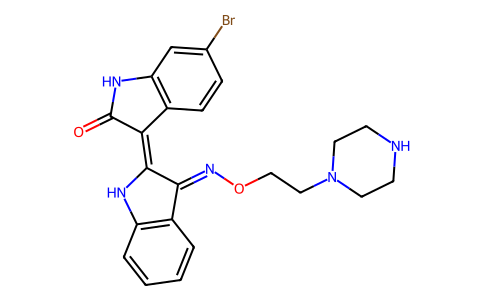
Physicochemical Properties
| Exact Mass | 467.095 |
| Elemental Analysis | C, 56.42; H, 4.73; Br, 17.06; N, 14.95; O, 6.83 |
| CAS # | 1067884-45-0 |
| Related CAS # | 1067884-45-0;1067884-56-3 (HCl); |
| PubChem CID | 135897898 |
| Appearance | Typically exists as solid at room temperature |
| LogP | 3.4 |
| Hydrogen Bond Donor Count | 3 |
| Hydrogen Bond Acceptor Count | 6 |
| Rotatable Bond Count | 5 |
| Heavy Atom Count | 30 |
| Complexity | 668 |
| Defined Atom Stereocenter Count | 0 |
| SMILES | N1C2=C(C=CC(Br)=C2)/C(=C2\C(=N\OCCN3CCNCC3)\C3=C(N\2)C=CC=C3)/C1=O |
| InChi Key | MQNSXNHCCSXFML-NHFJDJAPSA-N |
| InChi Code | InChI=1S/C22H22BrN5O2/c23-14-5-6-15-18(13-14)26-22(29)19(15)21-20(16-3-1-2-4-17(16)25-21)27-30-12-11-28-9-7-24-8-10-28/h1-6,13,24,26,29H,7-12H2/b27-20+ |
| Chemical Name | 6-bromo-3-[(3E)-3-(2-piperazin-1-ylethoxyimino)indol-2-yl]-1H-indol-2-ol |
| Synonyms | SCHEMBL26004568; MLS-2384; MLS2384; 6-bromo-3-[(3E)-3-(2-piperazin-1-ylethoxyimino)indol-2-yl]-1H-indol-2-ol; 1067884-45-0 |
| HS Tariff Code | 2934.99.9001 |
| Storage |
Powder-20°C 3 years 4°C 2 years In solvent -80°C 6 months -20°C 1 month |
| Shipping Condition | Room temperature (This product is stable at ambient temperature for a few days during ordinary shipping and time spent in Customs) |
Biological Activity
| Targets | JAK/Src kinase |
| ln Vitro | Janus kinase (JAK) and Src kinase are the two major tyrosine kinase families upstream of signal transducer and activator of transcription (STAT). Among the seven STAT family proteins, STAT3 is constitutively activated in many diverse cancers. Upon activation, JAK and Src kinases phosphorylate STAT3, and thereby promote cell growth and survival. MLS-2384 is a novel 6-bromoindirubin derivative with a bromo-group at the 6-position on one indole ring and a hydrophilic group at the 3'-position on the other indole ring. In this study, we investigated the kinase inhibitory activity and anticancer activity of MLS-2384. Our data from in vitro kinase assays, cell viability analyses, western blotting analyses, and animal model studies, demonstrate that MLS-2384 is a dual JAK/Src kinase inhibitor, and suppresses growth of various human cancer cells, such as prostate, breast, skin, ovarian, lung, and liver. Consistent with the inactivation of JAK and Src kinases, phosphorylation of STAT3 was inhibited in a dose-dependent manner in the cancer cells treated with MLS-2384. STAT3 downstream proteins involved in cell proliferation and survival, such as c-Myc and Mcl-1, are downregulated by MLS-2384 in prostate cancer cells, whereas survivin is downregulated in A2058 cells. In these two cancer cell lines, PARP is cleaved, indicating that MLS-2384 induces apoptosis in human melanoma and prostate cancer cells [1]. |
| ln Vivo |
MLS-2384 demonstrates low toxicity in normal human cells and normal mice [1] MLS-2384 inhibits approximately 50% viability of cancer cells at a concentration of 2.5 µmol/L (Fig. 2). We further tested MLS-2384 in normal human dermal fibroblast (NHDF) cells and normal mice. As shown in Figure 4A, NHDF cell viability was stable to treatments from 1 up to 20 µmol/L for 24 and 48 h, indicating low toxicity of MLS-2384 in normal human cells. We also investigated toxicity of MLS-2384 in BALB/c normal mice (Fig. 4B). BALB/c mice were treated with vehicle and MLS-2384 at doses of 25, 50, and 100 mg/kg once daily through oral gavage for 7 d. Mouse body weight was measured every day. As shown in Figure 4B, there was no weight loss in the treated mice, suggesting low toxicity of MLS-2384 in normal mice. MLS-2384 demonstrates anticancer activity in a mouse xenograft model of human melanoma [1] The low toxicity of MLS-2384 in normal human cells and normal mice supported in vivo study of MLS-2384 for anticancer activity. We tested the anticancer activity of MLS-2384 in vivo by using a human melanoma A2058 xenograft mouse model. A dose of 25 mg/kg of MLS-2384 was administrated by oral gavage and twice daily for 18 d in a NSG mouse xenograft model. As shown in Figure 5A, the tumor growth was significantly suppressed. No side effects were observed in the MLS-2384-treated mice. As shown in Figure 5B, mouse body weight remained stable. These findings show the antitumor activity of MLS-2384 in vivo against human melanoma cells in a mouse xenograft model with low toxicity. |
| Enzyme Assay |
In vitro kinase assay [1] Recombinant JAK family (JAK1, JAK2, TYK2) and Src proteins, substrates, and 33P-labeled ATP were used for the in vitro kinase assays. The recombinant protein catalytic domains were tagged with glutathione S-transferase (GST) and purified from insect cells. The substrate is pEY (mg/ml, Glu;Tyr = 4:1, molecular weight = 5000–20 000) for c-Src and JAK family kinases. The substrate was prepared in freshly constituted Base Reaction Buffer (comprising 20 mmol/L HEPES, pH 7.5; 10 mmol/L MgCl2; 1 mmol/L EGTA; 0.02% BRIJ-35; 0.02 mg/ml BSA; 0.1 mmol/L Na3VO4; 2 mmol/L dithiothreitol [DTT]; and 1% DMSO). Then, required cofactors and kinase were added into the substrate solution. MLS-2384 in DMSO was delivered into the kinase reaction mixture, and then 33P-labeled ATP (specific activity: 0.01 μCi/μl final) was added into the reaction mixture to initiate the reaction. The kinase reaction mixture was incubated for 120 min at room temperature. Reactions were spotted onto P81 ion-exchange paper for measurement of radioactivity. |
| Cell Assay |
Cell viability analysis [1] Human cancer cells were seeded at 12-well plates with 25 000 cells per well. After 24-h incubation, cells were treated with MLS-2384 or DMSO as the vehicle control for 24 h. Dead cells were removed by washing with PBS buffer solution. Then viable cells were collected by trypsinization. Viable cells were counted by Vi-CELLTM XR Cell Viability Analyzer. The values of cell viability were calculated as percentages of viable cell numbers from bromoindirubin-treated cells to viable cell numbers from the DMSO-treated cells. MTS cell proliferation assay [1] MTS reagent (CellTiter 96 AQueousOne Solution Cell proliferation Assay) was purchased from Promega. According to the manufacturer’s instruction, human cancer cells were seeded at 96-well plates with 5000 cells per well. After 24 h incubation, cells were treated with MLS-2384 or DMSO as vehicle control for 24 or 48 h. MTS reagent was added to the cell culture medium and absorbance was measured at 490 nm within 4 h by using a micro-plate reader. The values of cell viability were calculated as percentages of absorbance from treated samples to absorbance from the vehicle control. Western blot analysis [1] Cells were treated with DMSO or MLS-2384. After treatment, cell lysates were prepared in radioimmunoprecipitation assay (RIPA) buffer supplemented with inhibitors of proteases and sodium orthovanadate, an inhibitor of phosphotases. Protein concentrations were determined by BioMate Spectrometer (Thermo) and protein assay. A sample of 40 µg or 20 µg of each protein was resolved in 8% or between 8% and 16% gradient SDS-PAGE gels. After gel electrophoresis, proteins were transferred to Hybond-C membranes. The membranes were blocked in 5% nonfat milk in PBS containing 0.1% Tween 20 (Polysorbate 20; PBST) at room temperature for 1 to 3 h followed by an overnight incubation at 4 °C with primary antibodies in PBST containing 5% nonfat milk. The membranes were then washed with PBST and incubated with HRP-conjugated secondary antibody in 5% nonfat milk/PBST solution for 1 to 3 h at room temperature, or overnight at 4 °C. |
| Animal Protocol |
In vivo therapeutic efficacy [1] BALB/c mice (6–8 weeks old) were purchased from the National Cancer Institute for toxicity study. Immunodeficient NOD/SCID/IL2Rgamma null (NSG) mice (female; 6–8 weeks old) were purchased from The Jackson Laboratory for use as the xenograft model. A2058 human melanoma cells at a density of 2.5 × 10⁶ cells in 0.1 mL serum-free medium were inoculated subcutaneously into the dorsal area of NSG mice to create the xenograft model. MLS-2384 was freshly prepared in vehicle, 30% Soluto. When tumors became palpable, MLS-2384 or vehicle control was administered via oral gavage twice daily at a dose of 25 mg/kg body weight. Tumor growth was monitored every other day. Tumor volumes and mouse body weights were measured every 3 or 4 d. Tumor volumes were calculated by the formula: 0.5 × (larger diameter) × (small diameter)2. |
| References | [1]. MLS-2384, a new 6-bromoindirubin derivative with dual JAK/Src kinase inhibitory activity, suppresses growth of diverse cancer cells. Cancer Biol Ther . 2014 Feb;15(2):178-84. |
| Additional Infomation |
In previous studies, we showed that 6BIO, a 6-bromoindirubin derivative, targeted JAK/STAT3 signaling as a pan-JAK inhibitor, as well as targeting CDKs and GSK-3. We also demonstrated that a 7-bromoindirubin derivative, MLS-2438, targeted Src/STAT3 signaling as a Src inhibitor. 6BIO and MLS-2438 are different in substitution groups and positions. In an indirubin molecule, 6BIO has a bromo-group at the 6-position, whereas MLS-2438 has a bromo-group at the 7-position. In addition, MLS-2438 and 6BIO have different hydrophilic groups at the 3′-position. The compound in this study, MLS-2384, is a new 6-bromoindirubin derivative. It has a bromo-group at the 6-position same as 6BIO, and the same hydrophilic group at the 3′-position as MLS-2438. Based on the structural features and kinase inhibitory profiles of these compounds, we proposed that MLS-2384 may be a dual JAK/Src inhibitor and more potent in suppression of cancer cell growth. Our data have provided multiple lines of evidence to support that MLS-2384 is a dual JAK/Src inhibitor and suppresses growth of diverse human cancer cells effectively, both in vitro and in vivo. These findings suggest that substitutions and their positions on the indirubin molecule may modify the molecular binding affinity to different targets. In this study, the bromine substitution at the 6-position of indirubin molecule is important for molecular binding affinity to a target such as JAK, and the hydrophilic group at the 3′-position is important for binding a molecular target such as Src.
STAT3 has a central role in tumor cell growth and survival in many various cancer cells, and thereby, we focused on JAK and Src kinases because they are the two major tyrosine kinases upstream of STAT3. Indirubin and its derivatives have been documented as inhibitors of kinases such as CDK and GSK-3β. Here, we demonstrate that MLS-2384 is a dual JAK/Src inhibitor in multiple human cancer cell lines. However, we cannot exclude other molecular targets of MLS-2384 involved in cancer cells. MLS-2384 displays anticancer activity as a dual JAK/Src inhibitor in various cancer cells. Previously we reported molecular targets and anticancer activities in human melanoma cell lines for two other bromoindirubin derivatives, 6BIO and MLS-2438. In this study, we have extended our investigation of anticancer activities in diverse human cancer cell lines for this new 6-bromoindiribin derivative, MLS-2384. We have found that MLS-2384 effectively suppresses growth of multiple human cancer cells such as prostate, breast, skin, ovarian, lung, and liver, at a concentration of 2.5 µmol/L in cell culture medium. JAK has been reported for its compensatory effect in response to a Src inhibitor in cancer cells. When the cancer cells were treated with a Src inhibitor, phosphorylation of Src was decreased, but phosphorylation of JAK2 was maintained to compensate the inhibition of Src. Therefore, phosphorylation of STAT3 was less effectively inhibited by the treatment of a Src inhibitor alone. In this study, we present a dual JAK/Src inhibitor, MLS-2384 with potent anticancer activity in diverse cancer cell lines and in a mouse xenograft model. It may be more effective than a JAK or Src inhibitor to inhibit STAT3 signaling pathway in cancer cells. Furthermore, MLS-2384 is promising to be combined with other inhibitors to inhibit multiple cell signaling pathways, or combined with chemotherapeutics to overcome drug resistance. Thus, MLS-2384 is promising for development as a novel therapeutic agent targeting JAK/Src and STAT3 signaling in various human cancers. Future studies will be directed toward in vivo pre-clinical evaluation of MLS-2384 [1]. |
Solubility Data
| Solubility (In Vitro) | May dissolve in DMSO (in most cases), if not, try other solvents such as H2O, Ethanol, or DMF with a minute amount of products to avoid loss of samples |
| Solubility (In Vivo) |
Note: Listed below are some common formulations that may be used to formulate products with low water solubility (e.g. < 1 mg/mL), you may test these formulations using a minute amount of products to avoid loss of samples. Injection Formulations (e.g. IP/IV/IM/SC) Injection Formulation 1: DMSO : Tween 80: Saline = 10 : 5 : 85 (i.e. 100 μL DMSO stock solution → 50 μL Tween 80 → 850 μL Saline) *Preparation of saline: Dissolve 0.9 g of sodium chloride in 100 mL ddH ₂ O to obtain a clear solution. Injection Formulation 2: DMSO : PEG300 :Tween 80 : Saline = 10 : 40 : 5 : 45 (i.e. 100 μL DMSO → 400 μLPEG300 → 50 μL Tween 80 → 450 μL Saline) Injection Formulation 3: DMSO : Corn oil = 10 : 90 (i.e. 100 μL DMSO → 900 μL Corn oil) Example: Take the Injection Formulation 3 (DMSO : Corn oil = 10 : 90) as an example, if 1 mL of 2.5 mg/mL working solution is to be prepared, you can take 100 μL 25 mg/mL DMSO stock solution and add to 900 μL corn oil, mix well to obtain a clear or suspension solution (2.5 mg/mL, ready for use in animals). Injection Formulation 4: DMSO : 20% SBE-β-CD in saline = 10 : 90 [i.e. 100 μL DMSO → 900 μL (20% SBE-β-CD in saline)] *Preparation of 20% SBE-β-CD in Saline (4°C,1 week): Dissolve 2 g SBE-β-CD in 10 mL saline to obtain a clear solution. Injection Formulation 5: 2-Hydroxypropyl-β-cyclodextrin : Saline = 50 : 50 (i.e. 500 μL 2-Hydroxypropyl-β-cyclodextrin → 500 μL Saline) Injection Formulation 6: DMSO : PEG300 : castor oil : Saline = 5 : 10 : 20 : 65 (i.e. 50 μL DMSO → 100 μLPEG300 → 200 μL castor oil → 650 μL Saline) Injection Formulation 7: Ethanol : Cremophor : Saline = 10: 10 : 80 (i.e. 100 μL Ethanol → 100 μL Cremophor → 800 μL Saline) Injection Formulation 8: Dissolve in Cremophor/Ethanol (50 : 50), then diluted by Saline Injection Formulation 9: EtOH : Corn oil = 10 : 90 (i.e. 100 μL EtOH → 900 μL Corn oil) Injection Formulation 10: EtOH : PEG300:Tween 80 : Saline = 10 : 40 : 5 : 45 (i.e. 100 μL EtOH → 400 μLPEG300 → 50 μL Tween 80 → 450 μL Saline) Oral Formulations Oral Formulation 1: Suspend in 0.5% CMC Na (carboxymethylcellulose sodium) Oral Formulation 2: Suspend in 0.5% Carboxymethyl cellulose Example: Take the Oral Formulation 1 (Suspend in 0.5% CMC Na) as an example, if 100 mL of 2.5 mg/mL working solution is to be prepared, you can first prepare 0.5% CMC Na solution by measuring 0.5 g CMC Na and dissolve it in 100 mL ddH2O to obtain a clear solution; then add 250 mg of the product to 100 mL 0.5% CMC Na solution, to make the suspension solution (2.5 mg/mL, ready for use in animals). Oral Formulation 3: Dissolved in PEG400 Oral Formulation 4: Suspend in 0.2% Carboxymethyl cellulose Oral Formulation 5: Dissolve in 0.25% Tween 80 and 0.5% Carboxymethyl cellulose Oral Formulation 6: Mixing with food powders Note: Please be aware that the above formulations are for reference only. InvivoChem strongly recommends customers to read literature methods/protocols carefully before determining which formulation you should use for in vivo studies, as different compounds have different solubility properties and have to be formulated differently. (Please use freshly prepared in vivo formulations for optimal results.) |