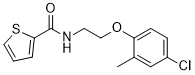
ML402 (ML-402) is a potent and selective activator of TREK-1/-2 and an agonist for OPRM1-OPRD1 (OPRM1: opioid receptor mu 1; OPRD1: delta opioid receptor) heterdimerization. ML402 selectively activates OPRM1-OPRD1 heterodimerization which may have potential use in the treatment of pain and alleviate unwanted effects associated with opiate use. ML402-define a cryptic binding pocket unlike other ion channel small-molecule binding sites and, together with functional studies, identify a cation-π interaction that controls selectivity. Together, our data reveal a druggable K2P site that stabilizes the C-type gate 'leak mode' and provide direct evidence for K2P selectivity filter gating.Heteromerization of OPRM1 with OPRD1 leads to the modulation of receptor binding and signaling properties. It has further been shown that the selective activation of the OPRM1-OPRD1 heteromer by a combination of OPRM1 agonist with OPRD1 antagonist can be blocked by antibodies that selectively recognize the heteromer.
Physicochemical Properties
| Molecular Formula | C14H14CLNO2S | |
| Molecular Weight | 295.784461498261 | |
| Exact Mass | 295.043 | |
| CAS # | 298684-44-3 | |
| Related CAS # |
|
|
| PubChem CID | 592973 | |
| Appearance | White to off-white solid powder | |
| LogP | 3.9 | |
| Hydrogen Bond Donor Count | 1 | |
| Hydrogen Bond Acceptor Count | 3 | |
| Rotatable Bond Count | 5 | |
| Heavy Atom Count | 19 | |
| Complexity | 303 | |
| Defined Atom Stereocenter Count | 0 | |
| SMILES | C1(C(NCCOC2=CC=C(Cl)C=C2C)=O)SC=CC=1 |
|
| InChi Key | RULQUKFOBAPKKR-UHFFFAOYSA-N | |
| InChi Code | InChI=1S/C14H14ClNO2S/c1-10-9-11(15)4-5-12(10)18-7-6-16-14(17)13-3-2-8-19-13/h2-5,8-9H,6-7H2,1H3,(H,16,17) | |
| Chemical Name |
|
|
| Synonyms |
|
|
| HS Tariff Code | 2934.99.9001 | |
| Storage |
Powder-20°C 3 years 4°C 2 years In solvent -80°C 6 months -20°C 1 month |
|
| Shipping Condition | Room temperature (This product is stable at ambient temperature for a few days during ordinary shipping and time spent in Customs) |
Biological Activity
| Targets | ML335 and ML402 activate K2P2.1 and K2P10.1 but not K2P4.1, according to two-electrode voltage-clamp studies on Xenopus oocytes (14.3±2.7 μM, K2P2.1-ML335; 13.7±7.0 μM, K2P2.1-ML402; 5.2±0.5 μM, K2P10.1-ML335; and 5.9±1.6 μM, K2P10.1-ML402). K2P2.1 Lys271, which is likewise a lysine in K2P10.1 but a glutamine in K2P4.1, is the only variation between TREK subfamily members at the cation-π interaction site in the K2P modulator pocket. When the Lys271 equivalent is switched between K2P2.1 and K2P4.1, ML335 and M402 activation exhibit a pronounced phenotypic reversal. K2P4.1 (Q258K) responds to both ML402 and ML335 with a smaller magnitude response than K2P2.1[1], but with an EC50 that is similar to K2P2.1 (14.3±2.7 μM, K2P2.1-ML335; 16.2±3.0 μM, K2P4.1(Q258K)-ML335; 13.7±7.0 μM, K2P2.1-ML402; 13.6±1.5 μM, K2P4.1 (Q258K)-ML402)[1]. |
| ln Vitro |
ML335 and ML402 activate K2P2.1 and K2P10.1 but not K2P4.1, according to two-electrode voltage-clamp studies on Xenopus oocytes (14.3±2.7 μM, K2P2.1-ML335; 13.7±7.0 μM, K2P2.1-ML402; 5.2±0.5 μM, K2P10.1-ML335; and 5.9±1.6 μM, K2P10.1-ML402). K2P2.1 Lys271, which is likewise a lysine in K2P10.1 but a glutamine in K2P4.1, is the only variation between TREK subfamily members at the cation-π interaction site in the K2P modulator pocket. When the Lys271 equivalent is switched between K2P2.1 and K2P4.1, ML335 and M402 activation exhibit a pronounced phenotypic reversal. K2P4.1 (Q258K) responds to both ML402 and ML335 with a smaller magnitude response than K2P2.1[1], but with an EC50 that is similar to K2P2.1 (14.3±2.7 μM, K2P2.1-ML335; 16.2±3.0 μM, K2P4.1(Q258K)-ML335; 13.7±7.0 μM, K2P2.1-ML402; 13.6±1.5 μM, K2P4.1 (Q258K)-ML402)[1]. ML402 activates K2P2.1 (TREK-1) channels expressed in Xenopus laevis oocytes, shifting the current-voltage relationship. The activation is concentration-dependent with an EC50 of 13.7 ± 7.0 μM. ML402 also activates K2P10.1 (TREK-2) channels expressed in Xenopus oocytes with an EC50 of 5.9 ± 1.6 μM, but shows no effect on K2P4.1 (TRAAK) channels. In inside-out patches from HEK293 cells expressing K2P2.1 (TREK-1), ML402 (5 μM) eliminates outward rectification induced by asymmetric K+/Rb+ conditions, shifting the channel to an ohmic "leak mode", indicative of direct activation of the selectivity filter C-type gate. The EC50 in this cellular system is 5.9 ± 1.6 μM. The selectivity of ML402 between TREK subfamily (TREK-1, TREK-2) and TRAAK is determined by a single lysine residue (Lys271 in TREK-1). Mutation of this lysine to glutamine (K271Q) in TREK-1 abolishes ML402 sensitivity, while introducing a lysine at the equivalent position in TRAAK (Q258K) confers sensitivity to ML402 with an EC50 similar to wild-type TREK-1. The activation effect of ML402 is specific and not observed with its structural analog where the aromatic upper ring is replaced with an aliphatic ring, highlighting the importance of the cation-π interaction for activity. The effects of other TREK activators like arachidonic acid, BL-1249, and ML67-33 are unchanged in the Lys271 mutant, indicating a distinct mechanism for ML402. [1] |
| ln Vivo |
|
| Cell Assay |
Two-electrode voltage clamp (TEVC) in Xenopus oocytes: Defolliculated stage V-VI Xenopus laevis oocytes were injected with 0.15–5 ng of cRNA encoding the K2P channel of interest. After 24–48 hours, oocytes were impaled with recording electrodes filled with 3M KCl. Currents were recorded in a perfusion solution while held at -80 mV and evoked by a voltage ramp protocol. ML402 was dissolved in DMSO and serially diluted in recording buffer for dose-response experiments. Currents were measured and analyzed to determine activation potency (EC50). Whole-cell patch-clamp in HEK293 cells: HEK 293T cells were transfected with plasmids encoding K2P2.1 (TREK-1). 24 hours post-transfection, whole-cell patch-clamp recordings were performed. The effect of ML402 on current at 0 mV was measured. Cells were perfused with ML402 until a stable potentiation was reached. Currents were elicited by voltage ramps. Inside-out patch-clamp in HEK293 cells: Excised inside-out patches from transfected HEK293 cells were used to study voltage-dependent activation under conditions that promote C-type gate-dependent rectification (150 mM extracellular K+, 150 mM intracellular Rb+). Currents were elicited by voltage steps in the absence and presence of 5 μM ML402. Rectification coefficients were calculated to assess the shift to leak mode. [1] |
| Animal Protocol |
|
| References |
[1]. K2P2.1 (TREK-1)-activator complexes reveal a cryptic selectivity filter binding site. Nature. 2017 Jul 20;547(7663):364-368. |
| Additional Infomation |
ML402 (N-[2-(4-chloro-2-methylphenoxy)ethyl]thiophene-2-carboxamide) is a thiophene-carboxamide compound identified as a selective activator of TREK subfamily two-pore domain potassium (K2P) channels. It binds to a novel "K2P modulator pocket" located behind the channel's selectivity filter, at the interface between the P1 pore helix and the M4 transmembrane helix. This site is distinct from known antagonist binding sites. The compound acts as a "molecular wedge", stabilizing the interface and reducing the dynamics of key residues (Phe134, Lys271, Trp275). This stabilization directly activates the channel's principal gate, the selectivity filter C-type gate, leading to a leak conductance mode. The selectivity for TREK-1/TREK-2 over TRAAK is governed by a cation-π interaction between the compound's aromatic upper ring and a lysine residue (Lys271 in TREK-1) in the binding pocket. This study presents the structural basis for a new class of direct C-type gate activators and identifies a cryptic, druggable site for modulating K2P channel function. [1] |
Solubility Data
| Solubility (In Vitro) |
|
|||
| Solubility (In Vivo) |
Solubility in Formulation 1: ≥ 2.5 mg/mL (8.45 mM) (saturation unknown) in 10% DMSO + 40% PEG300 + 5% Tween80 + 45% Saline (add these co-solvents sequentially from left to right, and one by one), clear solution. For example, if 1 mL of working solution is to be prepared, you can add 100 μL of 25.0 mg/mL clear DMSO stock solution to 400 μL PEG300 and mix evenly; then add 50 μL Tween-80 to the above solution and mix evenly; then add 450 μL normal saline to adjust the volume to 1 mL. Preparation of saline: Dissolve 0.9 g of sodium chloride in 100 mL ddH₂ O to obtain a clear solution. Solubility in Formulation 2: ≥ 2.5 mg/mL (8.45 mM) (saturation unknown) in 10% DMSO + 90% Corn Oil (add these co-solvents sequentially from left to right, and one by one), clear solution. For example, if 1 mL of working solution is to be prepared, you can add 100 μL of 25.0 mg/mL clear DMSO stock solution to 900 μL of corn oil and mix evenly. (Please use freshly prepared in vivo formulations for optimal results.) |
| Preparing Stock Solutions | 1 mg | 5 mg | 10 mg | |
| 1 mM | 3.3809 mL | 16.9045 mL | 33.8089 mL | |
| 5 mM | 0.6762 mL | 3.3809 mL | 6.7618 mL | |
| 10 mM | 0.3381 mL | 1.6904 mL | 3.3809 mL |