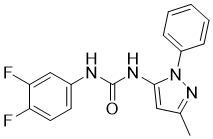
ML297 is a truly potent and selective GIRK channel agonist with IC50 values are 160, 887 and 914 nM for GIRK1/2, GIRK1/4 and GIRK1/3 respectively. ML297 exhibits no effect on GIRK2, GIRK2/3, Kir2.1 and Kv7.4 channels, and has minimal effect on a panel of other ion channels, receptors and transporters. The G-protein activated, inward-rectifying potassium (K(+)) channels, 'GIRKs', are a family of ion channels (Kir3.1-Kir3.4) that has been the focus of intense research interest for nearly two decades. GIRKs are comprised of various homo- and heterotetrameric combinations of four different subunits.ML297 is active in two in vivo models of epilepsy, a disease where up to 40% of patients remain with symptoms refractory to present treatments. The development of ML297 represents a truly significant advancement in our ability to selectively probe GIRK's role in physiology as well as providing the first tool for beginning to understand GIRK's potential as a target for a diversity of therapeutic indications such as epileptics.
Physicochemical Properties
| Molecular Formula | C17H14F2N4O | |
| Molecular Weight | 328.32 | |
| Exact Mass | 328.113 | |
| CAS # | 1443246-62-5 | |
| Related CAS # |
|
|
| PubChem CID | 56642816 | |
| Appearance | White to off-white solid powder | |
| Density | 1.3±0.1 g/cm3 | |
| Boiling Point | 377.8±42.0 °C at 760 mmHg | |
| Flash Point | 182.3±27.9 °C | |
| Vapour Pressure | 0.0±0.9 mmHg at 25°C | |
| Index of Refraction | 1.617 | |
| LogP | 4.73 | |
| Hydrogen Bond Donor Count | 2 | |
| Hydrogen Bond Acceptor Count | 4 | |
| Rotatable Bond Count | 3 | |
| Heavy Atom Count | 24 | |
| Complexity | 433 | |
| Defined Atom Stereocenter Count | 0 | |
| InChi Key | IEKSMUSSYJUQMY-UHFFFAOYSA-N | |
| InChi Code | InChI=1S/C17H14F2N4O/c1-11-9-16(23(22-11)13-5-3-2-4-6-13)21-17(24)20-12-7-8-14(18)15(19)10-12/h2-10H,1H3,(H2,20,21,24) | |
| Chemical Name |
|
|
| Synonyms |
|
|
| HS Tariff Code | 2934.99.9001 | |
| Storage |
Powder-20°C 3 years 4°C 2 years In solvent -80°C 6 months -20°C 1 month |
|
| Shipping Condition | Room temperature (This product is stable at ambient temperature for a few days during ordinary shipping and time spent in Customs) |
Biological Activity
| Targets | ML 297 has no effect whatsoever on GIRK2/3[1]. With an EC50 of 162 nM, ML297 exhibits concentration-dependent effectiveness in GIRK1/2-expressing cells [2]. It was demonstrated that ML297 is totally unable to alter the activity of HEK-293 cells that are only expressing GIRK2 and GIRKGIRK2/3 [2]. |
| ln Vitro |
ML 297 has no effect whatsoever on GIRK2/3[1]. With an EC50 of 162 nM, ML297 exhibits concentration-dependent effectiveness in GIRK1/2-expressing cells [2]. It was demonstrated that ML297 is totally unable to alter the activity of HEK-293 cells that are only expressing GIRK2 and GIRKGIRK2/3 [2]. ML297 was identified as a selective GIRK1/2 activator from a high-throughput screening campaign and subsequent chemical optimization. Its primary in vitro activity is the potent activation of GIRK1/2 channels, as measured by a thallium flux assay. [1] The compound demonstrates favorable drug metabolism and pharmacokinetics (DMPK) properties and is described as being centrally penetrant. [1] |
| ln Vivo |
ML297 (60 mg/kg; intraperitoneal injection) demonstrated a notable capacity to stop seizures and save lives while receiving PTZ therapy [2]. In an ascending dose study in mice (10, 30, 60 mg/kg, intraperitoneal injection), ML297 did not cause obvious distress at any dose tested. [2] Administration of ML297 (60 mg/kg, i.p.) produced an immediate decrease in home cage locomotor activity compared to vehicle-treated controls, as measured by the SmartCage system. [2] At the same dose (60 mg/kg, i.p.), ML297 caused only a modest (14%) and statistically insignificant decrease in performance on a rotarod test, suggesting its effects on locomotion were not primarily due to motor impairment. [2] In a maximal electroshock (MES) seizure model in mice, ML297 (60 mg/kg, i.p., administered 30 min prior to test) significantly increased the latency to seizure onset, with efficacy equivalent to sodium valproate (150 mg/kg). [2] In a pentylenetetrazol (PTZ)-induced seizure model, ML297 (60 mg/kg, i.p., administered 30 min prior to PTZ) significantly reduced the percentage of mice experiencing convulsions and significantly increased survival rates compared to vehicle controls. [2] |
| Cell Assay |
The primary cell-based assay used to characterize ML297 and its analogs was a thallium flux assay. This functional assay measures the activity of GIRK channels (specifically GIRK1/2 and GIRK1/4 heteromers) expressed in cells. The assay quantifies the influx of thallium ions through activated potassium channels as a surrogate for potassium flux, providing a readout of channel activity (activation or inhibition). The potency (EC₅₀ or IC₅₀) and efficacy (percentage activation relative to a reference compound or percentage inhibition relative to a standard inhibitor) for each compound were determined from triplicate measurements in this assay. [1] |
| Animal Protocol |
Animal/Disease Models: 8-10 month old C57/BL6 male mice (approximately 30 grams) [2] Doses: 60 mg/kg Route of Administration: intraperitoneal (ip) injection Experimental Results: Most animals neither convulsed nor died. Pharmacokinetic Study: ML297 was formulated at 3.33 mg/mL in 10% Tween80 in sterile water. Male C57BL/6 mice (20-25 g) received a single intraperitoneal (i.p.) injection at a dose of 60 mg/kg. Blood (via cardiac puncture) and brain tissues were collected 30 minutes after dosing for analysis of plasma and brain concentrations. [2] Behavioral and Efficacy Studies – General: For locomotor activity (SmartCage) and rotarod tests, male C57BL/6 mice were administered ML297 (60 mg/kg, i.p.) or vehicle, and testing commenced shortly after injection. [2] Maximal Electroshock (MES) Seizure Model: Male C57BL/6 mice (8-10 months old, ~30 g) were injected intraperitoneally with ML297 (60 mg/kg), sodium valproate (150 mg/kg), or vehicle (2% DMSO in 0.5% aqueous hydroxypropyl cellulose). Thirty minutes after injection, a maximal electrical stimulus (100 mA fixed current, 50-60 Hz, 0.6 ms pulse width, 0.3 s duration) was delivered via transauricular electrodes. The time to onset of seizures was recorded. [2] Pentylenetetrazol (PTZ)-Induced Seizure Model: Male C57BL/6 mice (8-10 months old, ~30 g) were injected intraperitoneally with ML297 (60 mg/kg), sodium valproate (150 mg/kg), or the same vehicle as above. Thirty minutes later, PTZ (40 mg/kg, i.p.) was administered. The time to onset of convulsions and survival/death within a 20-minute observation period were recorded. [2] |
| ADME/Pharmacokinetics |
In Vitro: ML297 exhibited moderate plasma protein binding in mouse plasma, with an unbound fraction (fu) of 0.026 (2.6% free). It showed high intrinsic clearance in mouse liver microsomes, with a predicted hepatic clearance (CLhep) of 88 mL/min/kg. Its metabolic stability was considered suboptimal. [2] In Vivo (Mouse, single 60 mg/kg i.p. dose): The maximum free plasma concentration (Cmax, free) was 640 nM. The maximum free brain concentration (Cmax, free) was 130 nM, resulting in a brain-to-plasma free concentration ratio of 0.2. The major metabolite, ML297-M1, was identified as the primary alcohol resulting from oxidation of the 3-methyl group on the pyrazole ring; this metabolite was inactive on GIRK1/2 and GIRK1/4. [2] |
| Toxicity/Toxicokinetics |
In an ascending dose study in mice (10, 30, 60 mg/kg, i.p.), animals appeared normal and not under obvious distress at all doses. At 60 mg/kg i.p., ML297 caused a decrease in general locomotor activity but only a modest, non-significant effect on motor coordination in the rotarod test. [2] |
| References |
[1]. Discovery of 'molecular switches' within a GIRK activator scaffold that afford selective GIRK inhibitors. Bioorg Med Chem Lett. 2013 Aug 15;23(16):4562-6. [2]. ML297 (VU0456810), the first potent and selective activator of the GIRK potassium channel, displays antiepileptic properties in mice. ACS Chem Neurosci. 2013 Sep 18;4(9):1278-86. |
| Additional Infomation |
ML297 (VU0456810) was chemically optimized from an initial HTS hit (VU0032230) through parallel synthesis efforts focused on modifying the urea moiety and its linkages. The urea linkage was found to be essential for activity. [1] ML297 served as the starting point for a multi-dimensional structure-activity relationship (SAR) campaign described in this letter, which led to the discovery of "molecular switches" – subtle structural modifications that converted the scaffold from a GIRK activator into selective GIRK inhibitors with varying selectivity profiles for GIRK1/2 and GIRK1/4. [1] This study highlights the challenging SAR, where minor changes significantly affected the mode of pharmacology (activator vs. inhibitor) and channel selectivity. [1] |
Solubility Data
| Solubility (In Vitro) |
|
|||
| Solubility (In Vivo) |
Solubility in Formulation 1: ≥ 2.08 mg/mL (6.34 mM) (saturation unknown) in 10% DMSO + 40% PEG300 + 5% Tween80 + 45% Saline (add these co-solvents sequentially from left to right, and one by one), clear solution. For example, if 1 mL of working solution is to be prepared, you can add 100 μL of 20.8 mg/mL clear DMSO stock solution to 400 μL PEG300 and mix evenly; then add 50 μL Tween-80 to the above solution and mix evenly; then add 450 μL normal saline to adjust the volume to 1 mL. Preparation of saline: Dissolve 0.9 g of sodium chloride in 100 mL ddH₂ O to obtain a clear solution. Solubility in Formulation 2: ≥ 2.08 mg/mL (6.34 mM) (saturation unknown) in 10% DMSO + 90% (20% SBE-β-CD in Saline) (add these co-solvents sequentially from left to right, and one by one), clear solution. For example, if 1 mL of working solution is to be prepared, you can add 100 μL of 20.8 mg/mL clear DMSO stock solution to 900 μL of 20% SBE-β-CD physiological saline solution and mix evenly. Preparation of 20% SBE-β-CD in Saline (4°C,1 week): Dissolve 2 g SBE-β-CD in 10 mL saline to obtain a clear solution. Solubility in Formulation 3: ≥ 2.08 mg/mL (6.34 mM) (saturation unknown) in 10% DMSO + 90% Corn Oil (add these co-solvents sequentially from left to right, and one by one), clear solution. For example, if 1 mL of working solution is to be prepared, you can add 100 μL of 20.8 mg/mL clear DMSO stock solution to 900 μL of corn oil and mix evenly. (Please use freshly prepared in vivo formulations for optimal results.) |
| Preparing Stock Solutions | 1 mg | 5 mg | 10 mg | |
| 1 mM | 3.0458 mL | 15.2290 mL | 30.4581 mL | |
| 5 mM | 0.6092 mL | 3.0458 mL | 6.0916 mL | |
| 10 mM | 0.3046 mL | 1.5229 mL | 3.0458 mL |