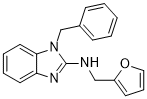
Physicochemical Properties
| Molecular Formula | C19H17N3O |
| Molecular Weight | 303.357784032822 |
| Exact Mass | 303.137 |
| Elemental Analysis | C, 75.23; H, 5.65; N, 13.85; O, 5.27 |
| CAS # | 831234-13-0 |
| PubChem CID | 667146 |
| Appearance | Off-white to light yellow solid powder |
| Density | 1.2±0.1 g/cm3 |
| Boiling Point | 512.4±60.0 °C at 760 mmHg |
| Flash Point | 263.7±32.9 °C |
| Vapour Pressure | 0.0±1.3 mmHg at 25°C |
| Index of Refraction | 1.648 |
| LogP | 4.23 |
| Hydrogen Bond Donor Count | 1 |
| Hydrogen Bond Acceptor Count | 3 |
| Rotatable Bond Count | 5 |
| Heavy Atom Count | 23 |
| Complexity | 372 |
| Defined Atom Stereocenter Count | 0 |
| SMILES | N1=C(NCC2=CC=CO2)N(CC2C=CC=CC=2)C2C1=CC=CC=2 |
| InChi Key | OECUWHDVQIITIS-UHFFFAOYSA-N |
| InChi Code | InChI=1S/C19H17N3O/c1-2-7-15(8-3-1)14-22-18-11-5-4-10-17(18)21-19(22)20-13-16-9-6-12-23-16/h1-12H,13-14H2,(H,20,21) |
| Chemical Name | 1-benzyl-N-(furan-2-ylmethyl)benzimidazol-2-amine |
| Synonyms | AC1903; AC-1903; AC 1903; |
| HS Tariff Code | 2934.99.9001 |
| Storage |
Powder-20°C 3 years 4°C 2 years In solvent -80°C 6 months -20°C 1 month |
| Shipping Condition | Room temperature (This product is stable at ambient temperature for a few days during ordinary shipping and time spent in Customs) |
Biological Activity
| ln Vitro | The brain and kidney have high expression levels of TRPC5, a non-selective cation channel that is permeable to Ca2+. Even in patch-clamp electrophysiological investigations, AC1903 (0-100 µM) suppresses riluzole-activated TRPC5 whole-cell currents, but not carbachol (CCh)-induced TRPC4 or OAG-induced TRPC6 currents. At high micromolar quantities, this is also true. ML204 (IC50=13.6 μM) and AC1903 (IC50=14.7 μM) exhibit nearly comparable ICIC50 values in human embryonic kidney 293 (HEK-293) cells that express TRPC5 [1]. When applied to both wild-type podocytes and podocytes expressing a mutant angiotensin II type 1 (AT1) receptor that is not inactivatable, AC1903 (30 µM) reduces the formation of reactive oxygen species (ROS) generated by angiotensin II[1]. AC1903 (30 µM) inhibits the production of ROS by caAT1R. Within 36 hours of caAT1R expression, there was an increase in podocyte death; however, AC1903 prevented podocytes from dying [1]. |
| ln Vivo | In an AT1 receptor transgenic nephropathy rat model, AC1903 (ip; 50 mg/kg; twice daily; 7 days) effectively suppresses proteinuria and decreases pseudocyst development and podocyte loss [1]. When administered intraperitoneally twice daily at a dose of 50 mg/kg, commencing on day 7 and continuing for one week until day 14, AC1903 significantly reduced proteinuria and preserved the number of podocytes. Furthermore, AC1903 had no effect on blood urea nitrogen, creatinine, or body weight in Dahl S rats, nor did it alter mean arterial pressure (MAP) [1]. |
| Cell Assay |
Cell Viability Assay[1] Cell Types: Podocytes Cell Tested Concentrations: 30 µM Incubation Duration: 36 hrs (hours) Experimental Results: Rescue of podocyte death. |
| Animal Protocol |
Animal/Disease Models: Dahl salt-sensitive rat hypertension-induced focal segmental glomerulosclerosis (FSGS) model [1] Doses: 50 mg/kg Route of Administration: intraperitoneal (ip) injection; intraperitoneal (ip) injection. 50 mg/kg; twice (two times) daily; 7 days Experimental Results: Inhibits progression of proteinuric nephropathy by sparing podocytes. Animal/Disease Models: 6weeks old Dahl S rats were treated with 2% NaCl for 1 week and suffered from severe and progressive proteinuria [1]. Doses: 50 mg/kg. Route of Administration: intraperitoneal (ip) injection; intraperitoneal (ip) injection; intraperitoneal (ip) injection. 50 mg/kg; twice (two times) daily; starting on day 7, treatment for 1 week until day 14 Experimental Results: Taking it at the beginning of a high-salt diet diminished the incidence of proteinuria, taking it one week after starting a high-salt diet prevented progression . |
| References |
[1]. A small-molecule inhibitor of TRPC5 ion channels suppresses progressive kidney disease in animal models. Science. |
Solubility Data
| Solubility (In Vitro) | DMSO : ~100 mg/mL (~329.64 mM) |
| Solubility (In Vivo) |
Solubility in Formulation 1: ≥ 2.5 mg/mL (8.24 mM) (saturation unknown) in 10% DMSO + 40% PEG300 + 5% Tween80 + 45% Saline (add these co-solvents sequentially from left to right, and one by one), clear solution. For example, if 1 mL of working solution is to be prepared, you can add 100 μL of 25.0 mg/mL clear DMSO stock solution to 400 μL PEG300 and mix evenly; then add 50 μL Tween-80 to the above solution and mix evenly; then add 450 μL normal saline to adjust the volume to 1 mL. Preparation of saline: Dissolve 0.9 g of sodium chloride in 100 mL ddH₂ O to obtain a clear solution. Solubility in Formulation 2: ≥ 2.5 mg/mL (8.24 mM) (saturation unknown) in 10% DMSO + 90% Corn Oil (add these co-solvents sequentially from left to right, and one by one), clear solution. For example, if 1 mL of working solution is to be prepared, you can add 100 μL of 25.0 mg/mL clear DMSO stock solution to 900 μL of corn oil and mix evenly. (Please use freshly prepared in vivo formulations for optimal results.) |
| Preparing Stock Solutions | 1 mg | 5 mg | 10 mg | |
| 1 mM | 3.2964 mL | 16.4821 mL | 32.9641 mL | |
| 5 mM | 0.6593 mL | 3.2964 mL | 6.5928 mL | |
| 10 mM | 0.3296 mL | 1.6482 mL | 3.2964 mL |