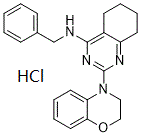
ML241 HCl is a novel and potent p97 inhibitor which inhibits p97 ATPase with an IC50 value of 100 nM. In a dual-reporter cell line, ML241 restricted the breakdown of a p97-dependent proteasome substrate but not a p97-independent one. Additionally, ML241 hampered the endoplasmic reticulum-associated degradation pathway (ERAD). Because it promotes the proteasome's degradation of ubiquinated proteins and aids in the maturation of autophagosomes, AAA ATPase p97 is essential for preserving protein homeostasis in eukaryotic cells. There is a chance that ML241 can treat cancer.
Physicochemical Properties
| Molecular Formula | C23H25CLN4O | |
| Molecular Weight | 408.93 | |
| Exact Mass | 408.171 | |
| Elemental Analysis | C, 67.56; H, 6.16; Cl, 8.67; N, 13.70; O, 3.91 | |
| CAS # | 2070015-13-1 | |
| Related CAS # |
|
|
| PubChem CID | 119081413 | |
| Appearance | White to off-white solid powder | |
| Hydrogen Bond Donor Count | 2 | |
| Hydrogen Bond Acceptor Count | 5 | |
| Rotatable Bond Count | 4 | |
| Heavy Atom Count | 29 | |
| Complexity | 497 | |
| Defined Atom Stereocenter Count | 0 | |
| SMILES | Cl.O1C2C=CC=CC=2N(CC1)C1=NC(=C2C(CCCC2)=N1)NCC1C=CC=CC=1 |
|
| InChi Key | DYHMHNNBOLCULH-UHFFFAOYSA-N | |
| InChi Code | InChI=1S/C23H24N4O.ClH/c1-2-8-17(9-3-1)16-24-22-18-10-4-5-11-19(18)25-23(26-22)27-14-15-28-21-13-7-6-12-20(21)27;/h1-3,6-9,12-13H,4-5,10-11,14-16H2,(H,24,25,26);1H | |
| Chemical Name | N-benzyl-2-(2,3-dihydro-1,4-benzoxazin-4-yl)-5,6,7,8-tetrahydroquinazolin-4-amine;hydrochloride | |
| Synonyms |
|
|
| HS Tariff Code | 2934.99.9001 | |
| Storage |
Powder-20°C 3 years 4°C 2 years In solvent -80°C 6 months -20°C 1 month Note: Please store this product in a sealed and protected environment, avoid exposure to moisture. |
|
| Shipping Condition | Room temperature (This product is stable at ambient temperature for a few days during ordinary shipping and time spent in Customs) |
Biological Activity
| Targets | p97 ATPase ( IC50 = 0.11 μM ); UbG76V–GFP ( IC50 = 3.5 μM ) |
| ln Vitro | ML241 hydrochloride is a strong p97 modulator with an IC50 value of 100 nM that inhibits p97 ATPase. With a Ki of 0.35 μM, ML241 hydrochloride inhibits p97 in relation to ATP. About 170 species of rest examined were not significantly inhibited by ML241 hydrochloride (20 μM). UbG76V-GFP is stabilized by ML241 hydrochloride, with an IC50 of 3.5 μM[1]. After 24 hours and 72 hours, respectively, the GI50s of ML241 hydrochloride on cytotoxic HCT15 and SW403 cells were 53 and 33 μM and 13 and 12 μM [2]. |
| Cell Assay | HeLa cells that are stable in their expression of ODD-luciferase are seeded (5000 cells/well) onto a 96-well white solid bottom plate and allowed to grow for 16 hours. Following a one-hour treatment with DMEM containing MG132 (4 μM), cells are twice washed with 100 μL PBS. In the well, cycloheximide (50 μg/mL), ML241, and DMEM containing 2.5% FBS are added. One of the four 96-well plates that have been prepared is removed from the incubator at each time interval (70, 90, 120, or 150 minutes). Each well holds 50 μL of medium. Luciferin (50 μL of 1 mg/mL in PBS) is added and incubated for 5 minutes at room temperature with 500 rpm shaking. The Synergy HT Microplate Reader uses an integration time of 0.1 ms to determine luminosity intensity[2]. |
| References |
[1]. Structure-activity relationship study reveals ML240 and ML241 as potent and selective inhibitors of p97 ATPase. ChemMedChem. 2013 Feb;8(2):297-312. [2]. Selective, reversible inhibitors of the AAA ATPase p97. Probe Reports from the NIH Molecular Libraries Program. April 14, 2011. |
Solubility Data
| Solubility (In Vitro) |
|
|||
| Solubility (In Vivo) |
Solubility in Formulation 1: ≥ 2.5 mg/mL (6.11 mM) (saturation unknown) in 10% DMSO + 40% PEG300 + 5% Tween80 + 45% Saline (add these co-solvents sequentially from left to right, and one by one), clear solution. For example, if 1 mL of working solution is to be prepared, you can add 100 μL of 25.0 mg/mL clear DMSO stock solution to 400 μL PEG300 and mix evenly; then add 50 μL Tween-80 to the above solution and mix evenly; then add 450 μL normal saline to adjust the volume to 1 mL. Preparation of saline: Dissolve 0.9 g of sodium chloride in 100 mL ddH₂ O to obtain a clear solution. Solubility in Formulation 2: ≥ 2.5 mg/mL (6.11 mM) (saturation unknown) in 10% DMSO + 90% (20% SBE-β-CD in Saline) (add these co-solvents sequentially from left to right, and one by one), clear solution. For example, if 1 mL of working solution is to be prepared, you can add 100 μL of 25.0 mg/mL clear DMSO stock solution to 900 μL of 20% SBE-β-CD physiological saline solution and mix evenly. Preparation of 20% SBE-β-CD in Saline (4°C,1 week): Dissolve 2 g SBE-β-CD in 10 mL saline to obtain a clear solution. Solubility in Formulation 3: ≥ 2.5 mg/mL (6.11 mM) (saturation unknown) in 10% DMSO + 90% Corn Oil (add these co-solvents sequentially from left to right, and one by one), clear solution. For example, if 1 mL of working solution is to be prepared, you can add 100 μL of 25.0 mg/mL clear DMSO stock solution to 900 μL of corn oil and mix evenly. (Please use freshly prepared in vivo formulations for optimal results.) |
| Preparing Stock Solutions | 1 mg | 5 mg | 10 mg | |
| 1 mM | 2.4454 mL | 12.2270 mL | 24.4541 mL | |
| 5 mM | 0.4891 mL | 2.4454 mL | 4.8908 mL | |
| 10 mM | 0.2445 mL | 1.2227 mL | 2.4454 mL |