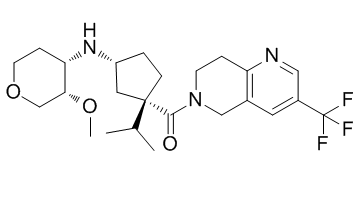
MK-0812 (MK0812) is a novel, potent and selective small molecule CCR2 antagonist with potential anti-Inflammatory and immunomodulatory activity. MK0812 caused an increase in the CCR2 ligand CCL2 and a selective decrease in the frequency of peripheral blood monocytes. The therapeutic potential for targeting CXCR2/CXCR1 in human arthritides is highlighted by the significantly greater impact of CXCR2/CXCR1 antagonism in this model of arthritis compared to CCR2 antagonism. In the tissue and synovial fluid of rheumatoid arthritis patients, neutrophils and monocytes are highly prevalent. It was investigated how small molecule chemokine receptor antagonists, like MK-0812, might prevent these cells from migrating in arthritis caused by anti-collagen antibodies.
Physicochemical Properties
| Molecular Formula | C24H34N3O3F3 |
| Molecular Weight | 469.54026 |
| Exact Mass | 469.255 |
| Elemental Analysis | C, 61.39; H, 7.30; F, 12.14; N, 8.95; O, 10.22 |
| CAS # | 624733-88-6 |
| Related CAS # | MK-0812 Succinate; 851916-42-2 |
| PubChem CID | 11180808 |
| Appearance | White to off-white solid powder |
| Density | 1.2±0.1 g/cm3 |
| Boiling Point | 562.0±50.0 °C at 760 mmHg |
| Flash Point | 293.7±30.1 °C |
| Vapour Pressure | 0.0±1.5 mmHg at 25°C |
| Index of Refraction | 1.538 |
| LogP | 2.37 |
| Hydrogen Bond Donor Count | 1 |
| Hydrogen Bond Acceptor Count | 8 |
| Rotatable Bond Count | 5 |
| Heavy Atom Count | 33 |
| Complexity | 692 |
| Defined Atom Stereocenter Count | 4 |
| SMILES | O=C([C@]1(C(C)C)C[C@H](N[C@H]2CCOC[C@H]2OC)CC1)N3CCC(N=CC(C(F)(F)F)=C4)=C4C3 |
| InChi Key | MTMDXAIUENDNDL-RJSMDTJLSA-N |
| InChi Code | InChI=1S/C24H34F3N3O3/c1-15(2)23(7-4-18(11-23)29-20-6-9-33-14-21(20)32-3)22(31)30-8-5-19-16(13-30)10-17(12-28-19)24(25,26)27/h10,12,15,18,20-21,29H,4-9,11,13-14H2,1-3H3/t18-,20+,21-,23+/m1/s1 |
| Chemical Name | [(1S,3R)-3-[[(3S,4S)-3-methoxyoxan-4-yl]amino]-1-propan-2-ylcyclopentyl]-[3-(trifluoromethyl)-7,8-dihydro-5H-1,6-naphthyridin-6-yl]methanone |
| Synonyms | MK0812; MK 0812; MK-0812 |
| HS Tariff Code | 2934.99.9001 |
| Storage |
Powder-20°C 3 years 4°C 2 years In solvent -80°C 6 months -20°C 1 month |
| Shipping Condition | Room temperature (This product is stable at ambient temperature for a few days during ordinary shipping and time spent in Customs) |
Biological Activity
| Targets | CCR2 | |
| ln Vitro | MK-0812 completely inhibits every MCP-1 mediated response in a concentration-dependent manner, with an IC50 of 3.2 nM. This value is comparable to the potency (IC50 4.5 nM) reported for MK-0812's inhibition of 125I-MCP-1 binding on isolated monocytes. Specifically, the antagonist causes a monocyte forward scatter measurement below unstimulated or basal levels in addition to totally blocking the shape change response to exogenous MCP-1. MK-0812 added to rhesus blood also prevents the shape change of monocytes induced by MCP-1. MK0812 is a powerful and specific small molecule antagonist of CCR2[2]. | |
| ln Vivo |
|
|
| Enzyme Assay | Human whole blood is drawn into EDTA tubes and used right away—within an hour. Blood (200 µL) is pre-incubated for 30 minutes at room temperature with MK-0812 (0.1% final DMSO concentration) for antagonist treated samples. Next, 4 µL of chemokine or buffer and 20 µL of FITC conjugated anti-CD14 antibody are added to each sample and gently mixed. A 100 µL aliquot of the blood mixture is incubated for 10 minutes at 37°C. It is then promptly put on ice and gently fixed for 1 minute with 250 µL of an ice cold fixative (49 mL PBS, 1.0 mL 4% para-formaldehyde). In order to lyse red blood cells, 1.0 mL of an ice-cold lysis solution containing 0.15 M NH4Cl2, 10 mM sodium bicarbonate, and 1 mM EDTA is added. The mixture is then incubated on ice for 20 minutes. Following the complete lysis of red blood cells, 100 µL of 4% para-formaldehyde is added, and flow cytometry is used to analyze the samples for measurements of forward scatter[1]. | |
| Animal Protocol |
|
|
| References |
[1]. Assessment of chemokine receptor function on monocytes in whole blood: In vitro and ex vivo evaluations of a CCR2 antagonist.J Immunol Methods. 2010 Jan 31;352(1-2):101-10. [2]. Pharmacological targeting reveals distinct roles for CXCR2/CXCR1 and CCR2 in a mouse model of arthritis.Biochem Biophys Res Commun. 2010 Jan 1;391(1):1080-6. |
|
| Additional Infomation | MK0812 has been used in trials studying the treatment of Relapsing-Remitting Multiple Sclerosis. |
Solubility Data
| Solubility (In Vitro) | DMSO: ~100 mg/mL (~213 mM) |
| Solubility (In Vivo) |
Solubility in Formulation 1: ≥ 2.5 mg/mL (5.32 mM) (saturation unknown) in 10% DMSO + 40% PEG300 + 5% Tween80 + 45% Saline (add these co-solvents sequentially from left to right, and one by one), clear solution. For example, if 1 mL of working solution is to be prepared, you can add 100 μL of 25.0 mg/mL clear DMSO stock solution to 400 μL PEG300 and mix evenly; then add 50 μL Tween-80 to the above solution and mix evenly; then add 450 μL normal saline to adjust the volume to 1 mL. Preparation of saline: Dissolve 0.9 g of sodium chloride in 100 mL ddH₂ O to obtain a clear solution. Solubility in Formulation 2: ≥ 2.5 mg/mL (5.32 mM) (saturation unknown) in 10% DMSO + 90% Corn Oil (add these co-solvents sequentially from left to right, and one by one), clear solution. For example, if 1 mL of working solution is to be prepared, you can add 100 μL of 25.0 mg/mL clear DMSO stock solution to 900 μL of corn oil and mix evenly. (Please use freshly prepared in vivo formulations for optimal results.) |
| Preparing Stock Solutions | 1 mg | 5 mg | 10 mg | |
| 1 mM | 2.1297 mL | 10.6487 mL | 21.2974 mL | |
| 5 mM | 0.4259 mL | 2.1297 mL | 4.2595 mL | |
| 10 mM | 0.2130 mL | 1.0649 mL | 2.1297 mL |