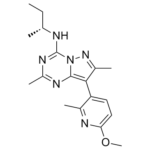
Pexacerfont (formerly known as BMS-562086) is a novel potent, selective and orally bioactive antagonist of corticotropin-releasing factor (CRF1) receptor antagonist with IC50 of 6.1±0.6 nM for human CRF1 receptor. Pexacerfont has also been suggested as a potential treatment for irritable bowel syndrome and depression. It is presently undergoing clinical trials for the treatment of anxiety disorders. BMS-562086 showed promising pharmacokinetic and ADME characteristics for additional research and development.
Physicochemical Properties
| Molecular Formula | C18H24N6O |
| Molecular Weight | 340.42276 |
| Exact Mass | 340.201 |
| Elemental Analysis | C, 63.51; H, 7.11; N, 24.69; O, 4.70 |
| CAS # | 459856-18-9 |
| PubChem CID | 9884366 |
| Appearance | White to off-white solid powder |
| LogP | 2.752 |
| Hydrogen Bond Donor Count | 1 |
| Hydrogen Bond Acceptor Count | 6 |
| Rotatable Bond Count | 5 |
| Heavy Atom Count | 25 |
| Complexity | 438 |
| Defined Atom Stereocenter Count | 1 |
| SMILES | CC[C@H](NC1=NC(C)=NC2=C(C3=CC=C(OC)N=C3C)C(C)=NN21)C |
| InChi Key | LBWQSAZEYIZZCE-SNVBAGLBSA-N |
| InChi Code | InChI=1S/C18H24N6O/c1-7-10(2)19-18-22-13(5)21-17-16(12(4)23-24(17)18)14-8-9-15(25-6)20-11(14)3/h8-10H,7H2,1-6H3,(H,19,21,22)/t10-/m1/s1 |
| Chemical Name | N-[(2R)-butan-2-yl]-8-(6-methoxy-2-methylpyridin-3-yl)-2,7-dimethylpyrazolo[1,5-a][1,3,5]triazin-4-amine |
| Synonyms | Pexacerfont; BMS-562086; BMS 562086; BMS562086; BMS-562,086; BMS562,086; BMS 562,086 |
| HS Tariff Code | 2934.99.9001 |
| Storage |
Powder-20°C 3 years 4°C 2 years In solvent -80°C 6 months -20°C 1 month |
| Shipping Condition | Room temperature (This product is stable at ambient temperature for a few days during ordinary shipping and time spent in Customs) |
Biological Activity
| Targets | human CRF1 receptor ( IC50 = 6.1±0.6 nM ) |
| ln Vitro | Pexacerfont exhibits a stronger and more targeted inhibitory effect (IC50=6.1 ± 0.6 nM) on the human CRF1 receptor and a lower affinity (IC50>1000 nM) for the biogenic amine receptors and CRF-binding protein[1]. |
| ln Vivo | Pexacerfont (BMS-562086) is effective in the elevated plus maze and defensive withdrawal models of anxiety in rats (1–10 mg/kg, orally administered). Rats, dogs, and chimpanzees' plasma Pexacerfont concentrations showed a multiexponential decline following the intravenous bolus dose. Pexacerfont's CLp was greater in dogs (11.6 mL/kg per min) and rats (17.9 mL/kg per min) than in chimpanzees (2.0 mL/kg per min). Assuming the value of CLp of Pexacerfont approximates the value of CLb in these three species, Pexacerfont has an estimated hepatic extraction ratio of 0.32, 0.38, and 0.08 in rats, dogs, and chimpanzees, respectively (calculated by dividing CLp by respective hepatic blood flow, 55.2, 30.9, and 25.5 mL/kg per min for rats, dogs, and chimpanzees). The blood to plasma concentration ratio of BMS-562086-equivalent radioactivity was 0.95 at one hour after dosing, indicating that the assumption that CLb is equal to CLp is reasonable, at least in rats[1]. |
| Cell Assay | At a density of 60,000 cells/cm2, 24 well Transwell plates with polycarbonate membranes are seeded with Caco-2 cells at passage 50 to 60. The cells are cultivated in a culture medium that includes 10% fetal bovine serum, 0.5 mM HEPES, 1% nonessential amino acids, 1% L-glutamine, 100 U/mL penicillin-G, and 100 μg/mL streptomycin for a duration of 21 to 25 days. Apical (AP) and basolateral (BL) media are swapped out for transport buffer (Hanks' balanced salt solution enhanced with 2% N, N-dimethylacetamide, pH 7.4) prior to the permeability tests. The AP medium is swapped out for a transport buffer containing 25 μM BMS-562086 to begin the AP to BL permeability study. Permeability tests are conducted at 37°C in all cases.Cell monolayer integrity is evaluated by measuring the values of transepithelial electrical resistance, or TIER. Each experiment is completed with the acquisition of TEER values. The investigations only include wells that have TEER values during the experiment that range from 400 to 500 Ω/cm2. The same protocol as for other transport experiments is used when conducting mannitol (25 or 100 μM) experiments. The Caco-2 cell monolayer integrity was probed using mannitol [1]. |
| Animal Protocol | Rats: There are two groups of male Sprague-Dawley rats (n = 3, 0.34-0.35 kg b.wt.): one group is instrumented with single jugular vein cannulas and is intended for oral administration, and the other group is instrumented with dual jugular vein cannulas and is intended for intravenous administration. Every rat is fasted for four hours following dosage and for about eighteen hours prior to use. Ad libitum water is offered. Three rats receive a single oral dose of 5 mg/kg of pexacerfont (BMS-562086) in 0.5% aqueous methylcellulose via gavage. Using a jugular vein cannula, three rats receive a single intravenous bolus dose of Pexacerfont at a dose of 1 mg/kg in 20% ethanol in saline. The jugular vein cannula is used to draw blood samples (0.2 mL/time point per animal) for Pexacerfont analysis at 0, 0.08 (intravenous dose only), 0.17 (intravenous dose only), 0.25, 0.5, 0.75, 1, 2, 4, 8, 12, 24, 48, 72, and 96 hours after the dose. The blood samples are centrifuged for 10 minutes at 1000g and 5°C to extract plasma. |
| References |
[1]. In vitro and in vivo metabolism and pharmacokinetics of BMS-562086, a potent and orally bioavailable corticotropin-releasing factor-1 receptor antagonist. Drug Metab Dispos. 2012 Jun;40(6):1093-103. |
| Additional Infomation |
Pexacerfont is a pyrazolopyridine. Pexacerfont has been investigated for the treatment of Alcoholism, Anxiety Disorder, Alcohol Dependence, and Alcohol-Related Disorders. |
Solubility Data
| Solubility (In Vitro) | DMSO: ~50 mg/mL (~146.9 mM) |
| Solubility (In Vivo) |
Solubility in Formulation 1: ≥ 2.5 mg/mL (7.34 mM) (saturation unknown) in 10% DMSO + 40% PEG300 + 5% Tween80 + 45% Saline (add these co-solvents sequentially from left to right, and one by one), clear solution. For example, if 1 mL of working solution is to be prepared, you can add 100 μL of 25.0 mg/mL clear DMSO stock solution to 400 μL PEG300 and mix evenly; then add 50 μL Tween-80 to the above solution and mix evenly; then add 450 μL normal saline to adjust the volume to 1 mL. Preparation of saline: Dissolve 0.9 g of sodium chloride in 100 mL ddH₂ O to obtain a clear solution. Solubility in Formulation 2: ≥ 2.5 mg/mL (7.34 mM) (saturation unknown) in 10% DMSO + 90% (20% SBE-β-CD in Saline) (add these co-solvents sequentially from left to right, and one by one), clear solution. For example, if 1 mL of working solution is to be prepared, you can add 100 μL of 25.0 mg/mL clear DMSO stock solution to 900 μL of 20% SBE-β-CD physiological saline solution and mix evenly. Preparation of 20% SBE-β-CD in Saline (4°C,1 week): Dissolve 2 g SBE-β-CD in 10 mL saline to obtain a clear solution. Solubility in Formulation 3: ≥ 2.5 mg/mL (7.34 mM) (saturation unknown) in 10% DMSO + 90% Corn Oil (add these co-solvents sequentially from left to right, and one by one), clear solution. For example, if 1 mL of working solution is to be prepared, you can add 100 μL of 25.0 mg/mL clear DMSO stock solution to 900 μL of corn oil and mix evenly. (Please use freshly prepared in vivo formulations for optimal results.) |
| Preparing Stock Solutions | 1 mg | 5 mg | 10 mg | |
| 1 mM | 2.9375 mL | 14.6877 mL | 29.3755 mL | |
| 5 mM | 0.5875 mL | 2.9375 mL | 5.8751 mL | |
| 10 mM | 0.2938 mL | 1.4688 mL | 2.9375 mL |