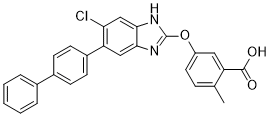
MK-3903 (MK3903) is a novel, potent and selective AMPK (AMP-activated protein kinase) activator with EC50 of 8 nM for α1 β1 γ1 subunit, leading to improved lipid metabolism and insulin sensitization in mice. It activates 10 of the 12 pAMPK complexes, with maximal activation exceeding 50% and EC50 values in the 8–40 nM range. Following oral administration, MK-3903 demonstrated strong target engagement in the mouse liver, improving lipid metabolism and insulin sensitization in the mice. With less pronounced effects in skeletal muscle, chronic oral administration of MK-3903 significantly increased ACC phosphorylation in the liver. The administration of MK-3903 to various mouse models led to the anticipated changes in lipid metabolism and enhancements in an indicator of insulin sensitization.
Physicochemical Properties
| Molecular Formula | C27H19CLN2O3 | |
| Molecular Weight | 454.904365777969 | |
| Exact Mass | 454.108 | |
| Elemental Analysis | C, 71.29; H, 4.21; Cl, 7.79; N, 6.16; O, 10.55 | |
| CAS # | 1219737-12-8 | |
| Related CAS # |
|
|
| PubChem CID | 45256689 | |
| Appearance | White to off-white solid powder | |
| LogP | 7.1 | |
| Hydrogen Bond Donor Count | 2 | |
| Hydrogen Bond Acceptor Count | 4 | |
| Rotatable Bond Count | 5 | |
| Heavy Atom Count | 33 | |
| Complexity | 664 | |
| Defined Atom Stereocenter Count | 0 | |
| InChi Key | FIKQZQDYGXAUHC-UHFFFAOYSA-N | |
| InChi Code | InChI=1S/C27H19ClN2O3/c1-16-7-12-20(13-21(16)26(31)32)33-27-29-24-14-22(23(28)15-25(24)30-27)19-10-8-18(9-11-19)17-5-3-2-4-6-17/h2-15H,1H3,(H,29,30)(H,31,32) | |
| Chemical Name |
|
|
| Synonyms |
|
|
| HS Tariff Code | 2934.99.9001 | |
| Storage |
Powder-20°C 3 years 4°C 2 years In solvent -80°C 6 months -20°C 1 month |
|
| Shipping Condition | Room temperature (This product is stable at ambient temperature for a few days during ordinary shipping and time spent in Customs) |
Biological Activity
| Targets | AMPK (EC50 = 8 nM) |
| ln Vitro | MK-3903 (compound 42) is a potent and selective AMP-activated protein kinase (AMPK) activator with an EC50 of 8 nM. MK-3903 activates 10 of the 12 phosphorylated AMPK (pAMPK) complexes with EC50 values in the range of 8 to 40 nM and maximal activation >50%. MK-3903 does not activate pAMPK6 and only partially activates pAMPK5 (up to 36% maximum). In LLC-PK1 cells, MK-3903 exhibits low permeability (Papp=6 10-6 cm/s), and it is a substrate for the organic anion transporter proteins OATP1B1 and OATP1B3 that are found in human liver uptake transporters. According to the findings, MK-3903 moderately binds to the prostanoid DP2 (CRTH2) receptor (binding IC50=1.8 μM), but not when 10% human serum is present (binding IC50>86 μM)[1]. |
| ln Vivo | MK-3903 (compound 42) exhibits moderate systemic plasma clearance (5.0 to 13 mL/min/kg), a volume of distribution at steady state of 0.6 to 1.1 L/kg, and a terminal halflife of approximately 2 hours in C57BL/6 mice, Sprague to Dawley rats, and beagle dogs. MK-3903 (3, 10, and 30 mg/kg) causes a significant reduction in hepatic fatty acid synthesis (FAS) when administered acutely orally to high-fructose-fed db/+ mice[1]. |
| Enzyme Assay | Enzymatic reaction is carried out. In a nutshell, to produce pAMPK, the target AMPK complex is appropriately diluted in the AMPK reaction buffer and incubated at room temperature for 30 min. After adding appropriately diluted MK-3903 (compound 42) in DMSO (1.2 L total) to the reaction buffer containing pAMPK (15 L per well), the plate is briefly vortexed, and the incubation is then allowed to proceed at room temperature for 30 minutes. After 60 minutes of room temperature incubation, the plate is sealed, and quench buffer is added to stop the reaction. Plots of product vs. activator concentration are used to calculate EC50s and activation parameters[1]. |
| Animal Protocol | In this study, DIO mice that are 17 weeks old are used. Mice are trained to receive vehicle at a dose of 5 mL/kg BID for 5 days (vehicle: 5% Tween 80, 0.25% methylcellulose, 0.02% SDS). At that point, mice are bled, their blood sugar and insulin levels are measured, and the mice are then divided into treatment groups according to body weight, blood sugar, and insulin levels. For a 12-day BID period, MK-3903 (compound 42) is administered orally to each group of animals at doses of 3 mg/kg, 10 mg/kg, 30 mg/kg, or just the vehicle. A second group of mice that received MK-3903 with vehicle at 30 mg/kg for 12 days is also included. Every day, both food intake and body weight are recorded[1]. |
| References |
[1]. Hit-to-Lead Optimization and Discovery of 5-((5-([1,1'-Biphenyl]-4-yl)-6-chloro-1H-benzo[d]imidazol-2-yl)oxy)-2-methylbenzoic Acid (MK-3903): A Novel Class of Benzimidazole-Based Activators of AMP-Activated Protein Kinase. J Med C |
Solubility Data
| Solubility (In Vitro) |
DMSO: ≥90 mg/mL Water: <1mg/mL Ethanol: <1mg/mL |
| Solubility (In Vivo) |
Solubility in Formulation 1: ≥ 2.5 mg/mL (5.50 mM) (saturation unknown) in 10% DMSO + 40% PEG300 + 5% Tween80 + 45% Saline (add these co-solvents sequentially from left to right, and one by one), clear solution. For example, if 1 mL of working solution is to be prepared, you can add 100 μL of 25.0 mg/mL clear DMSO stock solution to 400 μL PEG300 and mix evenly; then add 50 μL Tween-80 to the above solution and mix evenly; then add 450 μL normal saline to adjust the volume to 1 mL. Preparation of saline: Dissolve 0.9 g of sodium chloride in 100 mL ddH₂ O to obtain a clear solution. Solubility in Formulation 2: ≥ 2.5 mg/mL (5.50 mM) (saturation unknown) in 10% DMSO + 90% Corn Oil (add these co-solvents sequentially from left to right, and one by one), clear solution. For example, if 1 mL of working solution is to be prepared, you can add 100 μL of 25.0 mg/mL clear DMSO stock solution to 900 μL of corn oil and mix evenly. (Please use freshly prepared in vivo formulations for optimal results.) |
| Preparing Stock Solutions | 1 mg | 5 mg | 10 mg | |
| 1 mM | 2.1983 mL | 10.9914 mL | 21.9829 mL | |
| 5 mM | 0.4397 mL | 2.1983 mL | 4.3966 mL | |
| 10 mM | 0.2198 mL | 1.0991 mL | 2.1983 mL |