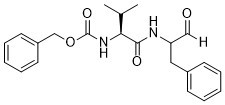
MDL-28170 (Calpain Inhibitor III) is a novel potent, selective, and membrane-permeable cysteine protease inhibitor of calpain that, when administered systemically, quickly crosses the blood-brain barrier. Also inhibiting γ-secretase is MDL-28170.
Physicochemical Properties
| Molecular Formula | C22H26N2O4 |
| Molecular Weight | 382.45284 |
| Exact Mass | 382.19 |
| Elemental Analysis | C, 69.09; H, 6.85; N, 7.32; O, 16.73 |
| CAS # | 88191-84-8 |
| Related CAS # | 88191-84-8 |
| PubChem CID | 72430 |
| Appearance | White to off-white solid powder |
| Density | 1.2±0.1 g/cm3 |
| Boiling Point | 450.4±45.0 °C at 760 mmHg |
| Flash Point | 226.2±28.7 °C |
| Vapour Pressure | 0.0±1.1 mmHg at 25°C |
| Index of Refraction | 1.571 |
| LogP | 3.77 |
| Hydrogen Bond Donor Count | 2 |
| Hydrogen Bond Acceptor Count | 4 |
| Rotatable Bond Count | 10 |
| Heavy Atom Count | 28 |
| Complexity | 497 |
| Defined Atom Stereocenter Count | 2 |
| SMILES | C(C1C=CC=CC=1)C(C=O)NC(=O)[C@H](C(C)C)NC(=O)OCC1C=CC=CC=1 |
| InChi Key | NGBKFLTYGSREKK-ANYOKISRSA-N |
| InChi Code | InChI=1S/C22H26N2O4/c1-16(2)20(24-22(27)28-15-18-11-7-4-8-12-18)21(26)23-19(14-25)13-17-9-5-3-6-10-17/h3-12,14,16,19-20H,13,15H2,1-2H3,(H,23,26)(H,24,27)/t19?,20-/m0/s1 |
| Chemical Name | benzyl N-[(2S)-3-methyl-1-oxo-1-[(1-oxo-3-phenylpropan-2-yl)amino]butan-2-yl]carbamate |
| Synonyms | MDL 28170; MDL-28170; MDL28170 |
| HS Tariff Code | 2934.99.9001 |
| Storage |
Powder-20°C 3 years 4°C 2 years In solvent -80°C 6 months -20°C 1 month |
| Shipping Condition | Room temperature (This product is stable at ambient temperature for a few days during ordinary shipping and time spent in Customs) |
Biological Activity
| Targets | calpain; Secretase |
| ln Vitro |
MDL-28170 enhances the synaptic response recovery in hippocampus slices after extended, moderate hypoxia without causing hypoxic depolarization in a significant and time-dependent manner[1]. MDL-28170 inhibits brain cysteine proteinase activity in a dose-dependent manner (in vitro Ki= 0.01 μM)[2]. |
| ln Vivo | Four animals in each of the two treatment groups receive treatment with MDL-28170 (50 mg/kg, i.p.) to totally prevent striatal damage. When MDL-28170 injections are administered to animals at 0.5 and 3 hours of recirculation, respectively, the number of necrotic neurons is decreased by 85% and 68%[2]. MDL-28170 (30 mg/kg, i.p.) decreases the corpus callosum's structural and functional degradation after fluid percussion injury[3]. MDL-28170 (10 mg/kg, i.p.) dramatically enhances nerve function metrics. In diabetic rats, nociceptive behavior is improved by MDL-28170 (3 and 10 mg/kg, i.p.) in diabetic rats[5]. |
| Cell Assay | To evaluate MDL28170's capacity to prevent H2O2-mediated necrosis. MDL28170 (50 nM, 500 nM, 5 μM, or 50 μM) is used to treat cells. For the duration of the experiment, a new drug and H2O2 solution is added to the cells after a one-hour drug pretreatment. The number of live or dead cells is counted three hours after exposure. |
| Animal Protocol |
Male Mongolian gerbils 50 mg/kg IP |
| References |
[1]. Neuronal recovery after moderate hypoxia is improved by the calpain inhibitor MDL28170. Brain Res. 1997 Sep 19;769(1):188-92. [2]. Postischemic treatment with calpain inhibitor MDL 28170 ameliorates brain damage in a gerbil model of global ischemia. Neurosci Lett. 1998 May 8;247(1):17-20. [3]. Calpain inhibitor MDL-28170 reduces the functional and structural deterioration of corpus callosum following fluid percussion injury. J Neurotrauma. 2007 Jun;24(6):960-78. [4]. A presenilin-1-dependent gamma-secretase-like protease mediates release of Notch intracellular domain. Nature. 1999 Apr 8;398(6727):518-22. [5]. Calpain inhibitor, MDL 28170 confer electrophysiological, nociceptive and biochemical improvement in diabetic neuropathy. Neuropharmacology. 2015 Oct;97:113-21. |
| Additional Infomation | Z-Val-Phe-H is a dipeptide resulting from the formal condensation of the carboxy group of N-benzyloxycarbonyl-L-valine with the amino group of L-phenylalanine aldehyde. It is a potent cell-permeable inhibitor of calpain I and II, and is also a gamma-secretase inhibitor. It has a role as an EC 3.4.22.53 (calpain-2) inhibitor, an EC 3.4.22.52 (calpain-1) inhibitor, an EC 3.4.23.46 (memapsin 2) inhibitor, an antileishmanial agent and an apoptosis inhibitor. It is an aldehyde, a dipeptide and a carbamate ester. |
Solubility Data
| Solubility (In Vitro) |
DMSO: 30~76 mg/mL (78.4~198.7 mM) Ethanol: ~10 mg/mL (~26.2 mM) |
| Solubility (In Vivo) |
Solubility in Formulation 1: ≥ 2.25 mg/mL (5.88 mM) (saturation unknown) in 10% DMSO + 40% PEG300 + 5% Tween80 + 45% Saline (add these co-solvents sequentially from left to right, and one by one), clear solution. For example, if 1 mL of working solution is to be prepared, you can add 100 μL of 22.5 mg/mL clear DMSO stock solution to 400 μL PEG300 and mix evenly; then add 50 μL Tween-80 to the above solution and mix evenly; then add 450 μL normal saline to adjust the volume to 1 mL. Preparation of saline: Dissolve 0.9 g of sodium chloride in 100 mL ddH₂ O to obtain a clear solution. Solubility in Formulation 2: ≥ 2.25 mg/mL (5.88 mM) (saturation unknown) in 10% DMSO + 90% Corn Oil (add these co-solvents sequentially from left to right, and one by one), clear solution. For example, if 1 mL of working solution is to be prepared, you can add 100 μL of 22.5 mg/mL clear DMSO stock solution to 900 μL of corn oil and mix evenly. (Please use freshly prepared in vivo formulations for optimal results.) |
| Preparing Stock Solutions | 1 mg | 5 mg | 10 mg | |
| 1 mM | 2.6147 mL | 13.0736 mL | 26.1472 mL | |
| 5 mM | 0.5229 mL | 2.6147 mL | 5.2294 mL | |
| 10 mM | 0.2615 mL | 1.3074 mL | 2.6147 mL |