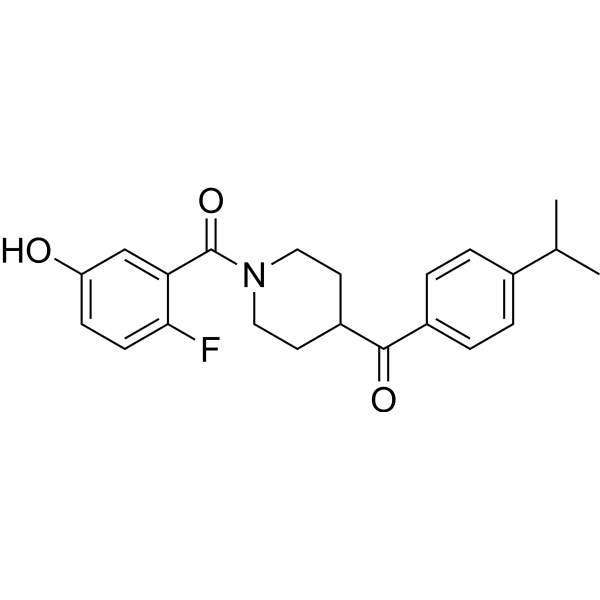
Physicochemical Properties
| Molecular Formula | C22H24FNO3 |
| Molecular Weight | 369.43 |
| Exact Mass | 369.174 |
| CAS # | 2324160-91-8 |
| PubChem CID | 138319671 |
| Appearance | White to off-white solid powder |
| Density | 1.2±0.1 g/cm3 |
| Boiling Point | 558.9±50.0 °C at 760 mmHg |
| Flash Point | 291.8±30.1 °C |
| Vapour Pressure | 0.0±1.6 mmHg at 25°C |
| Index of Refraction | 1.585 |
| LogP | 3.17 |
| Hydrogen Bond Donor Count | 1 |
| Hydrogen Bond Acceptor Count | 4 |
| Rotatable Bond Count | 4 |
| Heavy Atom Count | 27 |
| Complexity | 522 |
| Defined Atom Stereocenter Count | 0 |
| InChi Key | WUUBZNFATQKRPH-UHFFFAOYSA-N |
| InChi Code | InChI=1S/C22H24FNO3/c1-14(2)15-3-5-16(6-4-15)21(26)17-9-11-24(12-10-17)22(27)19-13-18(25)7-8-20(19)23/h3-8,13-14,17,25H,9-12H2,1-2H3 |
| Chemical Name | [1-(2-fluoro-5-hydroxybenzoyl)piperidin-4-yl]-(4-propan-2-ylphenyl)methanone |
| HS Tariff Code | 2934.99.9001 |
| Storage |
Powder-20°C 3 years 4°C 2 years In solvent -80°C 6 months -20°C 1 month |
| Shipping Condition | Room temperature (This product is stable at ambient temperature for a few days during ordinary shipping and time spent in Customs) |
Biological Activity
| Targets | IC50: 80 nM (MAGL)[1] |
| ln Vitro | In all examined cancer cell lines, MAGL-IN-1 (Compound 23) (0.02 - 200 μM; 96 hours) significantly inhibits cell viability, with an IC50 ranging from 7.9 to 57 μM [1]. Using 4-nitrobenzene acetate, MAGL-IN-1 (0.125-1 μM; 30 minutes) binds MAGL in a competitive manner with a Ki of 39 nM [1]. At 10 μM, MAGL-IN-1 (10 μM; 90 min) [1]. In U937 cells, MAGL-IN-1 (1 nM-100 μM; 15 min) inhibits [3H]2-oleoylglycerol (2-OG) hydrolysis in a concentration-dependent manner with an IC50 of 193 nM [1]. With an IC50 of 2.1 μM, MAGL-IN-1 (0.01-30 μM; 15 min) inhibits 2-OG hydrolysis in mouse meningeal preparations in a concentration-dependent manner [1]. |
| ln Vivo | In mouse plasma and brain levels, MAGL (Compound 23) (50 mg/kg; single ip) raises 2-AG levels without changing levels of AEA, arachidonic acid, or prostate[1]. |
| Cell Assay |
Cell Proliferation Assay[1] Cell Types: HCT116, MDA-MB-231, CAOV3, OVCAR3, SKOV3, and MRC5 cells Tested Concentrations: 0.02-200 μM Incubation Duration: 96 hrs (hours) Experimental Results: Inhibited the growth of human breast MDA-MB-231 , colorectal HCT116, and ovarian CAOV3, OVCAR3, and SKOV3 cancer cells, with IC50s of 7.9, 21, 25, 57, and 15 μM, respectively. Was inactive against MRC5 (IC50>100 μM). |
| Animal Protocol |
Animal/Disease Models: Male C57BL6 mice, 8-10 weeks old[1] Doses: 50 mg/kg Route of Administration: intraperitoneal (ip) injection; once Experimental Results: Increased 2-AG levels in the brain and plasma. |
| References |
[1]. Optimization of a Benzoylpiperidine Class Identifies a Highly Potent and Selective Reversible Monoacylglycerol Lipase (MAGL) Inhibitor. J Med Chem. 2019 Feb 28;62(4):1932-1958. |
Solubility Data
| Solubility (In Vitro) | DMSO: 62.5 mg/mL (169.18 mM) |
| Solubility (In Vivo) |
Solubility in Formulation 1: 2.08 mg/mL (5.63 mM) in 10% DMSO + 40% PEG300 + 5% Tween80 + 45% Saline (add these co-solvents sequentially from left to right, and one by one), suspension solution; with sonication. For example, if 1 mL of working solution is to be prepared, you can add 100 μL of 20.8 mg/mL clear DMSO stock solution to 400 μL PEG300 and mix evenly; then add 50 μL Tween-80 to the above solution and mix evenly; then add 450 μL normal saline to adjust the volume to 1 mL. Preparation of saline: Dissolve 0.9 g of sodium chloride in 100 mL ddH₂ O to obtain a clear solution. Solubility in Formulation 2: ≥ 2.08 mg/mL (5.63 mM) (saturation unknown) in 10% DMSO + 90% (20% SBE-β-CD in Saline) (add these co-solvents sequentially from left to right, and one by one), clear solution. For example, if 1 mL of working solution is to be prepared, you can add 100 μL of 20.8 mg/mL clear DMSO stock solution to 900 μL of 20% SBE-β-CD physiological saline solution and mix evenly. Preparation of 20% SBE-β-CD in Saline (4°C,1 week): Dissolve 2 g SBE-β-CD in 10 mL saline to obtain a clear solution. Solubility in Formulation 3: ≥ 2.08 mg/mL (5.63 mM) (saturation unknown) in 10% DMSO + 90% Corn Oil (add these co-solvents sequentially from left to right, and one by one), clear solution. For example, if 1 mL of working solution is to be prepared, you can add 100 μL of 20.8 mg/mL clear DMSO stock solution to 900 μL of corn oil and mix evenly. (Please use freshly prepared in vivo formulations for optimal results.) |
| Preparing Stock Solutions | 1 mg | 5 mg | 10 mg | |
| 1 mM | 2.7069 mL | 13.5344 mL | 27.0687 mL | |
| 5 mM | 0.5414 mL | 2.7069 mL | 5.4137 mL | |
| 10 mM | 0.2707 mL | 1.3534 mL | 2.7069 mL |