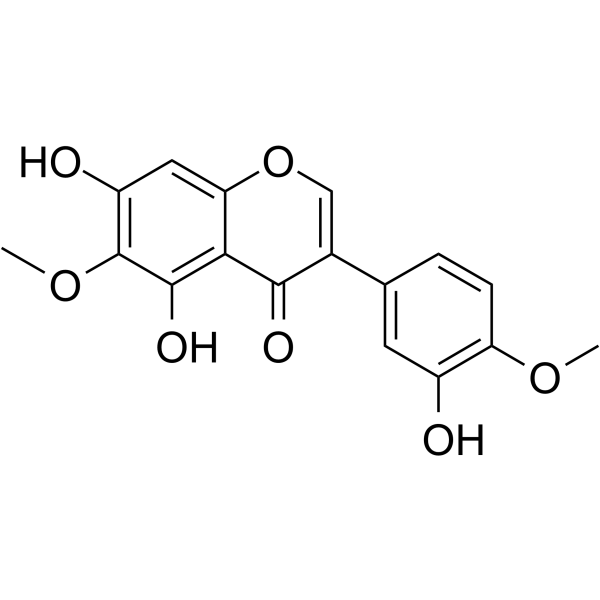
Physicochemical Properties
| Molecular Formula | C17H14O7 |
| Molecular Weight | 330.2889 |
| Exact Mass | 330.074 |
| CAS # | 86849-77-6 |
| PubChem CID | 5488781 |
| Appearance | Off-white to yellow solid powder |
| Density | 1.483g/cm3 |
| Boiling Point | 621.2ºC at 760mmHg |
| Flash Point | 232.8ºC |
| Index of Refraction | 1.67 |
| LogP | 2.594 |
| Hydrogen Bond Donor Count | 3 |
| Hydrogen Bond Acceptor Count | 7 |
| Rotatable Bond Count | 3 |
| Heavy Atom Count | 24 |
| Complexity | 505 |
| Defined Atom Stereocenter Count | 0 |
| InChi Key | WRZOUWHPDDOJNR-UHFFFAOYSA-N |
| InChi Code | InChI=1S/C17H14O7/c1-22-12-4-3-8(5-10(12)18)9-7-24-13-6-11(19)17(23-2)16(21)14(13)15(9)20/h3-7,18-19,21H,1-2H3 |
| Chemical Name | 5,7-dihydroxy-3-(3-hydroxy-4-methoxyphenyl)-6-methoxychromen-4-one |
| HS Tariff Code | 2934.99.9001 |
| Storage |
Powder-20°C 3 years 4°C 2 years In solvent -80°C 6 months -20°C 1 month Note: Please store this product in a sealed and protected environment, avoid exposure to moisture. |
| Shipping Condition | Room temperature (This product is stable at ambient temperature for a few days during ordinary shipping and time spent in Customs) |
Biological Activity
| Targets |
Liver X Receptor (LXR) (No IC50, Ki, or EC50 values were described in the accessible literature content) [1] |
| ln Vitro |
In macrophage RAW 264.7 cells, treatment with Iristectorigenin B (isolated from Belamcanda chinensis) resulted in increased expression of ATP-binding cassette transporter A1 (ABCA1) and ATP-binding cassette transporter G1 (ABCG1). The increased expression was detected at both the protein level (via Western blot analysis) and mRNA level (via reverse transcription-polymerase chain reaction, RT-PCR), indicating that Iristectorigenin B regulates the expression of these transporters at the transcriptional level. No specific concentration-dependent data (e.g., fold change of ABCA1/ABCG1 expression at different drug concentrations) were obtainable from the accessible content. [1] |
| Cell Assay |
RAW 264.7 macrophage cells were first cultured in an appropriate medium (commonly high-glucose Dulbecco's Modified Eagle Medium, DMEM) supplemented with fetal bovine serum (FBS) and antibiotics (e.g., penicillin-streptomycin) under standard cell culture conditions (37°C, 5% CO₂). After reaching a certain confluency (typically 70%-80%), the cells were treated with different concentrations of Iristectorigenin B (specific concentrations not accessible) for a predefined incubation period (common for such experiments: 12-24 hours). Following treatment, the cells were harvested; for Western blot analysis, total cellular proteins were extracted, separated by sodium dodecyl sulfate-polyacrylamide gel electrophoresis (SDS-PAGE), transferred to a membrane, and probed with primary antibodies against ABCA1, ABCG1, and a loading control (e.g., β-actin), followed by incubation with secondary antibodies and detection of signal. For RT-PCR analysis, total RNA was extracted from the harvested cells, reverse-transcribed into complementary DNA (cDNA), and then amplified using specific primers for ABCA1, ABCG1, and a reference gene (e.g., glyceraldehyde-3-phosphate dehydrogenase, GAPDH) to quantify the mRNA levels of the target transporters. [1] |
| References |
[1]. Iristectorigenin B isolated from Belamcanda chinensis is a liver X receptor modulator that increases ABCA1 and ABCG1 expression in macrophage RAW 264.7 cells. Biotechnol Lett. 2012 Dec;34(12):2213-21. |
| Additional Infomation |
Iristectorigenin B has been reported in Iris domestica, Monopteryx inpae, and other organisms with data available. Iristectorigenin B is a natural compound isolated from Belamcanda chinensis (a traditional medicinal plant). It acts as a Liver X Receptor (LXR) modulator, and its ability to increase ABCA1 and ABCG1 expression in RAW 264.7 macrophages suggests a potential role in regulating cholesterol efflux (a key process mediated by ABCA1 and ABCG1), which is relevant to lipid metabolism and related diseases. No further detailed background or mechanism information was accessible without the full text. [1] |
Solubility Data
| Solubility (In Vitro) | DMSO : ~125 mg/mL (~378.46 mM) |
| Solubility (In Vivo) |
Solubility in Formulation 1: ≥ 2.08 mg/mL (6.30 mM) (saturation unknown) in 10% DMSO + 40% PEG300 + 5% Tween80 + 45% Saline (add these co-solvents sequentially from left to right, and one by one), clear solution. For example, if 1 mL of working solution is to be prepared, you can add 100 μL of 20.8 mg/mL clear DMSO stock solution to 400 μL PEG300 and mix evenly; then add 50 μL Tween-80 to the above solution and mix evenly; then add 450 μL normal saline to adjust the volume to 1 mL. Preparation of saline: Dissolve 0.9 g of sodium chloride in 100 mL ddH₂ O to obtain a clear solution. Solubility in Formulation 2: ≥ 2.08 mg/mL (6.30 mM) (saturation unknown) in 10% DMSO + 90% (20% SBE-β-CD in Saline) (add these co-solvents sequentially from left to right, and one by one), clear solution. For example, if 1 mL of working solution is to be prepared, you can add 100 μL of 20.8 mg/mL clear DMSO stock solution to 900 μL of 20% SBE-β-CD physiological saline solution and mix evenly. Preparation of 20% SBE-β-CD in Saline (4°C,1 week): Dissolve 2 g SBE-β-CD in 10 mL saline to obtain a clear solution. Solubility in Formulation 3: ≥ 2.08 mg/mL (6.30 mM) (saturation unknown) in 10% DMSO + 90% Corn Oil (add these co-solvents sequentially from left to right, and one by one), clear solution. For example, if 1 mL of working solution is to be prepared, you can add 100 μL of 20.8 mg/mL clear DMSO stock solution to 900 μL of corn oil and mix evenly. (Please use freshly prepared in vivo formulations for optimal results.) |
| Preparing Stock Solutions | 1 mg | 5 mg | 10 mg | |
| 1 mM | 3.0276 mL | 15.1382 mL | 30.2764 mL | |
| 5 mM | 0.6055 mL | 3.0276 mL | 6.0553 mL | |
| 10 mM | 0.3028 mL | 1.5138 mL | 3.0276 mL |