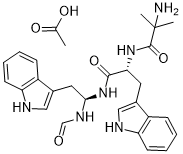
Macimorelin acetate (formerly AEZS-130; EP-1572; JMV-1843; trade name: Macrilen), the acetate salt form of Macimorelin, is a novel and potent synthetic small molecule growth hormone secretagogue receptor agonist approved in 2018 for use in the diagnosis of adult growth hormone deficiency. As a ghrelin agonist, it is orally active and stimulates the secretion of growth hormone (GH). As of December 2017, it became FDA-approved as a method to diagnose growth hormone deficiency. Traditionally, growth hormone deficiency was diagnosed via means of insulin tolerance test (IST) or glucagon stimulation test (GST). These two means are done parenterally, whereas Macrilen boasts an oral formulation for ease of administration for patients and providers.
Physicochemical Properties
| Molecular Formula | C28H34N6O5 | |
| Molecular Weight | 534.62 | |
| Exact Mass | 534.259 | |
| CAS # | 945212-59-9 | |
| Related CAS # | Macimorelin;381231-18-1 | |
| PubChem CID | 71526737 | |
| Appearance | White to off-white solid powder | |
| LogP | 5.156 | |
| Hydrogen Bond Donor Count | 7 | |
| Hydrogen Bond Acceptor Count | 6 | |
| Rotatable Bond Count | 9 | |
| Heavy Atom Count | 39 | |
| Complexity | 792 | |
| Defined Atom Stereocenter Count | 2 | |
| SMILES | CC(=O)O.CC(C)(C(=O)N[C@H](CC1=CNC2=CC=CC=C21)C(=O)N[C@H](CC3=CNC4=CC=CC=C43)NC=O)N |
|
| InChi Key | WVDSKQXKCDZXLH-OHIDFYLOSA-N | |
| InChi Code | InChI=1S/C26H30N6O3.C2H4O2/c1-26(2,27)25(35)31-22(11-16-13-28-20-9-5-3-7-18(16)20)24(34)32-23(30-15-33)12-17-14-29-21-10-6-4-8-19(17)21;1-2(3)4/h3-10,13-15,22-23,28-29H,11-12,27H2,1-2H3,(H,30,33)(H,31,35)(H,32,34);1H3,(H,3,4)/t22-,23-;/m1./s1 | |
| Chemical Name |
|
|
| Synonyms |
|
|
| HS Tariff Code | 2934.99.9001 | |
| Storage |
Powder-20°C 3 years 4°C 2 years In solvent -80°C 6 months -20°C 1 month |
|
| Shipping Condition | Room temperature (This product is stable at ambient temperature for a few days during ordinary shipping and time spent in Customs) |
Biological Activity
| ln Vivo |
In the IHKA mouse model, macimorelin perlite (5 mg/kg twice daily for 2 weeks) decreases the number and length of predictions [2]. Macimorelin Acetate is used as a diagnostic test to stimulate endogenous growth hormone (GH) secretion. In a phase III, open-label, randomized, two-way crossover trial (n=139 for efficacy analysis), a single oral dose of macimorelin (0.5 mg/kg body weight) was compared to the insulin tolerance test (ITT) for diagnosing adult growth hormone deficiency (AGHD). The macimorelin test induced a robust increase in GH levels in healthy individuals. Using a GH cutoff of 2.8 ng/mL for macimorelin and 5.1 ng/mL for ITT, the negative agreement between the tests was 95.38% (95% CI: 87.10% to 99.04%), and the positive agreement was 74.32% (95% CI: 62.84% to 83.78%). Sensitivity was 87% and specificity was 96%. In a post hoc analysis using a common cutoff of 5.1 ng/mL for both tests, the negative agreement was 93.85% (95% CI: 84.99% to 98.30%), positive agreement was 82.43% (95% CI: 71.83% to 90.30%), sensitivity was 92%, and specificity was 96%. The test showed high reproducibility (94%) in a substudy (n=33). [1] The peak GH levels after macimorelin administration were consistently higher than those after ITT across all AGHD likelihood groups (high, intermediate, low, and healthy controls). [1] |
| Animal Protocol |
Animal/Disease Models: Intrahippocampal kainic acid (IHKA) mouse model [2] Doses: 5 mg/kg Route of Administration: intraperitoneal (ip) injection, twice a day for two weeks. Experimental Results: The number and duration of seizures were Dramatically diminished during treatment, but there was no anti-epileptogenic or disease-modifying effect. C57BL/6 male mice (10 weeks old) were used. Status epilepticus (SE) was induced by unilateral intrahippocampal stereotaxic injection of kainic acid (KA). Sham-operated mice received saline injection at the same coordinates. [2] Starting 24 hours after SE induction, mice received intraperitoneal (IP) injections of Macimorelin Acetate (5 mg/kg) or vehicle (0.9% NaCl) twice daily (between 7:00-8:00 AM and 6:00-7:00 PM) for 2 weeks. The injection volume was 10 ml/kg body weight. [2] This was followed by a 2-week wash-out period with no drug administration. Mice were continuously monitored by electroencephalogram (EEG) throughout the treatment and wash-out periods. [2] For the acute food intake experiment on day 13 of treatment, mice were observed for 2 hours immediately after morning injection, with access to pre-weighed food pellets. Time spent eating and mass of food consumed were recorded. [2] At the end of the experiment (after wash-out), mice were perfused, and brains were collected for immunohistochemical analysis of neuronal and glial markers. [2] |
| ADME/Pharmacokinetics |
Previous studies (cited within the paper) indicate that a single oral dose of Macimorelin Acetate induces a strong dose-dependent increase in GH levels lasting 120 minutes, with peak plasma drug concentrations occurring between 50 and 75 minutes. [1] |
| Toxicity/Toxicokinetics |
In the phase III study, Macimorelin Acetate was safe and well-tolerated. No serious adverse events (SAEs) were reported for macimorelin. One case of a broken arm reported one day after a macimorelin test was considered unrelated to the drug. Non-serious adverse events (AEs) were less frequent and less severe compared to those during the ITT. The most frequently reported side effect was mild and transient dysgeusia (altered taste). No drug-related QT interval prolongation was documented in this study, although a previous study reported one asymptomatic QT prolongation that resolved spontaneously in a patient taking citalopram. [1] |
| References |
[1]. Macimorelin as a Diagnostic Test for Adult GH Deficiency. J Clin Endocrinol Metab. 2018 Aug 1;103(8):3083-3093. [2]. Translational potential of the ghrelin receptor agonist macimorelin for seizure suppression in pharmacoresistant epilepsy. Eur J Neurol. 2021 Sep;28(9):3100-3112. [3]. Ali SA, Garcia JM. Randomized clinical trial of the novel oral ghrelin mimetic macimorelin in the treatment of cancer cachexia: study design and preliminary results. Endocr Rev. 2013;34:. |
| Additional Infomation |
See also: Macimorelin (has active moiety). Drug Indication This medicinal product is for diagnostic use only. Â GHRYVELINÂ is indicated for the diagnosis of growth hormone deficiency (GHD) in adults. Macimorelin Acetate is an orally active ghrelin mimetic and growth hormone secretagogue (GHS). [1] It is proposed as a diagnostic test for Adult Growth Hormone Deficiency (AGHD). The test is simple, requiring only oral administration and four venous blood samples collected at 30, 45, 60, and 90 minutes post-dose for GH measurement. [1] The macimorelin test is more convenient, less time-consuming, less resource-intensive, and has a better safety profile (no risk of severe hypoglycemia) compared to the Insulin Tolerance Test (ITT). In this study, 99% of macimorelin tests were evaluable after the first attempt, compared to challenges with achieving adequate hypoglycemia for the ITT. [1] The recommended GH cutoff point for the macimorelin test using the IDS-iSYS human GH assay is 5.1 ng/mL. This cutoff provides an excellent balance between sensitivity and specificity and is identical to the cutoff recommended for the ITT with the same assay. [1] Limitations noted in the study: The test has not been evaluated in patients with uncontrolled diabetes, the elderly, pediatric patients, or a large number of patients with BMI >35 kg/m². Possible interactions with drugs that prolong the QT interval should be further evaluated. [1] |
Solubility Data
| Solubility (In Vitro) |
|
|||
| Solubility (In Vivo) |
Note: Listed below are some common formulations that may be used to formulate products with low water solubility (e.g. < 1 mg/mL), you may test these formulations using a minute amount of products to avoid loss of samples. Injection Formulations (e.g. IP/IV/IM/SC) Injection Formulation 1: DMSO : Tween 80: Saline = 10 : 5 : 85 (i.e. 100 μL DMSO stock solution → 50 μL Tween 80 → 850 μL Saline) *Preparation of saline: Dissolve 0.9 g of sodium chloride in 100 mL ddH ₂ O to obtain a clear solution. Injection Formulation 2: DMSO : PEG300 :Tween 80 : Saline = 10 : 40 : 5 : 45 (i.e. 100 μL DMSO → 400 μLPEG300 → 50 μL Tween 80 → 450 μL Saline) Injection Formulation 3: DMSO : Corn oil = 10 : 90 (i.e. 100 μL DMSO → 900 μL Corn oil) Example: Take the Injection Formulation 3 (DMSO : Corn oil = 10 : 90) as an example, if 1 mL of 2.5 mg/mL working solution is to be prepared, you can take 100 μL 25 mg/mL DMSO stock solution and add to 900 μL corn oil, mix well to obtain a clear or suspension solution (2.5 mg/mL, ready for use in animals). Injection Formulation 4: DMSO : 20% SBE-β-CD in saline = 10 : 90 [i.e. 100 μL DMSO → 900 μL (20% SBE-β-CD in saline)] *Preparation of 20% SBE-β-CD in Saline (4°C,1 week): Dissolve 2 g SBE-β-CD in 10 mL saline to obtain a clear solution. Injection Formulation 5: 2-Hydroxypropyl-β-cyclodextrin : Saline = 50 : 50 (i.e. 500 μL 2-Hydroxypropyl-β-cyclodextrin → 500 μL Saline) Injection Formulation 6: DMSO : PEG300 : castor oil : Saline = 5 : 10 : 20 : 65 (i.e. 50 μL DMSO → 100 μLPEG300 → 200 μL castor oil → 650 μL Saline) Injection Formulation 7: Ethanol : Cremophor : Saline = 10: 10 : 80 (i.e. 100 μL Ethanol → 100 μL Cremophor → 800 μL Saline) Injection Formulation 8: Dissolve in Cremophor/Ethanol (50 : 50), then diluted by Saline Injection Formulation 9: EtOH : Corn oil = 10 : 90 (i.e. 100 μL EtOH → 900 μL Corn oil) Injection Formulation 10: EtOH : PEG300:Tween 80 : Saline = 10 : 40 : 5 : 45 (i.e. 100 μL EtOH → 400 μLPEG300 → 50 μL Tween 80 → 450 μL Saline) Oral Formulations Oral Formulation 1: Suspend in 0.5% CMC Na (carboxymethylcellulose sodium) Oral Formulation 2: Suspend in 0.5% Carboxymethyl cellulose Example: Take the Oral Formulation 1 (Suspend in 0.5% CMC Na) as an example, if 100 mL of 2.5 mg/mL working solution is to be prepared, you can first prepare 0.5% CMC Na solution by measuring 0.5 g CMC Na and dissolve it in 100 mL ddH2O to obtain a clear solution; then add 250 mg of the product to 100 mL 0.5% CMC Na solution, to make the suspension solution (2.5 mg/mL, ready for use in animals). Oral Formulation 3: Dissolved in PEG400 Oral Formulation 4: Suspend in 0.2% Carboxymethyl cellulose Oral Formulation 5: Dissolve in 0.25% Tween 80 and 0.5% Carboxymethyl cellulose Oral Formulation 6: Mixing with food powders Note: Please be aware that the above formulations are for reference only. InvivoChem strongly recommends customers to read literature methods/protocols carefully before determining which formulation you should use for in vivo studies, as different compounds have different solubility properties and have to be formulated differently. (Please use freshly prepared in vivo formulations for optimal results.) |
| Preparing Stock Solutions | 1 mg | 5 mg | 10 mg | |
| 1 mM | 1.8705 mL | 9.3524 mL | 18.7049 mL | |
| 5 mM | 0.3741 mL | 1.8705 mL | 3.7410 mL | |
| 10 mM | 0.1870 mL | 0.9352 mL | 1.8705 mL |