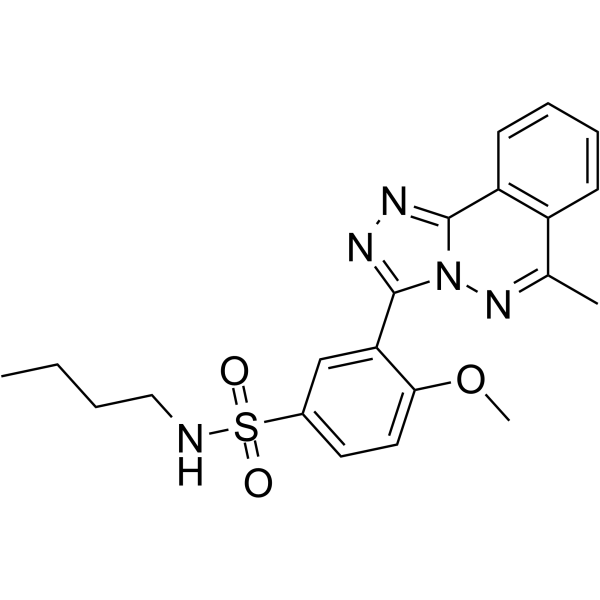
Physicochemical Properties
| Molecular Formula | C21H23N5O3S |
| Molecular Weight | 425.504022836685 |
| CAS # | 849000-18-6 |
| PubChem CID | 2044236 |
| Appearance | Light yellow to yellow solid powder |
| Hydrogen Bond Donor Count | 1 |
| Hydrogen Bond Acceptor Count | 7 |
| Rotatable Bond Count | 7 |
| Heavy Atom Count | 30 |
| Complexity | 672 |
| Defined Atom Stereocenter Count | 0 |
| SMILES | S(C1C=CC(=C(C=1)C1=NN=C2C3C=CC=CC=3C(C)=NN12)OC)(NCCCC)(=O)=O |
| HS Tariff Code | 2934.99.9001 |
| Storage |
Powder-20°C 3 years 4°C 2 years In solvent -80°C 6 months -20°C 1 month |
| Shipping Condition | Room temperature (This product is stable at ambient temperature for a few days during ordinary shipping and time spent in Customs) |
Biological Activity
| ln Vitro | By step-wise depolarizing voltages using the whole-cell patchclamp configuration, Lu AE98134 (30 μM) promotes the current mediated by Navv1.1 channel, activates Nav1.5 and, to a lesser extent, Nav1.2, but has no effect on Nav1.4, Nav1.6, and Nav1.7 currents in HEK cells expressing Nav1.1, Nav1.2, Nav1.6, Nav1.5, and Nav1.7[1]. Lu AE98134 (30 μM) lowers the action potential threshold, increasing the excitability of FSINs. Repeated firing of action potentials at specific frequencies is induced by intracellular depolarizing current pulses. In addition, Lu AE98134 increases excitability because each current pulse produces a greater number of spikes (163 in control and 230 in Lu AE98134) [1]. |
| ln Vivo | Fast spiking inhibitory interneurons (FSINs) from Dlx5/6+/− mice had wider action potentials and a greater depolarized spike threshold, which causes aberrant excitability. Lu AE98134 (30 μM) modulates various characteristics characteristic for NaV1.1 channels, increasing the excitability of FSINs neurons from both normal and Dlx5/6+ /− mice. In mature Dlx5/6+/− mice, selective FSIN activation by Lu AE98134 restores cognitive flexibility[1]. |
| References |
[1]. The sodium channel activator Lu AE98134 normalizes the altered firing properties of fast spiking interneurons in Dlx5/6 +/- mice. Neurosci Lett. 2018 Jan 1;662:29-35. |
Solubility Data
| Solubility (In Vitro) | DMSO: 250 mg/mL (587.54 mM) |
| Solubility (In Vivo) |
Solubility in Formulation 1: ≥ 2.08 mg/mL (4.89 mM) (saturation unknown) in 10% DMSO + 40% PEG300 + 5% Tween80 + 45% Saline (add these co-solvents sequentially from left to right, and one by one), clear solution. For example, if 1 mL of working solution is to be prepared, you can add 100 μL of 20.8 mg/mL clear DMSO stock solution to 400 μL PEG300 and mix evenly; then add 50 μL Tween-80 to the above solution and mix evenly; then add 450 μL normal saline to adjust the volume to 1 mL. Preparation of saline: Dissolve 0.9 g of sodium chloride in 100 mL ddH₂ O to obtain a clear solution. Solubility in Formulation 2: ≥ 2.08 mg/mL (4.89 mM) (saturation unknown) in 10% DMSO + 90% Corn Oil (add these co-solvents sequentially from left to right, and one by one), clear solution. For example, if 1 mL of working solution is to be prepared, you can add 100 μL of 20.8 mg/mL clear DMSO stock solution to 900 μL of corn oil and mix evenly. (Please use freshly prepared in vivo formulations for optimal results.) |
| Preparing Stock Solutions | 1 mg | 5 mg | 10 mg | |
| 1 mM | 2.3502 mL | 11.7509 mL | 23.5018 mL | |
| 5 mM | 0.4700 mL | 2.3502 mL | 4.7004 mL | |
| 10 mM | 0.2350 mL | 1.1751 mL | 2.3502 mL |