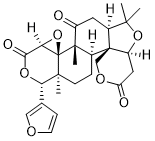
Limonin (also known as NSC-36508; Obaculactone; limonoate D-ring-lactone and limonoic acid di-delta-lactone), a naturally occurring limonoid, is a hexacyclic triterpenoid isolated in citrus fruits and other plants, which has antivirus and antitumor ability. It is a crystalline, white, bitter substance. It belongs to the chemical class of substances called furanolactones. According to reports, extracts from citrus seeds possess antiviral qualities that prevent retroviruses such as HIV-1 and HTLV-I from replicating. Limonin has also been shown to have neuroprotective properties.
Physicochemical Properties
| Molecular Formula | C26H30O8 | |
| Molecular Weight | 470.51 | |
| Exact Mass | 470.194 | |
| Elemental Analysis | C, 66.37; H, 6.43; O, 27.20 | |
| CAS # | 1180-71-8 | |
| Related CAS # |
|
|
| PubChem CID | 179651 | |
| Appearance | White to off-white solid powder | |
| Density | 1.4±0.1 g/cm3 | |
| Boiling Point | 668.4±55.0 °C at 760 mmHg | |
| Melting Point | 298ºC | |
| Flash Point | 358.0±31.5 °C | |
| Vapour Pressure | 0.0±2.0 mmHg at 25°C | |
| Index of Refraction | 1.602 | |
| LogP | 1.66 | |
| Hydrogen Bond Donor Count | 0 | |
| Hydrogen Bond Acceptor Count | 8 | |
| Rotatable Bond Count | 1 | |
| Heavy Atom Count | 34 | |
| Complexity | 1010 | |
| Defined Atom Stereocenter Count | 9 | |
| SMILES | O1[C@]2([H])C(=O)O[C@@]([H])(C3=C([H])OC([H])=C3[H])[C@]3(C([H])([H])[H])C([H])([H])C([H])([H])[C@]4([H])[C@@]56C([H])([H])OC(C([H])([H])[C@]5([H])OC(C([H])([H])[H])(C([H])([H])[H])[C@]6([H])C([H])([H])C([C@@]4(C([H])([H])[H])[C@]132)=O)=O |
|
| InChi Key | KBDSLGBFQAGHBE-MSGMIQHVSA-N | |
| InChi Code | InChI=1S/C26H30O8/c1-22(2)15-9-16(27)24(4)14(25(15)12-31-18(28)10-17(25)33-22)5-7-23(3)19(13-6-8-30-11-13)32-21(29)20-26(23,24)34-20/h6,8,11,14-15,17,19-20H,5,7,9-10,12H2,1-4H3/t14-,15-,17-,19-,20+,23-,24-,25+,26+/m0/s1 | |
| Chemical Name | (1R,2R,7S,10R,13R,14R,16S,19S,20S)-19-(furan-3-yl)-9,9,13,20-tetramethyl-4,8,15,18-tetraoxahexacyclo[11.9.0.02,7.02,10.014,16.014,20]docosane-5,12,17-trione | |
| Synonyms |
|
|
| HS Tariff Code | 2934.99.9001 | |
| Storage |
Powder-20°C 3 years 4°C 2 years In solvent -80°C 6 months -20°C 1 month |
|
| Shipping Condition | Room temperature (This product is stable at ambient temperature for a few days during ordinary shipping and time spent in Customs) |
Biological Activity
| Targets |
Human Endogenous Metabolite Limonin exhibits antifungal activity against Candida albicans, with a minimum inhibitory concentration (MIC) of 125 μg/mL in vitro [2] - It inhibits inducible nitric oxide synthase (iNOS) and cyclooxygenase-2 (COX-2) in lipopolysaccharide (LPS)-stimulated macrophages; 50 μM Limonin reduces iNOS protein levels by ~60% and COX-2 by ~55% [3] - Limonin inhibits human breast cancer (MCF-7) and colon cancer (HCT116) cell proliferation; but 100 μM Limonin reduces MCF-7 cell viability by ~45% [3] |
| ln Vitro |
Limonin is a citrus fruit-enriched furanolactone with antitumor and antivirus properties. With an EC50 of 60 μM, limonin prevents human immunodeficiency virus-1 (HIV-1) from replicating in human peripheral blood mononuclear cells (PBMC). (Source: ) In vivo, limonin also demonstrates antinociceptive and anti-inflammatory properties. [/2] Limonin regulates apoptosis and Wnt signaling to effectively inhibit the growth of human hepatoma HepG2 cells.[3] In LPS-stimulated RAW264.7 macrophages, treatment with 50 μM Limonin for 24 hours reduced nitric oxide (NO) production by ~70% (Griess reagent assay) and decreased tumor necrosis factor-α (TNF-α) levels by ~65% (ELISA); cell viability remained >90% (MTT assay) [1] - Against pathogenic fungi: 125 μg/mL Limonin inhibited growth of Candida albicans (MIC=125 μg/mL) and Aspergillus niger (MIC=250 μg/mL) in broth microdilution assays; no inhibition of Saccharomyces cerevisiae at concentrations up to 500 μg/mL [2] - In human MCF-7 breast cancer cells, 100 μM Limonin for 48 hours inhibited cell proliferation by ~45% (MTT assay) and induced G2/M cell cycle arrest (flow cytometry: ~25% increase in G2/M phase cells vs. vehicle) [3] - In LPS-stimulated human peripheral blood mononuclear cells (PBMCs), 25 μM Limonin for 18 hours reduced interleukin-6 (IL-6) secretion by ~60% and interleukin-1β (IL-1β) by ~55% (ELISA) [3] |
| ln Vivo |
Limonin demonstrated a 60% decrease in the tumor burden in female Syrian hamsters treated with DMBA, a drug that can cause tumors. It reduced 50% of the tumor mass and 20% of the tumor count. 0.05% limonin in the diet dramatically decreased (65%-92% inhibition) the incidence of colonic adenocarcinoma in male F344 rats treated with azoxymethane (AOM). Limonin therefore has chemopreventive effects on carcinogenesis that is chemically induced. In Wistar rats with carrageenan-induced paw edema (inflammatory model), oral administration of Limonin at 50 mg/kg once daily for 3 days reduced paw edema volume by ~50% on day 3 vs. vehicle; no significant effect at 25 mg/kg [3] |
| Enzyme Assay |
iNOS activity assay (from [3] abstract description): LPS-stimulated RAW264.7 macrophages were lysed in RIPA buffer. Cell lysates were mixed with L-arginine (substrate) and NADPH (cofactor) in assay buffer (50 mM Tris-HCl pH 7.4, 1 mM EDTA). Limonin was added at 10–100 μM, and the mixture was incubated at 37°C for 1 hour. NO production (indicator of iNOS activity) was measured via Griess reagent, and iNOS protein levels were detected via Western blot [3] - Fungal growth inhibition assay (from [2] abstract description): Fungal strains (Candida albicans, Aspergillus niger) were cultured in RPMI 1640 medium. Limonin was added at 31.25–500 μg/mL, and the mixture was incubated at 35°C for 48 hours. Fungal growth was assessed by measuring absorbance at 530 nm; MIC was defined as the lowest concentration with no visible growth [2] |
| Cell Assay |
Limonin inhibits HIV-1 replication in all cellular systems when it is cultivated in human peripheral blood mononuclear cells (PBMC) and monocytes/macrophages (M/M). In PBMC cells, this inhibition is dose-dependent and has an EC50 value of 60u μM. Limonin has the ability to induce apoptosis in human hepatoma HepG2 cells, as demonstrated by WB analysis of several apoptosis factors. RAW264.7 macrophage NO assay (from [1] abstract description): RAW264.7 cells were seeded at 5×10⁴ cells/well in 96-well plates and stimulated with LPS (1 μg/mL) for 1 hour. Cells were treated with Limonin (10–100 μM) for 24 hours. Culture supernatants were collected for NO detection (Griess reagent: absorbance 540 nm) and TNF-α quantification (ELISA). Cell viability was measured via MTT assay (absorbance 570 nm) [1] - MCF-7 cell proliferation assay (from [3] abstract description): MCF-7 cells were seeded at 1×10⁴ cells/well and treated with Limonin (25–100 μM) for 48 hours. MTT reagent was added (4-hour incubation), and absorbance at 570 nm was measured to calculate cell viability. For cell cycle analysis, cells were fixed with 70% ethanol, stained with propidium iodide (PI), and analyzed by flow cytometry [3] |
| Animal Protocol |
0.05% limonin in diet Female Syrian hamsters and rats Rat paw edema model (from [3] abstract description): Male Wistar rats (150–200 g) were divided into 3 groups: (1) Vehicle control: 0.5% DMSO + 0.9% saline (oral); (2) Limonin 25 mg/kg: dissolved in 0.5% DMSO + 0.9% saline (oral); (3) Limonin 50 mg/kg (same solvent, oral). Paw edema was induced by subplantar injection of 0.1 mL carrageenan (1% w/v) 1 hour after drug administration. Paw volume was measured using a plethysmometer at 0, 2, 4, 6, and 24 hours post-carrageenan injection; measurements were repeated daily for 3 days [3] |
| Toxicity/Toxicokinetics |
In RAW264.7 macrophages and human PBMCs, Limonin up to 100 μM for 24 hours had no significant cytotoxicity (cell viability >90% vs. vehicle) [1,3] - In normal human foreskin fibroblasts (NHFF), 100 μM Limonin for 48 hours reduced cell viability by <10% (MTT assay), indicating low toxicity to normal cells [3] |
| References |
[1]. Planta Med . 2003 Oct;69(10):910-3. [2]. Planta Med . 1998 May;64(4):339-42. [3]. J Nat Sci Biol Med . 2013 Jan;4(1):126-33. |
| Additional Infomation |
Limonin is a limonoid, an epoxide, a hexacyclic triterpenoid, a member of furans, an organic heterohexacyclic compound and a lactone. It has a role as a metabolite, an inhibitor and a volatile oil component. Limonin has been reported in Raulinoa echinata, Citrus tankan, and other organisms with data available. Limonin is a limonoid compound naturally occurring in citrus fruits (e.g., oranges, lemons, grapefruits); it is classified as a plant secondary metabolite with traditional use in folk medicine for anti-inflammatory purposes [1,3] - Its anti-inflammatory mechanism involves downregulating pro-inflammatory mediators (NO, TNF-α, IL-6) via inhibiting iNOS and COX-2 expression, though the exact signaling pathway (e.g., NF-κB) is not specified in the abstracts [1,3] - Limonin shows selective antifungal activity against pathogenic species (Candida albicans, Aspergillus niger) but not against non-pathogenic yeast (Saccharomyces cerevisiae) [2] |
Solubility Data
| Solubility (In Vitro) |
|
|||
| Solubility (In Vivo) |
Solubility in Formulation 1: ≥ 2.08 mg/mL (4.42 mM) (saturation unknown) in 10% DMSO + 90% (20% SBE-β-CD in Saline) (add these co-solvents sequentially from left to right, and one by one), clear solution. For example, if 1 mL of working solution is to be prepared, you can add 100 μL of 20.8 mg/mL clear DMSO stock solution to 900 μL of 20% SBE-β-CD physiological saline solution and mix evenly. Preparation of 20% SBE-β-CD in Saline (4°C,1 week): Dissolve 2 g SBE-β-CD in 10 mL saline to obtain a clear solution. Solubility in Formulation 2: ≥ 2.08 mg/mL (4.42 mM) (saturation unknown) in 10% DMSO + 90% Corn Oil (add these co-solvents sequentially from left to right, and one by one), clear solution. For example, if 1 mL of working solution is to be prepared, you can add 100 μL of 20.8 mg/mL clear DMSO stock solution to 900 μL of corn oil and mix evenly. (Please use freshly prepared in vivo formulations for optimal results.) |
| Preparing Stock Solutions | 1 mg | 5 mg | 10 mg | |
| 1 mM | 2.1254 mL | 10.6268 mL | 21.2535 mL | |
| 5 mM | 0.4251 mL | 2.1254 mL | 4.2507 mL | |
| 10 mM | 0.2125 mL | 1.0627 mL | 2.1254 mL |