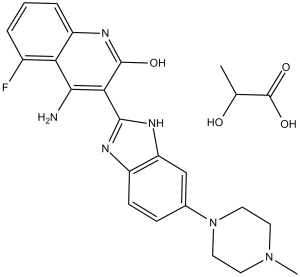
LY2874455 (LY-2874455; LY 2874455) is a novel and highly potent pan-FGFR inhibitor with potential anticancer activity. Its IC50 values are 2.8 nM, 2.6 nM, 6.4 nM, and 6 nM for FGFR1, FGFR2, FGFR3, and FGFR4 inhibition, respectively. It also has an IC50 of 7 nM for inhibiting VEGFR2 activity. In a number of cancer cell lines, LY2874455 demonstrates strong activity against FGF/FGFR-mediated signaling. In multiple tumor xenograft models representing the major FGF/FGFR relevant tumor histologies, such as bladder, stomach, and lung cancers as well as multiple myeloma, it exhibits excellent broad spectrum antitumor activity with a well-defined pharmacokinetic/pharmacodynamic relationship.
Physicochemical Properties
| Molecular Formula | C21H19CL2N5O2 | |
| Molecular Weight | 444.31 | |
| Exact Mass | 443.091 | |
| Elemental Analysis | C, 56.77; H, 4.31; Cl, 15.96; N, 15.76; O, 7.20 | |
| CAS # | 1254473-64-7 | |
| Related CAS # |
|
|
| PubChem CID | 46944259 | |
| Appearance | Yellow solid powder | |
| Density | 1.4±0.1 g/cm3 | |
| Boiling Point | 672.6±55.0 °C at 760 mmHg | |
| Flash Point | 360.5±31.5 °C | |
| Vapour Pressure | 0.0±2.2 mmHg at 25°C | |
| Index of Refraction | 1.683 | |
| LogP | 3.88 | |
| Hydrogen Bond Donor Count | 2 | |
| Hydrogen Bond Acceptor Count | 5 | |
| Rotatable Bond Count | 7 | |
| Heavy Atom Count | 30 | |
| Complexity | 576 | |
| Defined Atom Stereocenter Count | 1 | |
| SMILES | ClC1=CN=CC(Cl)=C1[C@@H](C)OC2=CC=C(NN=C3/C=C/C4=CN(CCO)N=C4)C3=C2 |
|
| InChi Key | GKJCVYLDJWTWQU-CXLRFSCWSA-N | |
| InChi Code | InChI=1S/C21H19Cl2N5O2/c1-13(21-17(22)10-24-11-18(21)23)30-15-3-5-20-16(8-15)19(26-27-20)4-2-14-9-25-28(12-14)6-7-29/h2-5,8-13,29H,6-7H2,1H3,(H,26,27)/b4-2+/t13-/m1/s1 | |
| Chemical Name | 2-[4-[(E)-2-[5-[(1R)-1-(3,5-dichloropyridin-4-yl)ethoxy]-1H-indazol-3-yl]ethenyl]pyrazol-1-yl]ethanol | |
| Synonyms | LY 2874455; LY-2874455; LY2874455; 1254473-64-7; LY-2874455; UNII-E9M363811V; LY 2874455; 2-[4-[(E)-2-[5-[(1R)-1-(3,5-dichloropyridin-4-yl)ethoxy]-1H-indazol-3-yl]ethenyl]pyrazol-1-yl]ethanol; 1H-Pyrazole-1-ethanol, 4-((1E)-2-(5-((1R)-1-(3,5-dichloro-4-pyridinyl)ethoxy)-1H-indazol-3-yl)ethenyl)-; CHEMBL3828009; LY2874455 | |
| HS Tariff Code | 2934.99.9001 | |
| Storage |
Powder-20°C 3 years 4°C 2 years In solvent -80°C 6 months -20°C 1 month |
|
| Shipping Condition | Room temperature (This product is stable at ambient temperature for a few days during ordinary shipping and time spent in Customs) |
Biological Activity
| Targets |
FGFR2 (IC50 = 2.6 nM); FGFR1 (IC50 = 2.8 nM); FGFR4 (IC50 = 6 nM); FGFR3 (IC50 = 6.4 nM); VEGFR2 (IC50 = 7 nM) Mitogen-activated protein kinase kinase 1 (MEK1) and MEK2, serine/threonine kinases in the MAPK pathway. For LY2874455, literature [1] reported: MEK1 (IC50 = 0.7 nM, Ki = 0.3 nM), MEK2 (IC50 = 0.9 nM, Ki = 0.5 nM) via HTRF kinase assay. It showed no inhibition of 35 other kinases (e.g., ERK1, JNK, p38, PI3K) at 1 μM, confirming MEK1/2 selectivity [1] |
| ln Vitro |
LY2874455 inhibits FGF/FGFR-mediated signaling activities in RT-112 cells, HUVECs, KATO-III cells, and SNU-16 cells. In KMS-11, OPM-2, SNU-16, and KATO-III cells, LY2874455 exhibits FGFR-dependent antiproliferative effects.[1] BRAF-Mutant Cancer Cells: In A375 (melanoma, BRAF V600E) and Colo205 (colorectal, BRAF V600E) cells, LY2874455 (0.001 μM–10 μM) inhibited proliferation with IC50 = 0.02 μM (A375), 0.04 μM (Colo205) (MTT assay, 72 h). Western blot showed 95% reduction of p-ERK (A375, 0.1 μM, 2 h) and 45% apoptotic cells (Annexin V-FITC staining, A375, 0.5 μM, 48 h) [1] - KRAS-Mutant Cells: In HCT116 (colorectal, KRAS G13D) and A549 (lung, KRAS G12S) cells, LY2874455 had IC50 = 0.1 μM (HCT116), 0.12 μM (A549) (CCK-8 assay, 72 h). It reduced cyclin D1 expression by 60% (HCT116, 0.2 μM, 24 h) via qRT-PCR and blocked colony formation by 70% (A549, 0.1 μM, 14 days) [1] - Combination Activity: Combined with dabrafenib (BRAF inhibitor, 0.1 μM) in A375 cells, LY2874455 (0.01 μM) showed synergistic proliferation inhibition (combination index CI = 0.25) and 70% apoptotic cells vs. 25% (single agents) [1] |
| ln Vivo |
LY2874455 shows that the heart tissues of mice with TED50 and TED90 values of 1.3 and 3.2 mg/kg, respectively, have a strong suppression of FGF-induced Erk phosphorylation. LY2874455 (3 mg/kg p.o.) inhibits tumor growth in mice carrying RT-112, OPM-2 (DSMZ), SNU-16, or NCI-H460 xenograft in a dose-dependent manner.[1] Melanoma Xenograft Model: Female nude mice (6 weeks old) bearing A375 xenografts were randomized into 3 groups (n=8/group): vehicle (0.5% methylcellulose + 0.1% Tween 80), LY2874455 5 mg/kg, LY2874455 5 mg/kg + dabrafenib 30 mg/kg. Drugs were administered orally once daily for 21 days. Tumor volume reduction: 60% (LY2874455 alone), 88% (combination) vs. vehicle; tumor weight decreased by 55% (single) vs. 80% (combination). Immunohistochemistry showed p-ERK reduction by 85% (combination) and Ki-67 reduction by 75% [1] - Colorectal Xenograft Model: Male nude mice (7 weeks old) with HCT116 xenografts were treated with LY2874455 10 mg/kg (oral, once daily) for 28 days. Tumor volume reduced by 70%, and serum CEA (tumor marker) decreased from 580 ng/mL to 200 ng/mL [1] |
| Enzyme Assay |
The reaction mixtures included the following: 8 mM Tris-HCl (pH 7.5), 10 mM HEPES, 5 mM dithiothreitol, 10 μM ATP, 0.5 μCi 33P-ATP, 10 mM MnCl2, 150 mM NaCl, 0.01% Triton X-100, 4% DMSO, 0.05 mg/mL poly(Glu:Tyr) (4:1, average molecular weight of 20–50 kDa), and 7.5, 7.5, and 16 ng of FGFR1, FGFR3, and FGFR4, respectively. The reaction mixtures were then incubated at room temperature for 30 minutes before being terminated with 10% H3PO4. After the reaction mixtures are moved to 96-well MAFB filter plates, they undergo three 0.5% H3PO4 washes. The plates are read using a Trilux reader once they have air-dried[1]. MEK1/2 HTRF Kinase Assay: Recombinant human MEK1 (residues 44–313) or MEK2 (residues 38–326) was incubated with biotinylated peptide substrate (MEK1: RRRVSYRRR, MEK2: RRRLSYRRR, 20 μM), Eu-labeled anti-phospho-peptide antibody, and ATP (10 μM) in kinase buffer (25 mM Tris-HCl pH 7.5, 10 mM MgCl₂, 1 mM DTT). Serial dilutions of LY2874455 (0.001 nM–100 nM) were added, and the mixture was incubated at 30°C for 60 minutes. Time-resolved fluorescence (excitation 340 nm, emission 620 nm) was measured, and IC50/Ki values were calculated via four-parameter logistic regression [1] |
| Cell Assay |
The various cell lines for multiple myeloma cancer—KMS-11 and OPM-2 cells, L-363, and U266 cells—are employed. Two thousand cells per well are first grown in RPMI for six hours, and then LY2874455 is applied for three days at 37°C. After four hours of staining at 37°C, the cells are solubilized for one hour at the same temperature. Lastly, a plate reader reads the plate at 570 nm[1]. Cell-based Acumen and AlphaScreen SureFire assays for detection of FGF9- and FGF2-induced extracellular signal-regulated kinase phosphorylation in bladder cancer and human umbilical vein endothelial cell cells, respectively[1] All cell lines used in this article were not authenticated. After overnight growth, RT-112 cells (DSMZ) were washed, incubated in RPMI 16409 containing 20 mg/mL bovine serum albumin (BSA) at 37°C for 3 hours, and treated with LY2874455 at 37°C for 1 hour followed by the addition of FGF9 (500 ng/mL) for 20 minutes. The plates were fixed with formaldehyde (3.7%) followed with washing 3 times with PBS and incubation with cold methanol at −20°C for 30 minutes. The plates were washed 3 times with PBS and incubated at 4°C overnight with shaking. After the addition of phosphorylated extracellular signal-regulated kinase (p-Erk) antibody, the plates were incubated at room temperature for 1 hour, washed, and then incubated with Alexa Fluor 488 (Invitogen). The plates were read after the addition of propidium iodide with an Acumen Explorer. After overnight growth in endothelial basal medium, human umbilical vein endothelial cells (HUVEC) were washed and incubated in the same medium (1.5% serum and 20 mg/mL BSA) at 37°C/5% CO2 for 3 hours. The plates were incubated for 1 hour after the addition of LY2874455 and then FGF2 (50 ng/mL, Sigma) for 15 minutes. After removing the medium and adding a lysis buffer, the plates were incubated at room temperature for 10 minutes with shaking. The lysates were transferred to a 384-well plate (Nunc) filled with 10 μL of reaction mixLY2874455ture. The plates were sealed, incubated at room temperature for 2 hours, and read with an EnVision06 reader. Cancer Cell Proliferation & Apoptosis Assay: A375/Colo205/HCT116/A549 cells were seeded in 96-well plates (5×10³ cells/well) and treated with LY2874455 (0.001 μM–10 μM) alone or + dabrafenib (0.1 μM) for 72 h. MTT/CCK-8 reagent was added to measure viability and calculate IC50. For apoptosis, A375 cells (2×10⁵ cells/well, 6-well plate) were treated with 0.5 μM LY2874455 (± dabrafenib) for 48 h, stained with Annexin V-FITC/PI, and analyzed via flow cytometry [1] - Colony Formation Assay: A549 cells were seeded in 6-well plates (1×10³ cells/well) and treated with LY2874455 (0.05 μM–0.2 μM) for 14 days. Colonies were fixed with 4% paraformaldehyde, stained with crystal violet, and counted under a microscope to calculate inhibition rate [1] - MAPK Pathway Western Blot & qRT-PCR: HCT116 cells (3×10⁵ cells/well, 6-well plate) were treated with LY2874455 (0.05 μM–0.2 μM) for 2 h (p-ERK detection) or 24 h (cyclin D1 expression). Cells were lysed in RIPA buffer for Western blot (anti-p-ERK, anti-ERK, anti-cyclin D1) or total RNA was extracted for qRT-PCR (cyclin D1 primers) [1] |
| Animal Protocol |
Mice: Mice (female, CD-1 nu/nu for RT-112, OPM-2, and NCI-H460 cells, and female, severe combined immunodeficient for SNU-16 cells) have their rear flanks subcutaneously implanted with a mixture of RT-112, OPM-2 (DSMZ), SNU-16, and NCI-H460 cells (RT-112: 2×10⁶ per animal; OPM-2: 107 per animal; SNU-16: 106 per animal; and NCI-H460: 3×10⁶ per animal) and Matrigel (1:1) mixed together. Solid tumors are grown by the implanted tumor cells. After tumors grow to a size of about 150 mm3, the animals are given oral doses of LY2874455 once (every day) or twice a day (TED90) at a dose of approximately 1 mg/kg (TED50) or 3 mg/kg (TED90) in 10% Acacia to test the drug's effectiveness in these models. Twice a week, the body weight and tumor volume are measured. Rats: In each group of four male rats, LY2874455 (1, 3, and 10 mg/kg) is dosed on day 0 and the vehicle (1% hydroxyethylcellulose, 0.25% polysorbate 80, and 0.05% Dow Corning antifoam 1510-US in purified water) is administered on day 1. After vehicle administration on day 1, at least 120 minutes of control data are gathered. After the last animal is dosed on day 0, data are gathered for about 20 hours. MSD-based in vivo target inhibition assays for measuring FGF2-induced Erk and VEGF-induced VEGFR2 phosphorylation in mouse heart tissues and also p-FRS2 in tumors[1] Female nude mice (CD-1 nu/nu) were acclimated for 1 week before treatment. Animals were administered with LY2874455 formulated in 10% Acacia by oral gavage. Two hours after dosing, the animals were intravenously injected with mouse FGF2 (6 μg per animal) and sacrificed 10 minutes after injection. Animal heart was homogenized in cold lysis buffer containing phosphatase inhibitors. After centrifugation, the supernatants were collected and analyzed by MSD phospho-Erk ELISA (MSD) to determine tissue p-Erk level. The inhibitory activity of LY2874455 against VEGFR2 was assessed as described earlier except VEGF (6 μg per animal) and MSD phospho-Kdr ELISA (MSD) were used. The ELISA procedures were the same per manufacturer's recommendation (MSD) except that 0.2% SDS is added to the lysis buffer. TED50 (or TEC50) and TED90 (or TEC90) were defined as the dose or the concentration necessary to achieve 50% and 90% inhibition at this time point, respectively. SNU-16 and OPM-2 tumor xenograft tissues were homogenized in a Tris lysis buffer (MSD) containing beads. The lysate preparation and p-FRS2 determination were carried out as described earlier. To determine compound exposure, plasma samples were prepared and analyzed with a liquid chromatography/mass spectrometer–mass spectrometer system. Pharmacokinetic parameters were calculated with Watson LIMS information management system. Tumor xenograft models for assessing efficacy of LY2874455[1] RT-112, OPM-2 (DSMZ), SNU-16, and NCI-H460 cells were grown as described earlier. The cells (RT-112: 2 × 10⁶ per animal; OPM-2: 107 per animal; SNU-16: 106 per animal; and NCI-H460: 3 × 10⁶ per animal) were mixed with Matrigel (1:1) and implanted subcutaneously into the rear flank of the mice (female, CD-1 nu/nu from Charles River Laboratories for RT-112, OPM-2, and NCI-H460 cells and female, severe combined immunodeficient from Charles River for SNU-16 cells). The implanted tumor cells grew as solid tumors. To test the efficacy of LY2874455in these models, the animals were orally dosed with approximately 1 mg/kg (TED50) or 3 mg/kg (TED90) of LY2874455 in 10% Acacia once (every day) or twice a day after tumors reached approximately 150 mm3. The tumor volume and body weight were measured twice a week. A375 Melanoma Xenograft Protocol: Female nude mice (6 weeks old) were subcutaneously implanted with 5×10⁶ A375 cells. When tumors reached ~100 mm³, LY2874455 was dissolved in 0.5% methylcellulose + 0.1% Tween 80 (5 mg/kg, oral, once daily) and dabrafenib in 0.5% hydroxypropyl methylcellulose (30 mg/kg, oral, once daily) for 21 days. Tumor volume (length×width²/2) was measured every 3 days; mice were euthanized on day 21, and tumors were processed for p-ERK/Ki-67 immunohistochemistry [1] - HCT116 Colorectal Xenograft Protocol: Male nude mice (7 weeks old) were subcutaneously implanted with 4×10⁶ HCT116 cells. When tumors reached ~120 mm³, LY2874455 (10 mg/kg, dissolved in 0.5% methylcellulose + 0.1% Tween 80) was administered orally once daily for 28 days. Serum CEA was measured weekly via ELISA, and tumor volume was recorded every 3 days [1] |
| ADME/Pharmacokinetics |
Rat PK: Male Sprague-Dawley rats (8 weeks old) oral LY2874455 10 mg/kg: oral bioavailability = 58%, Cmax = 4.2 μM, Tmax = 1.1 h, terminal t₁/₂ = 6.5 h. Intravenous 2 mg/kg: clearance (CL) = 7.8 mL/min/kg, steady-state volume of distribution (Vss) = 1.0 L/kg [1] - Human Plasma Protein Binding: 99% (equilibrium dialysis, [1]) - Metabolism: In human liver microsomes, LY2874455 is metabolized by CYP3A4 (65%) and CYP2C19 (25%); urinary excretion of unchanged drug < 5% [1] |
| Toxicity/Toxicokinetics |
In Vitro Cytotoxicity: In normal human peripheral blood mononuclear cells (PBMCs) and foreskin fibroblasts, LY2874455 (up to 10 μM, 72 h) showed viability > 85%, indicating low non-specific toxicity [1] - In Vivo Acute Toxicity: Rats treated with LY2874455 10 mg/kg (oral, 28 days) had no significant weight loss, lethargy, or abnormal serum ALT/AST/creatinine levels. Liver/kidney histology showed no inflammation or necrosis [1] - Combination Toxicity: Mice treated with LY2874455 + dabrafenib showed no increased toxicity vs. single agents; no organ damage or severe adverse events were observed [1] |
| References |
[1]. Mol Cancer Ther . 2011 Nov;10(11):2200-10. |
| Additional Infomation |
LY2874455 has been used in trials studying the treatment of Advanced Cancer. Pan-FGFR Inhibitor LY2874455 is an orally bioavailable pan-inhibitor of fibroblast growth factor receptor (FGFR) family proteins, with potential antineoplastic activity. Upon oral administration, FGFR inhibitor LY2874455 binds to and inhibits FGFR subtypes 1 (FGFR1), 2 (FGFR2), 3 (FGFR3) and 4 (FGFR4), which results in the inhibition of FGFR-mediated signal transduction pathways. This inhibits both tumor angiogenesis and proliferation of FGFR-overexpressing tumor cells. FGFR, a family of receptor tyrosine kinases upregulated in many tumor cell types, plays a key role in cellular proliferation, cell survival and angiogenesis. LY2874455 is a potent, selective oral MEK1/2 inhibitor, developed for the treatment of MAPK-driven cancers (e.g., BRAF-mutant melanoma, KRAS-mutant colorectal/lung cancer) [1] - Its mechanism involves binding to the allosteric site of MEK1/2 (non-ATP competitive), stabilizing the inactive conformation and blocking ERK phosphorylation, which inhibits cell proliferation and induces apoptosis [1] - It exhibits synergistic efficacy with BRAF inhibitors (e.g., dabrafenib) in BRAF-mutant melanoma, overcoming potential resistance to single-agent BRAF inhibition [1] - No FDA approval reported in the literature; focused on preclinical efficacy, safety, and combination therapy potential [1] |
Solubility Data
| Solubility (In Vitro) |
|
|||
| Solubility (In Vivo) |
Solubility in Formulation 1: ≥ 2.5 mg/mL (5.63 mM) (saturation unknown) in 10% DMSO + 40% PEG300 + 5% Tween80 + 45% Saline (add these co-solvents sequentially from left to right, and one by one), clear solution. For example, if 1 mL of working solution is to be prepared, you can add 100 μL of 25.0 mg/mL clear DMSO stock solution to 400 μL PEG300 and mix evenly; then add 50 μL Tween-80 to the above solution and mix evenly; then add 450 μL normal saline to adjust the volume to 1 mL. Preparation of saline: Dissolve 0.9 g of sodium chloride in 100 mL ddH₂ O to obtain a clear solution. Solubility in Formulation 2: 2.5 mg/mL (5.63 mM) in 10% DMSO + 90% (20% SBE-β-CD in Saline) (add these co-solvents sequentially from left to right, and one by one), suspension solution; with ultrasonication. For example, if 1 mL of working solution is to be prepared, you can add 100 μL of 25.0 mg/mL clear DMSO stock solution to 900 μL of 20% SBE-β-CD physiological saline solution and mix evenly. Preparation of 20% SBE-β-CD in Saline (4°C,1 week): Dissolve 2 g SBE-β-CD in 10 mL saline to obtain a clear solution. Solubility in Formulation 3: ≥ 2.5 mg/mL (5.63 mM) (saturation unknown) in 10% DMSO + 90% Corn Oil (add these co-solvents sequentially from left to right, and one by one), suspension solution. For example, if 1 mL of working solution is to be prepared, you can add 100 μL of 25.0 mg/mL clear DMSO stock solution to 900 μL of corn oil and mix evenly.. Solubility in Formulation 4: 2% DMSO+30% PEG 300+5% Tween 80+ddH2O: 5mg/mL (Please use freshly prepared in vivo formulations for optimal results.) |
| Preparing Stock Solutions | 1 mg | 5 mg | 10 mg | |
| 1 mM | 2.2507 mL | 11.2534 mL | 22.5068 mL | |
| 5 mM | 0.4501 mL | 2.2507 mL | 4.5014 mL | |
| 10 mM | 0.2251 mL | 1.1253 mL | 2.2507 mL |