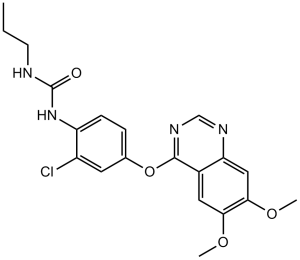
KRN 633 (KRN-633) is a novel, potent, selective, cell-permeable, reversible, and ATP-competitive inhibitor of VEGFR1/2/3 with potential antitumor activity. It does not prevent the phosphorylation of FGFR-1, EGFR, or c-Met in cells, but it weakly inhibits PDGFR-α/β and c-Kit. Its IC50s for VEGFR1/2/3 are 170 nM, 160 nM, and 125 nM. In a number of in vivo tumor xenograft models in athymic mice and rats, KRN633 inhibits the growth of tumors originating from a variety of tissues, including the prostate, lung, and colon. Additionally, KRN633 causes some well-established tumors to shrink as well as those that had grown back after treatment was stopped. KRN633 was well tolerated and had no appreciable effects on the animals' overall health or body weight. KRN633 may be helpful in treating diseases that depend on pathologic angiogenesis, such as solid tumors.
Physicochemical Properties
| Molecular Formula | C20H21CLN4O4 | |
| Molecular Weight | 416.86 | |
| Exact Mass | 416.125 | |
| Elemental Analysis | C, 57.62; H, 5.08; Cl, 8.50; N, 13.44; O, 15.35 | |
| CAS # | 286370-15-8 | |
| Related CAS # |
|
|
| PubChem CID | 9549295 | |
| Appearance | White to off-white solid powder | |
| Density | 1.3±0.1 g/cm3 | |
| Boiling Point | 545.6±50.0 °C at 760 mmHg | |
| Melting Point | 229 °C | |
| Flash Point | 283.7±30.1 °C | |
| Vapour Pressure | 0.0±1.5 mmHg at 25°C | |
| Index of Refraction | 1.629 | |
| LogP | 4.14 | |
| Hydrogen Bond Donor Count | 2 | |
| Hydrogen Bond Acceptor Count | 6 | |
| Rotatable Bond Count | 7 | |
| Heavy Atom Count | 29 | |
| Complexity | 529 | |
| Defined Atom Stereocenter Count | 0 | |
| SMILES | ClC1C([H])=C(C([H])=C([H])C=1N([H])C(N([H])C([H])([H])C([H])([H])C([H])([H])[H])=O)OC1C2=C([H])C(=C(C([H])=C2N=C([H])N=1)OC([H])([H])[H])OC([H])([H])[H] |
|
| InChi Key | VPBYZLCHOKSGRX-UHFFFAOYSA-N | |
| InChi Code | InChI=1S/C20H21ClN4O4/c1-4-7-22-20(26)25-15-6-5-12(8-14(15)21)29-19-13-9-17(27-2)18(28-3)10-16(13)23-11-24-19/h5-6,8-11H,4,7H2,1-3H3,(H2,22,25,26) | |
| Chemical Name | 1-[2-chloro-4-(6,7-dimethoxyquinazolin-4-yl)oxyphenyl]-3-propylurea | |
| Synonyms | KRN633; KRN-633; K00589a; VEGF receptor tyrosine kinase inhibitor III; 1-(2-chloro-4-(6,7-dimethoxyquinazolin-4-yloxy)phenyl)-3-propylurea; 1-{2-chloro-4-[(6,7-dimethoxyquinazolin-4-yl)oxy]phenyl}-3-propylurea; KRN 633 | |
| HS Tariff Code | 2934.99.9001 | |
| Storage |
Powder-20°C 3 years 4°C 2 years In solvent -80°C 6 months -20°C 1 month |
|
| Shipping Condition | Room temperature (This product is stable at ambient temperature for a few days during ordinary shipping and time spent in Customs) |
Biological Activity
| Targets |
VEGFR1 (IC50 = 170 nM); VEGFR2 (IC50 = 160 nM); VEGFR3 (IC50 = 125 nM) KRN 633 inhibits vascular endothelial growth factor receptor 2 (VEGFR2) tyrosine kinase (IC₅₀ = 0.02 μM) and VEGFR1 tyrosine kinase (IC₅₀ = 0.2 μM) [1] KRN 633 also shows inhibitory activity against platelet-derived growth factor receptor β (PDGFRβ) (IC₅₀ = 0.3 μM) [3] |
| ln Vitro |
KRN 633 is a novel quinazoline urea derivative that has IC50 values of 170 nM, 160 nM, and 125 nM, respectively, strongly inhibiting the VEGFR1, VEGFR2, and VEGFR3 receptors. With regard to non-RTKs, such as c-Kit, breast tumor kinase, PDGF receptor (PDGFRα and β), and tunica interna endothelial cell kinase tyrosine kinases (IC50 = 965, 9850, 4330, 9200, and 9900 nM, respectively), it exhibits less inhibitory activity. With an IC50 of 1.16 nM, KRN 633 potently suppresses the ligand-induced VEGF-induced phosphorylation of VEGFR2 in HUVECs. With IC50 values of 3.51 nM and 6.08 nM for ERK1 and ERK2, respectively, KRN 633 also inhibits the phosphorylation of the MAP kinases in endothelial cells that is dependent on VEGF but not bFGF. It has also been demonstrated that KRN633 inhibits HUVECs' VEGF-driven proliferation with an IC50 of 14.9 nM, but it only marginally inhibits FGF-driven proliferation at 3 μM.[1] By inhibiting the Akt and ERK phosphorylation signaling pathways, KRN 633 inhibits the hypoxia-induced transcriptional activation of HIF-1α in a concentration-dependent manner with an IC50 of 3.79 μM.[2] KRN 633 dose-dependently inhibited the proliferation of human umbilical vein endothelial cells (HUVECs) induced by VEGF, with an IC₅₀ of 0.05 μM. At 0.5 μM, it suppressed VEGF-mediated HUVEC migration by ~85% and tube formation by ~90%. It also blocked VEGF-induced phosphorylation of VEGFR2 and downstream signaling molecules (Akt and ERK1/2) in HUVECs at concentrations ≥ 0.1 μM [1] KRN 633 inhibited the proliferation of various tumor cell lines, including A549 (lung cancer) and HT-29 (colorectal cancer), with IC₅₀ values of 3.2 μM and 4.5 μM, respectively. It induced G1 phase cell cycle arrest in A549 cells at 2 μM [2] KRN 633 suppressed PDGF-BB-induced proliferation of rat aortic smooth muscle cells (RASMCs) with an IC₅₀ of 0.4 μM. It blocked PDGFRβ phosphorylation and downstream signaling (STAT3) in RASMCs at 0.5 μM [3] |
| ln Vivo |
KRN633 has good antitumor activity in vivo because it inhibits tumor vessel formation and vascular permeability, despite not being cytotoxic to different cancer cells in vitro. When KRN633 is administered once daily at a dose of 100 mg/kg/d, it significantly inhibits the growth of tumors in A549, LC-6-LCK, HT29, Ls174T, LNCap, and Du145 cells. When administered twice daily at a dose of 100 mg/kg, however, HT29 tumors experience growth inhibition of approximately 90%.[1] When KRN 633 (300 mg/kg, p.o.) is administered to mid-pregnancy mice, the placenta and fetal organs' vascularization is reduced, which lowers the blood supply to the fetal tissues and raises the possibility of inducing intrauterine growth restriction (IUGR).[3] KRN 633 inhibited tumor growth and angiogenesis in nude mice bearing HT-29 colorectal cancer xenografts when administered orally at 30 mg/kg/day for 21 days. Tumor volume was reduced by ~65% compared to the control group, and intratumoral microvessel density (assessed by CD31 immunostaining) decreased by ~70% [1] KRN 633 suppressed lung metastasis of B16-F10 melanoma cells in C57BL/6 mice. Intraperitoneal injection of 10 mg/kg twice weekly for 14 days reduced the number of lung metastatic nodules by ~80% [2] KRN 633 inhibited neointimal hyperplasia in a rat carotid artery injury model. Oral administration of 20 mg/kg/day for 28 days reduced neointimal area by ~55% compared to the vehicle control [3] |
| Enzyme Assay |
To find the IC50 values against various recombinant VEGF receptors, cell-free kinase assays are performed. KRN633 is examined at concentrations ranging from 0.3 nM to 10 μM. Every assay is conducted in four duplicates using one microgram of ATP. Recombinant VEGFR1, VEGFR2, and PDGFRβ kinase domains were individually incubated with ATP and specific peptide substrates in the presence of serial dilutions of KRN 633. Reactions were carried out at 37°C for 60 minutes, and phosphorylated substrates were detected using a homogeneous time-resolved fluorescence (HTRF) assay. Inhibition rates were calculated by comparing fluorescence intensity with vehicle controls, and IC₅₀ values were derived from dose-response curves [1] VEGFR2 kinase activity was further validated using a colorimetric assay. Recombinant VEGFR2 was incubated with KRN 633, ATP, and a chromogenic substrate. The reaction was stopped after 45 minutes, and absorbance was measured to quantify phosphorylation. IC₅₀ was determined to confirm consistency with HTRF results [3] |
| Cell Assay |
The media that contains 10% FBS and antibiotics is used to plate cancer cells at densities that are known to allow for exponential growth during the assay period. After incubating the cells for 24 hours, they are treated with KRN633 (0.01 to 10 μM) or with just the vehicle (0.1% DMSO in medium), and they are left to grow for an additional 96 hours. WST-1 reagent is used to measure the viability of cells. HUVECs were seeded in 96-well plates at 5×10³ cells/well and cultured overnight. KRN 633 (0.01-1 μM) was added 1 hour before stimulation with VEGF (50 ng/mL). After 72 hours, cell viability was measured using a tetrazolium-based assay to calculate the IC₅₀ for proliferation inhibition. For Western blot analysis, HUVECs were treated with the drug (0.1-1 μM) and VEGF, then lysed and probed with antibodies against phosphorylated VEGFR2, Akt, ERK1/2, and GAPDH [1] A549 and HT-29 cells were seeded in 96-well plates and treated with KRN 633 (0.1-10 μM) for 72 hours. Cell viability was measured using the same tetrazolium-based assay. For cell cycle analysis, A549 cells were treated with 2 μM KRN 633 for 24 hours, fixed, stained with propidium iodide, and analyzed by flow cytometry [2] RASMCs were seeded in 96-well plates and serum-starved for 24 hours. KRN 633 (0.05-2 μM) was added 1 hour before stimulation with PDGF-BB (20 ng/mL). After 48 hours, cell proliferation was assessed by BrdU incorporation assay. Western blot was used to detect phosphorylated PDGFRβ and STAT3 [3] |
| Animal Protocol |
Rats: Human tumor xenografts are implanted in the hind flank of BALB/cA and Jcl-nu athymic rats. When the tumors reach the average size indicated (162 to 657 mm 3 ), rats are randomized into groups of five and treated with KRN-633 or vehicle once (qd) or twice (bid) per day at the indicated dosages. On the 14th day following the last treatment, the percentage of inhibition of tumor growth is calculated in comparison to the vehicle-treated group[1]. Mice: The mice are divided into five-group randomization once the tumors reach the average sizes of 500 to 667 mm 3 or 103 to 260 mm 3 . Following that, they receive treatment with KRN-633 or a vehicle once (qd) or twice (bid) daily at doses ranging from 10 to 100 mg/kg. The day following the final treatment, the percentage of tumor growth inhibition (TGI) relative to the vehicle-treated group is computed[1]. Inhibition of the vascular endothelial growth factor (VEGF) signaling pathway during pregnancy contributes to several pathologic pregnancies, such as hypertension, preeclampsia, and intrauterine growth restriction, but its effects on the fetus have not been fully examined. To determine how inhibition of the VEGF signaling pathway affects the fetal vascular development of mid pregnancy, we treated pregnant mice daily with either the VEGF receptor-2 (VEGFR-2) tyrosine kinase inhibitor KRN633 (300 mg/kg, p.o.) or the vehicle from 13.5 to 15.5 day of pregnancy. On the 16.5 day of pregnancy, the vascular beds in the placenta and several organs of the fetus were visualized by fluorescent immunohistochemistry. All mice treated with KRN633 appeared healthy, and total numbers of fetuses per litter were unaffected. However, weights of the placenta and fetus from KRN633-treated mice were lower than those from the vehicle-treated ones. No external malformations and bleeding were observed in the placenta and fetus, whereas immunohistochemical analyses revealed that the vascular development in labyrinthine zone of placenta and fetal organs examined (skin, pancreas, kidney, and lung) were impaired by KRN633 treatment. These results suggest that inhibition of the VEGF signaling pathway during mid pregnancy suppresses vascular growth of both the placenta and fetus without obvious health impairments of mother mice and increases the risk of induction of intrauterine growth restriction.[3] Nude mice bearing HT-29 colorectal cancer xenografts (100-150 mm³) were randomly divided into control and treatment groups. KRN 633 was suspended in 0.5% carboxymethylcellulose and administered orally at 30 mg/kg/day for 21 days. Tumor volume was measured every 3 days, and mice were euthanized to collect tumors for CD31 immunostaining [1] C57BL/6 mice were injected with B16-F10 melanoma cells via the tail vein. Two days later, mice were treated with KRN 633 via intraperitoneal injection at 10 mg/kg twice weekly for 14 days. At the end of treatment, mice were euthanized, and lungs were harvested to count metastatic nodules [2] Male Sprague-Dawley rats underwent carotid artery balloon injury. Starting 24 hours after injury, rats were administered KRN 633 orally at 20 mg/kg/day for 28 days. Rats were euthanized, and carotid arteries were collected for histopathological analysis of neointimal hyperplasia [3] |
| ADME/Pharmacokinetics |
KRN 633 had an oral bioavailability of ~40% in mice after a single dose of 30 mg/kg. The plasma half-life was approximately 6.5 hours, and the maximum plasma concentration (Cmax) was 2.8 μg/mL achieved at 1.5 hours post-administration [1] In rats, oral administration of KRN 633 at 20 mg/kg resulted in an AUC₀-24h of 22.4 μg·h/mL. The drug was widely distributed in the liver, kidneys, and lungs, with tumor tissue concentration ~2.5-fold higher than plasma concentration [3] |
| Toxicity/Toxicokinetics |
Mice treated with KRN 633 at 30 mg/kg/day for 21 days showed mild weight loss (~7%) but no significant organ toxicity. Serum levels of alanine transaminase (ALT), aspartate transaminase (AST), and creatinine were within normal ranges [1] Rats treated with KRN 633 at 20 mg/kg/day for 28 days had no obvious hematological abnormalities or renal toxicity. Mild gastrointestinal irritation (diarrhea) was observed in 10% of animals, which resolved without intervention [3] The plasma protein binding rate of KRN 633 was ~92% in human plasma as determined by equilibrium dialysis [2] |
| References |
[1]. Mol Cancer Ther . 2004 Dec;3(12):1639-49. [2]. Cancer Lett . 2010 Oct 1;296(1):17-26. [3]. J Pharmacol Sci . 2010;112(3):290-8. |
| Additional Infomation |
Vascular endothelial growth factor (VEGF) and its receptor VEGFR-2 play a central role in angiogenesis, which is necessary for solid tumors to expand and metastasize. Specific inhibitors of VEGFR-2 tyrosine kinase are therefore thought to be useful for treating cancer. We showed that the quinazoline urea derivative KRN633 inhibited tyrosine phosphorylation of VEGFR-2 (IC50 = 1.16 nmol/L) in human umbilical vein endothelial cells. Selectivity profiling with recombinant tyrosine kinases showed that KRN633 was highly selective for VEGFR-1, -2, and -3. KRN633 also blocked the activation of mitogen-activated protein kinases by VEGF, along with human umbilical vein endothelial cell proliferation and tube formation. The propagation of various cancer cell lines in vitro was not inhibited by KRN633. However, p.o. administration of KRN633 inhibited tumor growth in several in vivo tumor xenograft models with diverse tissue origins, including lung, colon, and prostate, in athymic mice and rats. KRN633 also caused the regression of some well-established tumors and those that had regrown after the cessation of treatment. In these models, the trough serum concentration of KRN633 had a more significant effect than the maximum serum concentration on antitumor activity. KRN633 was well tolerated and had no significant effects on body weight or the general health of the animals. Histologic analysis of tumor xenografts treated with KRN633 revealed a reduction in the number of endothelial cells in non-necrotic areas and a decrease in vascular permeability. These data suggest that KRN633 might be useful in the treatment of solid tumors and other diseases that depend on pathologic angiogenesis.[1] The hypoxia-inducible factor (HIF) is a heterodimeric basic helix-loop-helix transcriptional factor and the activated HIF plays pivotal roles in various pathological conditions, including inflammation and cancer. HIF-1alpha overexpression has been observed in many common human cancers, including brain, breast, colon, lung, ovary, and prostate, and HIF-mediated genes, such as vascular endothelial growth factor (VEGF), inducible nitric oxide synthase (iNOS), and insulin-like growth factor (IGF)-1, are associated with tumor angiogenesis, metastasis, and invasion. Therefore, the pro-oncogenic protein HIF is a novel target of cancer therapy. We examined the effects of VEGFR inhibitors, AAL993, SU5416, and KRN633, on suppression of HIF-1alpha accumulation under the hypoxic condition. We found that VEGFR tyrosine kinase inhibitors, AAL993, SU5416, and KRN633, possess dual functions: inhibition of VEGFR signaling and HIF-1alpha expression under the hypoxic condition. The detailed mechanistic study indicated that SU5416 and KRN633 suppressed HIF-1alpha expression through inhibition of both Akt and ERK phosphorylation signaling pathways, whereas AAL993 suppressed HIF-1alpha expression through ERK inhibition without affecting Akt phosphorylation.[2] KRN-633 is a small molecule drug with a maximum clinical trial phase of I. KRN 633 is a small-molecule inhibitor that targets VEGFR1, VEGFR2, and PDGFRβ, exerting antitumor, antiangiogenic, and anti-neointimal hyperplasia effects [1] The inhibitory activity of KRN 633 against tumor metastasis suggests its potential application in the treatment of advanced cancers with high metastatic risk [2] KRN 633 may be a promising candidate for the prevention of restenosis after vascular intervention due to its ability to inhibit smooth muscle cell proliferation [3] |
Solubility Data
| Solubility (In Vitro) |
|
|||
| Solubility (In Vivo) |
|
| Preparing Stock Solutions | 1 mg | 5 mg | 10 mg | |
| 1 mM | 2.3989 mL | 11.9944 mL | 23.9889 mL | |
| 5 mM | 0.4798 mL | 2.3989 mL | 4.7978 mL | |
| 10 mM | 0.2399 mL | 1.1994 mL | 2.3989 mL |