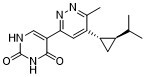
LY-3475070 (LY3475070; LY 3475070) is a novel, potent, oral and selective CD73 inhibitor (cluster of differentiation 73, IC50 = 28 nM) with potential anticancer activity.
Physicochemical Properties
| Molecular Formula | C15H18N4O2 |
| Molecular Weight | 286.3290 |
| Exact Mass | 286.142 |
| Elemental Analysis | C, 62.92; H, 6.34; N, 19.57; O, 11.18 |
| CAS # | 2375815-63-5 |
| PubChem CID | 152262911 |
| Appearance | White to off-white solid |
| LogP | 1 |
| Hydrogen Bond Donor Count | 2 |
| Hydrogen Bond Acceptor Count | 4 |
| Rotatable Bond Count | 3 |
| Heavy Atom Count | 21 |
| Complexity | 488 |
| Defined Atom Stereocenter Count | 2 |
| SMILES | CC1=NN=C(C=C1[C@H]2C[C@@H]2C(C)C)C3=CNC(=O)NC3=O |
| InChi Key | WHRUIISQCORGKK-KOLCDFICSA-N |
| InChi Code | InChI=1S/C15H18N4O2/c1-7(2)9-4-11(9)10-5-13(19-18-8(10)3)12-6-16-15(21)17-14(12)20/h5-7,9,11H,4H2,1-3H3,(H2,16,17,20,21)/t9-,11+/m1/s1 |
| Chemical Name | 5-(5-((1S,2R)-2-isopropylcyclopropyl)-6-methylpyridazin-3-yl)pyrimidine-2,4(1H,3H)-dione |
| Synonyms | LY 3475070; LY-3475070; 2375815-63-5; LY-3475070; CD73-IN-3; ly3475070; 5-(5-((1S,2R)-2-Isopropylcyclopropyl)-6-methylpyridazin-3-yl)pyrimidine-2,4(1H,3H)-dione; CHEMBL4792487; 5-[6-Methyl-5-[(1S,2R)-2-propan-2-ylcyclopropyl]pyridazin-3-yl]-1H-pyrimidine-2,4-dione; AKA9175T4N; LY3475070 |
| HS Tariff Code | 2934.99.9001 |
| Storage |
Powder-20°C 3 years 4°C 2 years In solvent -80°C 6 months -20°C 1 month |
| Shipping Condition | Room temperature (This product is stable at ambient temperature for a few days during ordinary shipping and time spent in Customs) |
Biological Activity
| Targets |
CD73 Ecto-5'-nucleotidase (CD73) (IC50 = 0.4 nM in recombinant human CD73 enzyme assay; IC50 = 3.2 nM in mouse CD73 enzyme assay) [1] |
| ln Vitro |
With an EC50 of 0.213 μM, CD73-IN-3 suppresses CD73 activity in human serum. At 0.52 μM, 1.56 μM, and 4.68 μM, respectively, CD73-IN-3 suppresses CD73 activity in human serum by 56.8%, 71.7%, and 76.9% [1]. The IC50 of CD73-IN-3 for CD73 is 0.0073 μM, according to the detection results of CD73 in Calu6 human cells [1]. Recombinant CD73 enzyme inhibition: LY-3475070 potently inhibits human and mouse CD73-mediated hydrolysis of AMP to adenosine. The IC50 values are 0.4 nM (human CD73) and 3.2 nM (mouse CD73), with > 10,000-fold selectivity over other nucleotidases (e.g., CD39, alkaline phosphatase) [1] - Cellular adenosine production inhibition: In MDA-MB-231 breast cancer cells (expressing endogenous CD73), the compound inhibits AMP-induced adenosine accumulation with an IC50 of 8.7 nM. At 100 nM, it reduces extracellular adenosine levels by 92% compared to the vehicle control [1] - Immunomodulatory activity: In human PBMC co-culture assays, LY-3475070 (10–100 nM) reverses adenosine-mediated suppression of T-cell proliferation. At 50 nM, T-cell proliferation is restored to 85% of the adenosine-free control level [1] - Anticancer cell migration: Treatment of MDA-MB-231 cells with LY-3475070 (1–100 nM) inhibits cell migration in a concentration-dependent manner. At 50 nM, migration is reduced by 68% compared to the control [1] |
| ln Vivo |
CD73 Inhibitor LY3475070 is an orally bioavailable inhibitor of the ectoenzyme CD73 (cluster of differentiation 73; 5'-ecto-nucleotidase; 5'-NT; ecto-5'-nucleotidase), with potential immunomodulating and antineoplastic activities. Upon oral administration, CD73 inhibitor LY3475070 targets and binds to CD73, leading to clustering of and internalization of CD73. This prevents CD73-mediated conversion of adenosine monophosphate (AMP) to adenosine and decreases the amount of free adenosine in the tumor microenvironment (TME). This prevents adenosine-mediated lymphocyte suppression and increases the activity of CD8-positive effector cells and natural killer (NK) cells. This also activates macrophages and reduces the activity of myeloid-derived suppressor cells (MDSCs) and regulatory T-lymphocytes (Tregs). By abrogating the inhibitory effect on the immune system and enhancing the cytotoxic T-cell-mediated immune response against tumor cells, tumor cell growth decreases. In addition, clustering and internalization of CD73 decreases the migration of cancer cells and prevents metastasis. CD73, a plasma membrane protein belonging to the 5'-nucleotidase (NTase) family, catalyzes the conversion of extracellular nucleotides, such as AMP, to membrane-permeable nucleosides, such as adenosine. It is upregulated in a number of cancer cell types and plays a key role in adenosine-mediated immunosuppression within the TME. Mouse tumor growth inhibition: C57BL/6 mice bearing MC38 colon cancer xenografts were treated with LY-3475070. Oral administration of 10 mg/kg twice daily for 21 days reduced tumor volume by 56% (treatment group volume: 320 ± 45 mm³ vs. control: 728 ± 62 mm³) and tumor weight by 52% [1] - Inhibition of in vivo adenosine production: BALB/c mice were injected with AMP (i.p.) and treated with LY-3475070 (10 mg/kg, p.o.) 1 hour prior. Serum adenosine levels 30 minutes post-AMP injection were reduced by 83% in the treatment group compared to the control [1] - Combination anticancer efficacy: In MC38 tumor-bearing mice, combination treatment of LY-3475070 (10 mg/kg, p.o., bid) with anti-PD-1 antibody (10 mg/kg, i.p., q3d) resulted in 78% tumor volume reduction, which was significantly greater than either monotherapy (LY-3475070 alone: 56%; anti-PD-1 alone: 41%) [1] |
| Enzyme Assay |
Recombinant CD73 enzyme activity assay: Recombinant human or mouse CD73 was incubated with reaction buffer containing AMP (substrate) and serial dilutions of LY-3475070 (0.01 nM–1 μM) at 37°C for 60 minutes. The amount of adenosine produced was quantified using a fluorescence-based detection system. IC50 values were calculated by fitting the dose-response curve to a four-parameter logistic model [1] - Nucleotidase selectivity assay: Parallel assays were performed using recombinant CD39, alkaline phosphatase, and ecto-nucleotide pyrophosphatase/phosphodiesterase 1 (ENPP1) with their respective substrates. LY-3475070 at concentrations up to 10 μM showed no significant inhibition of these enzymes (inhibition rate < 5% vs. control) [1] |
| Cell Assay |
Cellular adenosine accumulation assay: MDA-MB-231 cells were seeded in 24-well plates (2×10⁵ cells/well) and incubated overnight. Cells were pretreated with LY-3475070 (0.1 nM–1 μM) for 1 hour, then stimulated with AMP (100 μM) for 2 hours. Culture supernatants were collected, and adenosine concentrations were measured using LC-MS/MS. IC50 values were derived from dose-response curves [1] - T-cell proliferation assay: Human PBMCs were isolated and seeded in 96-well plates with anti-CD3/CD28 antibodies to stimulate T-cell proliferation. Adenosine (1 μM) and LY-3475070 (0.1 nM–1 μM) were added, and cells were cultured for 72 hours. Proliferation was quantified by measuring incorporation of a thymidine analog using a microplate reader [1] - Cell migration assay: MDA-MB-231 cells were seeded in the upper chamber of Transwell inserts. LY-3475070 (0.1 nM–1 μM) was added to both upper and lower chambers, and cells were incubated for 24 hours. Migrated cells on the lower membrane were fixed, stained, and counted manually. Migration inhibition rate was calculated relative to the vehicle control [1] |
| Animal Protocol |
MC38 colon cancer xenograft model: C57BL/6 mice (6–8 weeks old) were subcutaneously injected with MC38 cells (5×10⁶ cells/100 μL PBS) into the right flank. When tumors reached ~150 mm³, mice were randomized into control (vehicle) and treatment groups (n=8 per group). LY-3475070 was formulated in 0.5% hydroxypropyl methylcellulose (HPMC) + 0.1% Tween 80, administered orally at 10 mg/kg twice daily (bid) for 21 days. Tumor volume was measured every 3 days (volume = length × width² / 2), and body weight was recorded to monitor toxicity [1] - Serum adenosine inhibition model: BALB/c mice (n=6 per group) were administered LY-3475070 (10 mg/kg, p.o.) or vehicle 1 hour prior to intraperitoneal (i.p.) injection of AMP (20 mg/kg). Blood samples were collected via retro-orbital plexus 30 minutes post-AMP injection, and serum adenosine levels were quantified by LC-MS/MS [1] - Combination therapy model: MC38 tumor-bearing mice were randomized into four groups (n=8 per group): vehicle, LY-3475070 (10 mg/kg, p.o., bid), anti-PD-1 antibody (10 mg/kg, i.p., q3d), and combination. Treatment was initiated when tumors reached ~150 mm³ and continued for 21 days. Tumor volume and body weight were measured every 3 days [1] - Pharmacokinetic study: Sprague-Dawley rats (n=3 per time point) were administered a single oral dose of LY-3475070 (10 mg/kg, formulated in 0.5% HPMC + 0.1% Tween 80). Blood samples were collected at 0.25, 0.5, 1, 2, 4, 8, 12, and 24 hours post-administration. Plasma drug concentrations were measured by LC-MS/MS, and pharmacokinetic parameters were calculated using non-compartmental analysis [1] |
| ADME/Pharmacokinetics |
Oral bioavailability: In Sprague-Dawley rats, the oral bioavailability of LY-3475070 is 68% following a single 10 mg/kg oral dose [1] - Plasma pharmacokinetics: Peak plasma concentration (Cmax) is 1.8 μM, achieved at 1.2 hours (Tmax) post-administration. The elimination half-life (t1/2) is 6.8 hours, and the area under the plasma concentration-time curve (AUC₀₋₂₄h) is 12.3 μM·h [1] - Tissue distribution: Twenty-four hours after oral administration of 10 mg/kg, the compound distributes widely to tissues, with highest concentrations in the liver (4.2 μM), kidney (3.8 μM), and tumor (2.5 μM). Brain penetration is low (0.12 μM, brain-to-plasma ratio = 0.08) [1] - Metabolism and excretion: In rat studies, ~72% of the administered dose is excreted in feces (58% as parent compound, 14% as metabolites) and 23% in urine (11% as parent compound, 12% as metabolites) within 72 hours. In vitro liver microsome assays show minimal metabolism (parent compound remaining: 89% after 2 hours) [1] |
| Toxicity/Toxicokinetics |
Acute toxicity: Single oral doses of LY-3475070 up to 300 mg/kg in Sprague-Dawley rats and C57BL/6 mice do not cause mortality or significant clinical toxicity. The LD50 is > 300 mg/kg in both species [1] - Repeat-dose toxicity: Rats treated with LY-3475070 (10, 50, 200 mg/kg, p.o., qd) for 28 days show no significant body weight changes or dose-related adverse effects. Hematological and serum biochemical parameters (ALT, AST, creatinine, BUN) are within normal ranges [1] - Organ toxicity: Histopathological examination of major organs (liver, kidney, heart, lung, spleen, lymph nodes) from repeat-dose toxicity studies reveals no abnormal lesions or inflammation [1] - Plasma protein binding: In vitro assays show that LY-3475070 binds to human plasma proteins at a rate of 83% and to rat plasma proteins at 81% [1] |
| References |
[1]. Cd73 inhibitors. Patent WO2019168744 A1. |
| Additional Infomation |
CD73 Inhibitor LY3475070 is an orally bioavailable inhibitor of the ectoenzyme CD73 (cluster of differentiation 73; 5'-ecto-nucleotidase; 5'-NT; ecto-5'-nucleotidase), with potential immunomodulating and antineoplastic activities. Upon oral administration, CD73 inhibitor LY3475070 targets and binds to CD73, leading to clustering of and internalization of CD73. This prevents CD73-mediated conversion of adenosine monophosphate (AMP) to adenosine and decreases the amount of free adenosine in the tumor microenvironment (TME). This prevents adenosine-mediated lymphocyte suppression and increases the activity of CD8-positive effector cells and natural killer (NK) cells. This also activates macrophages and reduces the activity of myeloid-derived suppressor cells (MDSCs) and regulatory T-lymphocytes (Tregs). By abrogating the inhibitory effect on the immune system and enhancing the cytotoxic T-cell-mediated immune response against tumor cells, tumor cell growth decreases. In addition, clustering and internalization of CD73 decreases the migration of cancer cells and prevents metastasis. CD73, a plasma membrane protein belonging to the 5'-nucleotidase (NTase) family, catalyzes the conversion of extracellular nucleotides, such as AMP, to membrane-permeable nucleosides, such as adenosine. It is upregulated in a number of cancer cell types and plays a key role in adenosine-mediated immunosuppression within the TME. Mechanism of action: LY-3475070 binds to the active site of CD73, inhibiting its catalytic activity and blocking the conversion of extracellular AMP to adenosine. This reduces adenosine-mediated immunosuppression, enhances anti-tumor immune responses, and inhibits cancer cell migration and survival [1] - Selectivity profile: The compound exhibits high selectivity for CD73 over other nucleotidases (CD39, ENPP1, alkaline phosphatase) and a panel of 150+ kinases, GPCRs, and ion channels (inhibition rate < 10% at 10 μM) [1] - Therapeutic potential: LY-3475070 is being developed for the treatment of solid tumors (e.g., breast, colon, lung cancer) as a monotherapy or in combination with immune checkpoint inhibitors (e.g., anti-PD-1, anti-PD-L1 antibodies). It also shows potential for treating inflammatory diseases mediated by adenosine [1] - Formulation characteristics: The compound is soluble in DMSO (≥ 20 mM) and aqueous formulations (0.5% HPMC + 0.1% Tween 80) at concentrations up to 10 mg/mL, suitable for oral and parenteral administration [1] |
Solubility Data
| Solubility (In Vitro) | DMSO : ~100 mg/mL (~349.25 mM) |
| Solubility (In Vivo) |
Solubility in Formulation 1: ≥ 2.5 mg/mL (8.73 mM) (saturation unknown) in 10% DMSO + 90% (20% SBE-β-CD in Saline) (add these co-solvents sequentially from left to right, and one by one), clear solution. For example, if 1 mL of working solution is to be prepared, you can add 100 μL of 25.0 mg/mL clear DMSO stock solution to 900 μL of 20% SBE-β-CD physiological saline solution and mix evenly. Preparation of 20% SBE-β-CD in Saline (4°C,1 week): Dissolve 2 g SBE-β-CD in 10 mL saline to obtain a clear solution. Solubility in Formulation 2: ≥ 2.5 mg/mL (8.73 mM) (saturation unknown) in 10% DMSO + 90% Corn Oil (add these co-solvents sequentially from left to right, and one by one), clear solution. For example, if 1 mL of working solution is to be prepared, you can add 100 μL of 25.0 mg/mL clear DMSO stock solution to 900 μL of corn oil and mix evenly. (Please use freshly prepared in vivo formulations for optimal results.) |
| Preparing Stock Solutions | 1 mg | 5 mg | 10 mg | |
| 1 mM | 3.4925 mL | 17.4624 mL | 34.9247 mL | |
| 5 mM | 0.6985 mL | 3.4925 mL | 6.9849 mL | |
| 10 mM | 0.3492 mL | 1.7462 mL | 3.4925 mL |