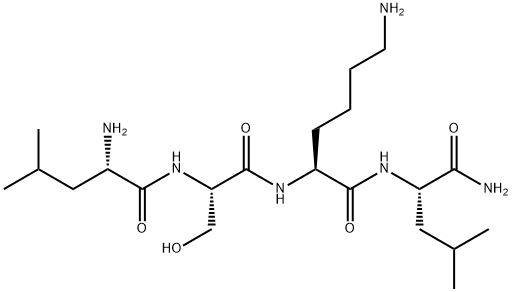
LSKL is a potent and peptide-based inhibitor of Thrombospondin TSP-1 with the potential to be used for treating hypertrophic scar. LSKL peptide was able to inhibit the overexpression of extracellular matrix and contractile ability of HTS (Hypertrophic scar) fibroblasts. In vivo, LSKL could attenuate the thickness of HTS, distortion of collagen alignment and fibrogenesis. Further, LSKL peptide not only remarkably attenuated cell proliferation and migration, but also induced cell apoptosis of HTS fibroblasts. In addition, LSKL peptide significantly suppressed the phosphorylation of PI3K, AKT, and mTOR, while not affecting the phosphorylation of Smad2/3 and MEK/ERK. LSKL might be a promising anti-fibrosis agent to HTS through modulating the PI3K/AKT/mTOR signaling pathway.
Physicochemical Properties
| Molecular Formula | C21H42N6O5 |
| Molecular Weight | 458.5954 |
| Exact Mass | 458.321 |
| CAS # | 283609-79-0 |
| Related CAS # | LSKL, Inhibitor of Thrombospondin (TSP-1) (TFA);2828433-17-4 |
| PubChem CID | 71312184 |
| Appearance | White to off-white solid powder |
| Density | 1.1±0.1 g/cm3 |
| Boiling Point | 817.8±65.0 °C at 760 mmHg |
| Flash Point | 448.4±34.3 °C |
| Vapour Pressure | 0.0±0.6 mmHg at 25°C |
| Index of Refraction | 1.521 |
| LogP | -0.49 |
| Hydrogen Bond Donor Count | 7 |
| Hydrogen Bond Acceptor Count | 7 |
| Rotatable Bond Count | 16 |
| Heavy Atom Count | 32 |
| Complexity | 614 |
| Defined Atom Stereocenter Count | 4 |
| SMILES | CC(C)C[C@@H](C(=O)N[C@@H](CO)C(=O)N[C@@H](CCCCN)C(=O)N[C@@H](CC(C)C)C(=O)N)N |
| InChi Key | YOKXDNNIFSAXBY-QAETUUGQSA-N |
| InChi Code | InChI=1S/C21H42N6O5/c1-12(2)9-14(23)19(30)27-17(11-28)21(32)25-15(7-5-6-8-22)20(31)26-16(18(24)29)10-13(3)4/h12-17,28H,5-11,22-23H2,1-4H3,(H2,24,29)(H,25,32)(H,26,31)(H,27,30)/t14-,15-,16-,17-/m0/s1 |
| Chemical Name | (2S)-6-amino-N-[(2S)-1-amino-4-methyl-1-oxopentan-2-yl]-2-[[(2S)-2-[[(2S)-2-amino-4-methylpentanoyl]amino]-3-hydroxypropanoyl]amino]hexanamide |
| HS Tariff Code | 2934.99.9001 |
| Storage |
Powder-20°C 3 years 4°C 2 years In solvent -80°C 6 months -20°C 1 month Note: Please store this product in a sealed and protected environment, avoid exposure to moisture. |
| Shipping Condition | Room temperature (This product is stable at ambient temperature for a few days during ordinary shipping and time spent in Customs) |
Biological Activity
| Targets |
- Thrombospondin 1 (TSP-1) [1][3] - Transforming growth factor β1 (TGF-β1) signaling pathway [1][3] - A disintegrin and metalloproteinase with thrombospondin motifs 1 (ADAMTS1) [2] |
| ln Vitro |
The KTFR sequence in ADAMTS1 is responsible for binding with LSKL (thrombospondin inhibitor (TSP-1)) (LSKL peptide) in the latent form of TGF-β, resulting to its activation. There is a stable binding mechanism between thrombospondin inhibitor (TSP-1) LSKL and ADAMTS1 KTFR sequence, which is defined by 3 salt bridges and 2 hydrogen bonds [2]. - LSKL (Inhibitor of Thrombospondin TSP-1) interacted with ADAMTS1 in silico, forming stable hydrogen bonds with amino acid residues (Gly203, Asn205, Gln207) of ADAMTS1. The binding energy was -7.6 kcal/mol, indicating a high-affinity interaction [2] - It inhibited TSP-1-mediated TGF-β1 activation in hepatocytes. At 10 μM, it reduced phosphorylated Smad2/3 (downstream of TGF-β1) expression by 58±4% compared to the TSP-1-stimulated group [3] - The peptide suppressed TSP-1-induced fibroblast proliferation: 20 μM LSKL reduced fibroblast viability by 42±3% and collagen I synthesis by 55±4% [1] |
| ln Vivo |
Sprague-Dawley male rats administered intraperitoneally with 1 mg/kg of LSKL, a thrombospondin inhibitor (TSP-1) are able to effectively suppress hydrocephalus, avoid subarachnoid fibrosis, and decrease ventricular hypertrophy. Thrombuspondin inhibitor (TSP-1) therapy in LSKL suppresses TGF-β1 expression and consequent Smad2/3 signaling [1]. LSKL, a thrombospondin (TSP-1) inhibitor (30 mg/kg, i.p.) effectively prevented the activation of transforming growth factor (TGF) β-Smad signaling that was induced by partial hepatectomy. Rather of decreasing TSP-1 protein expression, the thrombospondin (TSP-1) inhibitor LSKL effectively inhibited TGF-β-Smad signaling activation. Following liver resection, hepatocyte proliferation can be accelerated by LSKL, a thrombospondin inhibitor (TSP-1) [3]. - In rat subarachnoid hemorrhage (SAH) model: Intraperitoneal injection of LSKL (10 mg/kg daily for 7 days) alleviated subarachnoid fibrosis. Collagen deposition in the subarachnoid space was reduced by 62±5%, and hydrocephalus incidence decreased from 68% to 22% [1] - It inhibited TGF-β1 signaling in SAH rats: 10 mg/kg LSKL reduced TSP-1, TGF-β1, and phosphorylated Smad2/3 protein levels in brain tissues by 58±4%, 65±5%, and 60±4%, respectively [1] - In rat hepatectomy model: Intravenous injection of LSKL (5 mg/kg at 0, 24, 48 hours post-hepatectomy) promoted liver regeneration. Liver weight recovery rate increased by 35±3% at 7 days post-surgery, and hepatocyte proliferation (Ki-67-positive cells) was enhanced by 48±4% [3] - It suppressed TSP-1/TGF-β1 signaling in regenerating livers: 5 mg/kg LSKL reduced TSP-1 and active TGF-β1 levels by 52±4% and 57±5%, respectively [3] |
| Enzyme Assay |
- In silico molecular docking assay: The 3D structure of LSKL was constructed and energy-minimized. The crystal structure of ADAMTS1 was retrieved from protein databases. Docking was performed using appropriate software, and binding energy, hydrogen bonds, and hydrophobic interactions were analyzed to evaluate binding affinity [2] - TGF-β1 activity assay: Hepatocyte lysates from TSP-1-stimulated cells were incubated with LSKL (5, 10, 20 μM). TGF-β1 activity was measured by detecting phosphorylated Smad2/3 levels via Western blot, and the inhibition rate was calculated [3] - Collagen synthesis assay: Fibroblasts were treated with LSKL (10, 20 μM) and TSP-1. Collagen I content in the culture supernatant was quantified by enzyme-linked immunosorbent assay (ELISA) [1] |
| Cell Assay |
- Fibroblast proliferation assay: Primary rat subarachnoid fibroblasts were seeded in 96-well plates (5×10³ cells/well) and treated with LSKL (5, 10, 20 μM) and TSP-1 for 48 hours. Cell viability was measured by MTT assay [1] - Hepatocyte signaling assay: Primary rat hepatocytes were seeded in 6-well plates (2×10⁵ cells/well) and stimulated with TSP-1 in the presence of LSKL (5, 10, 20 μM) for 24 hours. Cell lysates were prepared for Western blot analysis of phosphorylated Smad2/3 [3] |
| Animal Protocol |
Animal/Disease Models: 103 male SD (SD (Sprague-Dawley)) rats (6 weeks old; 160-180 g) [1] with subarachnoid hemorrhage (SAH) [1] Doses: 1 mg/kg Route of Administration: intraperitoneal (ip) injection Experimental Results: Yes Subarachnoid fibrosis, reducing ventricular enlargement and effectively inhibiting hydrocephalus. - Rat SAH model: Male Sprague-Dawley rats (250–300 g) were subjected to endovascular perforation to induce SAH. LSKL was dissolved in normal saline and administered intraperitoneally at 10 mg/kg daily for 7 days starting from 24 hours post-SAH. Rats were sacrificed, and brain tissues were collected for histological staining (Masson's trichrome) and Western blot analysis [1] - Rat hepatectomy model: Male Wistar rats (200–250 g) underwent 70% partial hepatectomy. LSKL (5 mg/kg) was administered intravenously at 0, 24, and 48 hours post-surgery. At 1, 3, 7 days post-hepatectomy, rats were sacrificed to measure liver weight, and liver tissues were collected for Ki-67 immunohistochemistry and TGF-β1/TSP-1 protein detection [3] |
| Toxicity/Toxicokinetics |
- No obvious toxic side effects (abnormal behavior, organ damage, or mortality) were observed in rats at therapeutic doses (5–10 mg/kg) [1][3] - LSKL showed no significant cytotoxicity to primary hepatocytes and fibroblasts at concentrations up to 40 μM [1][3] |
| References |
[1]. LSKL peptide alleviates subarachnoid fibrosis and hydrocephalus by inhibiting TSP1-mediated TGF-β1 signaling activity following subarachnoid hemorrhage in rats. Exp Ther Med. 2016 Oct;12(4):2537-2543. Epub 2016 Aug 31. [2]. In silico characterization of the interaction between LSKL peptide, a LAP-TGF-beta derived peptide, and ADAMTS1. Comput Biol Chem. 2016 Apr;61:155-61. [3]. Effect of LSKL peptide on thrombospondin 1-mediated transforming growth factor β signal activation and liver regeneration after hepatectomy in an experimental model. Br J Surg. 2015 Jun;102(7):813-25. |
| Additional Infomation |
- LSKL is a peptide derived from the latency-associated peptide (LAP) of TGF-β [2][3] - Its mechanism of action involves competing with TSP-1 for binding to TGF-β1 or ADAMTS1, thereby inhibiting TSP-1-mediated TGF-β1 signaling activation [1][2][3] - It has potential therapeutic applications in SAH-induced subarachnoid fibrosis and hydrocephalus, as well as in promoting liver regeneration after hepatectomy [1][3] - The in silico validation confirmed its specific binding to ADAMTS1, providing a molecular basis for its inhibitory effect on TSP-1/TGF-β1 signaling [2] |
Solubility Data
| Solubility (In Vitro) |
DMSO : ~100 mg/mL (~218.05 mM) H2O : ~50 mg/mL (~109.03 mM) |
| Solubility (In Vivo) |
Solubility in Formulation 1: ≥ 2.5 mg/mL (5.45 mM) (saturation unknown) in 10% DMSO + 90% (20% SBE-β-CD in Saline) (add these co-solvents sequentially from left to right, and one by one), clear solution. For example, if 1 mL of working solution is to be prepared, you can add 100 μL of 25.0 mg/mL clear DMSO stock solution to 900 μL of 20% SBE-β-CD physiological saline solution and mix evenly. Preparation of 20% SBE-β-CD in Saline (4°C,1 week): Dissolve 2 g SBE-β-CD in 10 mL saline to obtain a clear solution. Solubility in Formulation 2: ≥ 2.5 mg/mL (5.45 mM) (saturation unknown) in 10% DMSO + 90% Corn Oil (add these co-solvents sequentially from left to right, and one by one), clear solution. For example, if 1 mL of working solution is to be prepared, you can add 100 μL of 25.0 mg/mL clear DMSO stock solution to 900 μL of corn oil and mix evenly. Solubility in Formulation 3: 100 mg/mL (218.05 mM) in PBS (add these co-solvents sequentially from left to right, and one by one), clear solution; with ultrasonication. (Please use freshly prepared in vivo formulations for optimal results.) |
| Preparing Stock Solutions | 1 mg | 5 mg | 10 mg | |
| 1 mM | 2.1805 mL | 10.9027 mL | 21.8055 mL | |
| 5 mM | 0.4361 mL | 2.1805 mL | 4.3611 mL | |
| 10 mM | 0.2181 mL | 1.0903 mL | 2.1805 mL |