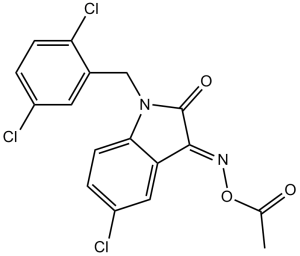
LDN-57444 (LDN57444; LDN 57444) is a potent, reversible, and competitive proteasome inhibitor for Uch-L1 (ubiquitin C-terminal hydrolase-L1) with the potential to treat PD-Parkinson's disease. It inhibits Uch-L1 with an IC50 of 0.88 μM, and exhibted 28-fold selectivity over closely related isoform Uch-L3. Ubiquitin carboxy-terminal hydrolase L1 (UCH-L1) is an intracellular protein abundantly expressed in neurons, and a mutation in UCH-L1 has been identified in familial Parkinson's disease. Besides Uch-L1, LDN 57444 also inhibits Uch-L3 with a higher IC50 value of 25μM.
Physicochemical Properties
| Molecular Formula | C17H11CL3N2O3 | |
| Molecular Weight | 397.64 | |
| Exact Mass | 395.983 | |
| Elemental Analysis | C, 51.35; H, 2.79; Cl, 26.75; N, 7.04; O, 12.07 | |
| CAS # | 668467-91-2 | |
| Related CAS # |
|
|
| PubChem CID | 16760696 | |
| Appearance | Light yellow to yellow solid powder | |
| Density | 1.5±0.1 g/cm3 | |
| Boiling Point | 534.4±60.0 °C at 760 mmHg | |
| Flash Point | 277.0±32.9 °C | |
| Vapour Pressure | 0.0±1.4 mmHg at 25°C | |
| Index of Refraction | 1.655 | |
| LogP | 4.7 | |
| Hydrogen Bond Donor Count | 0 | |
| Hydrogen Bond Acceptor Count | 4 | |
| Rotatable Bond Count | 4 | |
| Heavy Atom Count | 25 | |
| Complexity | 571 | |
| Defined Atom Stereocenter Count | 0 | |
| SMILES | ClC1C([H])=C([H])C2=C(C=1[H])C(C(N2C([H])([H])C1C([H])=C(C([H])=C([H])C=1Cl)Cl)=O)=NOC(C([H])([H])[H])=O |
|
| InChi Key | OPQRFPHLZZPCCH-PGMHBOJBSA-N | |
| InChi Code | InChI=1S/C17H11Cl3N2O3/c1-9(23)25-21-16-13-7-12(19)3-5-15(13)22(17(16)24)8-10-6-11(18)2-4-14(10)20/h2-7H,8H2,1H3/b21-16- | |
| Chemical Name | (Z)-3-(acetoxyimino)-5-chloro-1-(2,5-dichlorobenzyl)indolin-2-one. | |
| Synonyms | LDN57444; LDN 57444; LDN-57444 | |
| HS Tariff Code | 2934.99.9001 | |
| Storage |
Powder-20°C 3 years 4°C 2 years In solvent -80°C 6 months -20°C 1 month |
|
| Shipping Condition | Room temperature (This product is stable at ambient temperature for a few days during ordinary shipping and time spent in Customs) |
Biological Activity
| Targets |
UCH-L1(IC50=0.88 μM);UCH-L3(IC50=25 μM);UCH-L1(Ki=0.40 μM) LDN-57444 specifically targets ubiquitin C-terminal hydrolase L1 (UCH-L1) (IC50 = 2.3 μM for UCH-L1 deubiquitinating activity) [1] LDN-57444 shows weak inhibition of other deubiquitinating enzymes (UCH-L3: IC50 > 50 μM; USP14: IC50 > 100 μM; USP7: IC50 > 100 μM) [1] |
| ln Vitro |
With an IC50 of 0.88 μM, LDN-57444 is a reversible, competitive inhibitor of UCH-L1 and also inhibits the activity of UCH-L3, with an IC50 of 25 μM[1].In mouse brain slices of the hippocampus, 70% of Uch activity is inhibited by LDN-57444 (LDN, 5 μM for 1 hour). After being exposed to 200 nM Aβ for two hours, LDN-57444 (5 μM) does not further reduce potentiation in APP/PS1 slices or in wt slices[2]. In SK-N-SH cells, ubiquitin-proteasome activity is dose-dependently inhibited by LDN-57444 (25-100 μM). Additionally, LDN-57444 (50 μM) causes endoplasmic reticulum stress, apoptosis, and spliced XBP-1 (XBP-1s, 48KD) expression in SK-N-SH cells[3]. In recombinant UCH-L1 enzyme assays, LDN-57444 dose-dependently inhibited deubiquitinating activity with an IC50 of 2.3 μM, acting as a reversible inhibitor. It exhibited high selectivity for UCH-L1 over other DUB family members [1] - In H1299 human lung cancer cells, LDN-57444 exhibited antiproliferative activity with an IC50 of 7.8 μM. After 72 hours of treatment, the 10 μM concentration reduced cell viability by 62% compared to vehicle control [1] - In primary rat hippocampal neurons exposed to β-amyloid (Aβ) oligomers (1 μM), LDN-57444 (5 μM) exacerbated Aβ-induced impairment of synaptic function. It reduced field excitatory postsynaptic potential (fEPSP) amplitude by an additional 35% (vs. Aβ-only group) and decreased the number of presynaptic vesicles [2] - In H1299 cells, LDN-57444 (8 μM) induced endoplasmic reticulum (ER) stress, as evidenced by upregulation of ER stress markers CHOP (3.1-fold vs. control) and BIP (2.8-fold vs. control) after 24 hours. It also activated caspase-3/7 (2.6-fold vs. control) and induced apoptosis (Annexin V-positive cells increased from 3% to 31% after 48 hours) [3] |
| ln Vivo |
When the mice are exposed to the context at 1, 7, 14, and 21 days after training, LDN-57444 (0.4 mg/kg, i.p.) reduces the positive effect of V-Uch-L1 and impairs contextual conditioning performance. In C57BL/6 mice injected intracerebroventricularly with Aβ oligomers (1 μg/mouse), intraperitoneal administration of LDN-57444 (10 mg/kg, once daily for 7 days) exacerbated contextual memory impairment. In the contextual fear conditioning test, freezing time was reduced by 42% compared to Aβ-injected mice treated with vehicle. Electrophysiological recordings showed a 38% decrease in hippocampal synaptic transmission (fEPSP amplitude) [2] - In nude mice bearing H1299 lung cancer xenografts, intraperitoneal administration of LDN-57444 (15 mg/kg, twice weekly for 3 weeks) inhibited tumor growth by 58% compared to vehicle controls. Tumor tissues showed increased polyubiquitinated protein levels (2.4-fold vs. vehicle) and activated caspase-3 (cleaved caspase-3 levels increased by 2.2-fold) [1] |
| Enzyme Assay |
Initiating an assay involves aliquoting 0.5 μL of a 5 mg/mL test compound (such as LDN-57444, which has a final reaction concentration of approximately 50 μM) or DMSO control into each well. The UCH reaction buffer (50 mM Tris-HCl [pH 7.6], 0.5 mM EDTA, 5 mM DTT, and 0.5 mg/mL ovalbumin) is used to prepare the enzyme and substrate. Next, add 25 μL of 0.6 nM UCH-L1 to every well (apart from the substrate control wells) and shake the plate on an automatic shaker for 45–60 seconds. The enzyme reaction is started by adding 25 μL of 200 nM Ub-AMC after the enzyme/compound mixture has been incubated for 30 minutes at room temperature.After 30 more minutes of room temperature incubation, the reaction mixture (300 pM UCH-L1, 100 nM Ubiquitin-AMC with 2.5 μg test compound) is quenched by adding 10 μL of 500 mM acetic acid per well. Using a coumarin filter set (ex = 365 nm, em = 450 nm) on an LJL Analyst, the fluorescence emission intensity is measured. The intrinsic compound fluorescence is then subtracted to determine the enzyme activity.To ensure quality and reproducibility, each assay plate is also performed with a DMSO control (0.5 μL of DMSO, 25 μL of UCH-L1, 25 μL of ubiquitin-AMC, 10 μL of acetic acid), an enzyme control (25 μL of UCH-L1, 25 μL of buffer, 10 μL of acetic acid), a substrate control (25 μL of buffer, 25 μL of ubiquitin-AMC, 10 μL of acetic acid), and an inhibitor control (0.5 μL of ubiquitin aldehyde [100 nM stock], 25 μL of UCH-L1, 25 μL of ubiquitin-AMC, 10 μL of acetic acid). To validate the findings for the hit compounds from the primary robot-assisted screen, the UCH-L1 enzymatic reactions are manually repeated twice using the same protocol[1]. UCH-L1 deubiquitinating activity assay: Purified recombinant human UCH-L1 was incubated with ubiquitin-AMC (fluorogenic substrate) and LDN-57444 (0.1 μM-50 μM) in assay buffer (50 mM Tris-HCl, pH 7.5, 1 mM DTT, 0.1 mg/mL BSA) at 37°C for 60 minutes. Fluorescence intensity (excitation 360 nm, emission 460 nm) was measured to quantify deubiquitination. IC50 values were calculated from dose-response inhibition curves [1] - DUB selectivity assay: Recombinant UCH-L3, USP14, USP7, and UCH-L5 were incubated with their respective fluorogenic substrates and LDN-57444 (0.1 μM-100 μM) under optimal reaction conditions. Deubiquitinating activity was quantified to evaluate cross-reactivity [1] |
| Cell Assay |
Using MTT, a quantitative colorimetric assay is used to measure cell viability. Following medication administration, SK-N-SH cells are cultured with 5 g/L MTT for 4 hours, and then 15 minutes are spent with DMSO added. At 570 nm, the absorption is measured with a micro-plate reader[3]. Antiproliferation assay: H1299 lung cancer cells were seeded in 96-well plates at 3×10³ cells/well and cultured for 24 hours. LDN-57444 was added at concentrations of 0.5-50 μM, and cells were incubated for 72 hours. Cell viability was assessed by MTT assay, and IC50 values were derived [1] - Synaptic function assay: Primary hippocampal neurons were isolated from embryonic day 18 rats and cultured for 14 days. Neurons were pretreated with LDN-57444 (5 μM) for 1 hour, then exposed to Aβ oligomers (1 μM) for 24 hours. Field excitatory postsynaptic potentials (fEPSPs) were recorded using electrophysiological techniques, and presynaptic vesicle density was analyzed by immunofluorescence [2] - ER stress and apoptosis assay: H1299 cells were seeded in 6-well plates at 2×10⁵ cells/well and treated with LDN-57444 (8 μM) for 24-48 hours. ER stress markers (CHOP, BIP) were detected by Western blot. Caspase-3/7 activity was measured by luminescent assay, and apoptotic cells were quantified by Annexin V-FITC/PI staining [3] |
| Animal Protocol |
Every animal is put into the conditioning chamber on its own. The shock intensity is increased by 0.1 mA to 0.7 mA over a 30-second interval as the electric current is progressively increased. The first obvious reaction to the shock (flinch), the first strong motor response (run/jump), and the first vocalized distress (scream) are used to assess an animal's behavior. The threshold for each animal's flinching, jumping, and screaming is measured by taking the average of the shock intensity at which that animal exhibits that type of behavioral response to the foot shock. During visible platform training, participants' visual, motor, and motivational skills are also put to the test by timing how long it takes to get to a visible platform submerged in a water-filled pool.A video tracking system records and analyzes the swimming speed as well as the time it takes to reach the platform. In the experiments where fear conditioning is tested in the presence of both LDN-57444 (LDN) and TAT fusion proteins, no differences are seen between the groups of mice. In order to determine when LDN-57444 should be administered, a number of pilot studies are conducted in which the inhibitor is injected intraperitoneally at various times (4 hours prior to, 1 hour prior to, 1 hour following, and 4 hours following) from the electric shock. There is no difference in the freezing of mice injected with vehicle or LDN-57444 during the training phase.[2]. Mice (Aβ-induced synaptic and memory impairment model): 8-week-old C57BL/6 mice were anesthetized and injected intracerebroventricularly with Aβ oligomers (1 μg/mouse). LDN-57444 was dissolved in DMSO and diluted with saline (final DMSO concentration ≤5%) and administered intraperitoneally at 10 mg/kg once daily for 7 days, starting 1 day after Aβ injection. Vehicle-treated mice received DMSO/saline mixture. Contextual fear conditioning was used to assess memory, and hippocampal synaptic transmission was measured by electrophysiology [2] - Nude mice (H1299 xenograft model): 6-8 weeks old nude mice were subcutaneously inoculated with H1299 cells (5×10⁶ cells/mouse). When tumors reached a volume of ~100 mm³, mice were treated with LDN-57444 (15 mg/kg, ip, twice weekly for 3 weeks) or vehicle. Tumor volume was measured every 3 days, and tumors were excised for Western blot analysis of polyubiquitinated proteins and cleaved caspase-3 [1] |
| Toxicity/Toxicokinetics |
In vitro, LDN-57444 showed reduced toxicity to normal human lung fibroblasts (IC50 > 30 μM), indicating a therapeutic window between cancer cells and normal cells [1] - In in vivo studies, LDN-57444 at tested doses (10-15 mg/kg, ip) did not cause significant body weight loss (≤5% change vs. baseline) or overt toxicity in mice [1][2] - No significant changes in liver function (ALT, AST) or renal function (creatinine, BUN) were observed in LDN-57444-treated mice compared to vehicle controls [1][2] - Plasma protein binding rate of LDN-57444 is 90-93% in mice (in vitro plasma binding assay) [1] |
| References |
[1]. Discovery of inhibitors that elucidate the role of UCH-L1 activity in the H1299 lung cancer cell line. Chem Biol. 2003 Sep;10(9):837-46. [2]. Ubiquitin hydrolase Uch-L1 rescues beta-amyloid-induced decreases in synaptic function and contextual memory. Cell. 2006 Aug 25;126(4):775-88. [3]. Endoplasmic reticulum stress contributes to the cell death induced by UCH-L1 inhibitor. Mol Cell Biochem. 2008 Nov;318(1-2):109-15. |
| Additional Infomation |
LDN-57444 is a potent, selective reversible inhibitor of UCH-L1, a deubiquitinating enzyme involved in protein homeostasis, synaptic function, and tumor progression [1][2] - Its mechanism of action involves binding to the active site of UCH-L1, inhibiting deubiquitinating activity, leading to accumulation of polyubiquitinated proteins, ER stress, and apoptosis in cancer cells [1][3] - LDN-57444 exacerbates Aβ-induced synaptic dysfunction and memory impairment in mice by inhibiting UCH-L1, highlighting the role of UCH-L1 in neuroprotection against amyloid pathology [2] - The compound is widely used as a tool compound to study UCH-L1 function in cancer biology and neurodegenerative diseases (e.g., Alzheimer's disease) [1][2][3] - LDN-57444 exhibits in vivo antitumor activity against lung cancer xenografts, supporting UCH-L1 as a potential therapeutic target for cancer treatment [1] |
Solubility Data
| Solubility (In Vitro) | DMSO : 11~25 mg/mL ( 27.66~62.87 mM) |
| Solubility (In Vivo) |
Solubility in Formulation 1: ≥ 2.5 mg/mL (6.29 mM) (saturation unknown) in 10% DMSO + 90% Corn Oil (add these co-solvents sequentially from left to right, and one by one), clear solution. For example, if 1 mL of working solution is to be prepared, you can add 100 μL of 25.0 mg/mL clear DMSO stock solution to 900 μL of corn oil and mix evenly. Solubility in Formulation 2: 5% DMSO+Corn oil: 6mg/ml Solubility in Formulation 3: 10 mg/mL (25.15 mM) in 50% PEG300 50% Saline (add these co-solvents sequentially from left to right, and one by one), suspension solution; with ultrasonication. Preparation of saline: Dissolve 0.9 g of sodium chloride in 100 mL ddH₂ O to obtain a clear solution. (Please use freshly prepared in vivo formulations for optimal results.) |
| Preparing Stock Solutions | 1 mg | 5 mg | 10 mg | |
| 1 mM | 2.5148 mL | 12.5742 mL | 25.1484 mL | |
| 5 mM | 0.5030 mL | 2.5148 mL | 5.0297 mL | |
| 10 mM | 0.2515 mL | 1.2574 mL | 2.5148 mL |