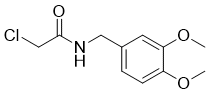
DKM 2-93 is a covalent and selective inhibitor of the ubiquitin-like modifier activating enzyme 5 (UBA5). DKM 2-93 is a covalent ligand that impairs pancreatic cancer cell survival and in vivo tumor growth through covalently modifying the catalytic cysteine of UBA5, thereby inhibiting its activity as a protein that activates the ubiquitin-like protein UFM1 to UFMylate proteins. UBA5 is a novel pancreatic cancer therapeutic target and DKM 2-93 as a relatively selective lead inhibitor of UBA5.
Physicochemical Properties
| Molecular Formula | C11H14CLNO3 | |
| Molecular Weight | 243.07 | |
| Exact Mass | 243.066 | |
| Elemental Analysis | C, 54.22; H, 5.79; Cl, 14.55; N, 5.75; O, 19.70 | |
| CAS # | 65836-72-8 | |
| Related CAS # |
|
|
| PubChem CID | 2392259 | |
| Appearance | White to light yellow solid powder | |
| Density | 1.194g/cm3 | |
| Boiling Point | 425.7ºC at 760 mmHg | |
| Flash Point | 211.3ºC | |
| Index of Refraction | 1.522 | |
| LogP | 1.949 | |
| Hydrogen Bond Donor Count | 1 | |
| Hydrogen Bond Acceptor Count | 3 | |
| Rotatable Bond Count | 5 | |
| Heavy Atom Count | 16 | |
| Complexity | 225 | |
| Defined Atom Stereocenter Count | 0 | |
| SMILES | ClC([H])([H])C(N([H])C([H])([H])C1C([H])=C([H])C(=C(C=1[H])OC([H])([H])[H])OC([H])([H])[H])=O |
|
| InChi Key | CETPWRGZGWGPSV-UHFFFAOYSA-N | |
| InChi Code | InChI=1S/C11H14ClNO3/c1-15-9-4-3-8(5-10(9)16-2)7-13-11(14)6-12/h3-5H,6-7H2,1-2H3,(H,13,14) | |
| Chemical Name | 2-Chloro-N-(3,4-dimethoxy-benzyl)-acetamide | |
| Synonyms |
|
|
| HS Tariff Code | 2934.99.9001 | |
| Storage |
Powder-20°C 3 years 4°C 2 years In solvent -80°C 6 months -20°C 1 month |
|
| Shipping Condition | Room temperature (This product is stable at ambient temperature for a few days during ordinary shipping and time spent in Customs) |
Biological Activity
| Targets |
UBA5(IC50= 430 μM);PaCa2 cells(IC50= 90 μM);Panc1 cells(IC50= 30 μM)
DKM 2-93 covalently binds to UBA5 (Ubiquitin-like modifier activating enzyme 5, a cysteine-dependent enzyme) in pancreatic cancer cells [1] |
| ln Vitro |
UBA5, or ubiquitin-like modifier activating enzyme 5, is a novel therapeutic target for pancreatic cancer. By covalently altering UBA5's catalytic cysteine, DKM 2-93 reduces the viability of pancreatic cancer cells by impeding UBA5's ability to function as a protein that triggers the ubiquitin-like protein UFM1 to UFMylate proteins. DKM 2-93 has an IC50 of 30 μM for Panc1 and 90 μM for PaCa2 cells, respectively, which inhibits their survival[1]. 1. Chemoproteomic profiling (isoTOP-ABPP) identified DKM 2-93 as a covalent ligand that selectively binds to UBA5 in pancreatic ductal adenocarcinoma (PDAC) cell lines (PANC-1, MiaPaCa-2, AsPC-1) and non-malignant pancreatic ductal epithelial (HPDE) cells; competitive ABPP confirmed that DKM 2-93 binding to UBA5 was concentration-dependent and reversible (no off-target binding to other cysteine proteases/enzymes) [1] 2. siRNA-mediated knockdown of UBA5 in PDAC cells (PANC-1, MiaPaCa-2) significantly reduced cell viability (CCK-8 assay, p<0.01 by Student’s t test), while overexpression of UBA5 rescued cell viability in DKM 2-93-treated PDAC cells (p<0.05 by Student’s t test) [1] 3. DKM 2-93 treatment (10/20/40 μM, 72 h) reduced viability of PDAC cell lines (PANC-1, MiaPaCa-2, AsPC-1) in a concentration-dependent manner (CCK-8 assay, p<0.01/p<0.001 by one-way ANOVA), with minimal effect on HPDE cell viability (p>0.05) [1] 4. DKM 2-93 (20 μM, 48 h) induced apoptosis in PDAC cells (Annexin V-FITC/PI staining, flow cytometry, p<0.01 by Student’s t test) and suppressed colony formation (colony formation assay, p<0.01 by Student’s t test) [1] 5. Western blot analysis showed that DKM 2-93 (10/20 μM, 24/48 h) downregulated UBA5 protein expression in PDAC cells, reduced levels of UFM1 (Ubiquitin-fold modifier 1) conjugation, and upregulated cleaved caspase-3/caspase-9 (apoptosis markers, p<0.01 by Student’s t test) [1] |
| ln Vivo |
In tumor xenograft studies in immune-deficient mice, a daily dose of DKM 2-93 significantly inhibits the growth of PaCa2 cells tumors in vivo without causing weight loss or overt toxicity[1]. 1. Subcutaneous xenograft model: PANC-1 cells (5×10⁶) were injected into the flanks of BALB/c nude mice (6–8 weeks old); when tumors reached ~100 mm³, DKM 2-93 was administered intraperitoneally (IP) at 10/20 mg/kg every other day for 21 days (vehicle: 10% DMSO + 90% corn oil); tumor volume was measured every 3 days, and tumor weight was recorded at sacrifice (n=6 mice per group); DKM 2-93 (20 mg/kg) significantly reduced tumor volume (p<0.01 by two-way ANOVA) and tumor weight (p<0.01 by Student’s t test) without affecting mouse body weight [1] 2. Immunohistochemistry (IHC) of xenograft tumors showed that DKM 2-93 (20 mg/kg) reduced UBA5 protein expression (H-score quantification, p<0.01 by Student’s t test), decreased Ki-67 (proliferation marker, p<0.01 by Student’s t test), and increased cleaved caspase-3 (apoptosis marker, p<0.01 by Student’s t test) [1] |
| Enzyme Assay |
1. IsoTOP-ABPP (isotope-tagged activity-based protein profiling) assay: PDAC/HPDE cell lysates were incubated with DKM 2-93 (0–50 μM) or vehicle (DMSO) for 1 h at 37°C; lysates were labeled with azide-functionalized ABPP probes, conjugated to biotin-alkyne via copper-catalyzed azide-alkyne cycloaddition (CuAAC), enriched with streptavidin beads, and analyzed by LC-MS/MS to identify covalently bound proteins; spectral counting and fold-change analysis confirmed UBA5 as the primary target [1] 2. Competitive ABPP assay: PDAC cell lysates were preincubated with increasing concentrations of DKM 2-93 (0–100 μM) for 1 h at 37°C, then labeled with fluorescent ABPP probes; in-gel fluorescence scanning quantified probe binding to UBA5, with IC₅₀ calculated from dose-response curves [1] 3. UFM1 conjugation assay: Recombinant UBA5, UFC1 (UFM1-conjugating enzyme 1), and UFL1 (UFM1 ligase 1) were incubated with UFM1 and ATP in the presence/absence of DKM 2-93 (0–40 μM) for 2 h at 37°C; UFM1 conjugation to substrate proteins was detected by Western blotting, with densitometry used to quantify inhibition (p<0.01 by one-way ANOVA) [1] |
| Cell Assay |
For 48 hours, PaCa2 and Panc1 cells are exposed to 0-1000 μM DKM 2-93. Hoescht stain is used to measure cell viability[1]. 1. PDAC cell viability assay: PANC-1/MiaPaCa-2/AsPC-1/HPDE cells were seeded in 96-well plates (5×10³ cells/well) and incubated overnight; cells were treated with DKM 2-93 (0/10/20/40 μM) or vehicle (DMSO) for 72 h; CCK-8 reagent was added, absorbance was measured at 450 nm, and cell viability was calculated as % of vehicle control (n=6 replicates per group, one-way ANOVA for statistical analysis) [1] 2. siRNA knockdown/overexpression assay: PDAC cells were transfected with UBA5 siRNA (50 nM) or UBA5 overexpression plasmid (2 μg/mL) using transfection reagent for 48 h; transfected cells were treated with DKM 2-93 (20 μM) for 72 h; cell viability was measured by CCK-8 assay (n=6 replicates per group, Student’s t test for statistical analysis) [1] 3. Apoptosis assay: PDAC cells (1×10⁵ cells/well) were seeded in 6-well plates, treated with DKM 2-93 (20 μM) or vehicle for 48 h; cells were harvested, stained with Annexin V-FITC and PI, and analyzed by flow cytometry (10,000 cells per sample, Student’s t test for statistical analysis) [1] 4. Colony formation assay: PDAC cells (5×10² cells/well) were seeded in 6-well plates, treated with DKM 2-93 (10/20 μM) or vehicle for 14 days; colonies were fixed with methanol, stained with crystal violet, and counted (n=3 replicates per group, Student’s t test for statistical analysis) [1] 5. Western blot assay: PDAC cells were treated with DKM 2-93 (10/20 μM) for 24/48 h; total protein was extracted, quantified, separated by SDS-PAGE, transferred to membranes, and probed with antibodies against UBA5, UFM1, cleaved caspase-3/caspase-9, and β-actin (loading control); band densitometry was performed, and relative protein levels were calculated (n=3 independent experiments, Student’s t test for statistical analysis) [1] |
| Animal Protocol |
Mice To begin the tumor xenograft study, mice are given subcutaneous injections of PaCa2 cells. Three days later, the mice are given either vehicle or DKM 2-93 (50 mg/kg ip, once daily) as a treatment[1]. 1. Subcutaneous xenograft model (PANC-1 cells): 6–8 week-old BALB/c nude mice were housed under specific pathogen-free (SPF) conditions; PANC-1 cells (5×10⁶ in 0.1 mL PBS + Matrigel (1:1 v/v)) were injected subcutaneously into the right flank of each mouse; tumor volume was measured every 3 days using calipers (volume = length × width² / 2); when tumors reached ~100 mm³, mice were randomized into 3 groups (vehicle, 10 mg/kg DKM 2-93, 20 mg/kg DKM 2-93, n=6 per group); DKM 2-93 was dissolved in 10% DMSO + 90% corn oil and administered intraperitoneally (IP) every other day for 21 days; mouse body weight was recorded every 3 days; at study endpoint (day 21), mice were euthanized, tumors were excised, weighed, and fixed in 4% paraformaldehyde for IHC analysis [1] 2. IHC staining of xenograft tumors: Fixed tumor tissues were embedded in paraffin, sectioned (4 μm), deparaffinized, and antigen-retrieved; sections were incubated with primary antibodies against UBA5, Ki-67, and cleaved caspase-3 overnight at 4°C, followed by secondary antibody incubation; DAB staining was performed, and sections were counterstained with hematoxylin; H-score (UBA5) or percentage of positive cells (Ki-67/cleaved caspase-3) was quantified by two independent pathologists (blinded to treatment groups) [1] |
| Toxicity/Toxicokinetics |
1. DKM 2-93 showed no significant toxicity in BALB/c nude mice at therapeutic doses (10/20 mg/kg IP every other day for 21 days): no changes in body weight (p>0.05 by two-way ANOVA), no gross pathological changes in major organs (liver, kidney, heart, spleen) at necropsy, and no elevation of serum alanine transaminase (ALT)/aspartate transaminase (AST) (liver toxicity markers) or blood urea nitrogen (BUN)/creatinine (kidney toxicity markers) (p>0.05 by Student’s t test) [1] |
| References |
[1]. Chemoproteomic Screening of Covalent Ligands Reveals UBA5 As a Novel Pancreatic Cancer Target. ACS Chem Biol. 2017 Apr 21;12(4):899-904. |
| Additional Infomation |
1. DKM 2-93 is a first-in-class covalent inhibitor of UBA5, a key enzyme in the UFM1 conjugation pathway; UBA5 is overexpressed in pancreatic ductal adenocarcinoma (PDAC) and is essential for PDAC cell survival and proliferation [1] 2. The UFM1 conjugation pathway (UBA5-UFC1-UFL1) regulates endoplasmic reticulum (ER) stress and protein homeostasis; DKM 2-93 disrupts this pathway by covalently binding to the catalytic cysteine of UBA5, leading to ER stress, apoptosis, and reduced PDAC cell viability [1] 3. Chemoproteomic screening (isoTOP-ABPP) is a powerful tool for identifying selective covalent ligands and their protein targets in cancer cells, enabling the discovery of novel oncogenic targets like UBA5 [1] 4. DKM 2-93 demonstrates selective anti-tumor activity against PDAC (minimal toxicity to non-malignant HPDE cells) and is a promising lead compound for pancreatic cancer therapy [1] |
Solubility Data
| Solubility (In Vitro) |
DMSO : 49~125 mg/mL ( 201.07~512.95 mM ) Ethanol : ~14 mg/mL |
| Solubility (In Vivo) |
Solubility in Formulation 1: ≥ 2.08 mg/mL (8.54 mM) (saturation unknown) in 10% DMSO + 40% PEG300 + 5% Tween80 + 45% Saline (add these co-solvents sequentially from left to right, and one by one), clear solution. For example, if 1 mL of working solution is to be prepared, you can add 100 μL of 20.8 mg/mL clear DMSO stock solution to 400 μL PEG300 and mix evenly; then add 50 μL Tween-80 to the above solution and mix evenly; then add 450 μL normal saline to adjust the volume to 1 mL. Preparation of saline: Dissolve 0.9 g of sodium chloride in 100 mL ddH₂ O to obtain a clear solution. Solubility in Formulation 2: ≥ 2.08 mg/mL (8.54 mM) (saturation unknown) in 10% DMSO + 90% (20% SBE-β-CD in Saline) (add these co-solvents sequentially from left to right, and one by one), clear solution. For example, if 1 mL of working solution is to be prepared, you can add 100 μL of 20.8 mg/mL clear DMSO stock solution to 900 μL of 20% SBE-β-CD physiological saline solution and mix evenly. Preparation of 20% SBE-β-CD in Saline (4°C,1 week): Dissolve 2 g SBE-β-CD in 10 mL saline to obtain a clear solution. Solubility in Formulation 3: ≥ 2.08 mg/mL (8.54 mM) (saturation unknown) in 10% DMSO + 90% Corn Oil (add these co-solvents sequentially from left to right, and one by one), clear solution. For example, if 1 mL of working solution is to be prepared, you can add 100 μL of 20.8 mg/mL clear DMSO stock solution to 900 μL of corn oil and mix evenly. Solubility in Formulation 4: 5% DMSO + Corn oil: 5mg/ml (Please use freshly prepared in vivo formulations for optimal results.) |
| Preparing Stock Solutions | 1 mg | 5 mg | 10 mg | |
| 1 mM | 4.1140 mL | 20.5702 mL | 41.1404 mL | |
| 5 mM | 0.8228 mL | 4.1140 mL | 8.2281 mL | |
| 10 mM | 0.4114 mL | 2.0570 mL | 4.1140 mL |