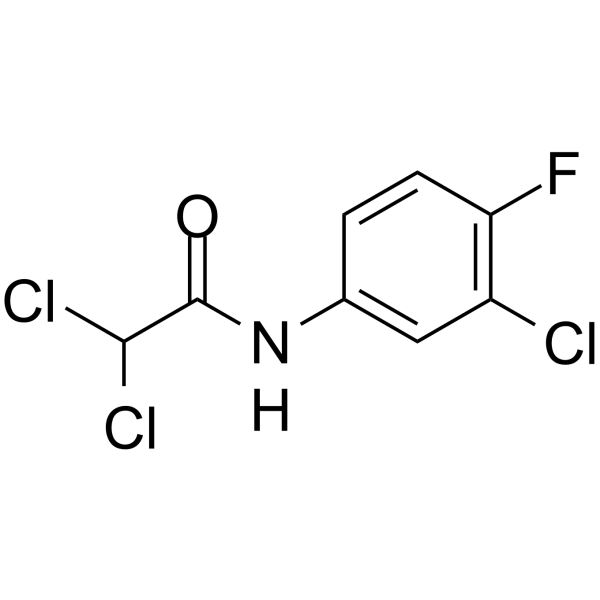
Physicochemical Properties
| Molecular Formula | C8H5CL3FNO |
| Molecular Weight | 256.49 |
| Exact Mass | 254.942 |
| CAS # | 349106-80-5 |
| PubChem CID | 4322881 |
| Appearance | Light yellow to yellow solid powder |
| LogP | 3.5 |
| Hydrogen Bond Donor Count | 1 |
| Hydrogen Bond Acceptor Count | 2 |
| Rotatable Bond Count | 2 |
| Heavy Atom Count | 14 |
| Complexity | 215 |
| Defined Atom Stereocenter Count | 0 |
| SMILES | C(NC1=CC=C(F)C(Cl)=C1)(=O)C(Cl)Cl |
| InChi Key | WZVDWCGCAQYINC-UHFFFAOYSA-N |
| InChi Code | InChI=1S/C8H5Cl3FNO/c9-5-3-4(1-2-6(5)12)13-8(14)7(10)11/h1-3,7H,(H,13,14) |
| Chemical Name | 2,2-dichloro-N-(3-chloro-4-fluorophenyl)acetamide |
| HS Tariff Code | 2934.99.9001 |
| Storage |
Powder-20°C 3 years 4°C 2 years In solvent -80°C 6 months -20°C 1 month |
| Shipping Condition | Room temperature (This product is stable at ambient temperature for a few days during ordinary shipping and time spent in Customs) |
Biological Activity
| ln Vitro | When paired with doxorubicin, LDCA (2-100 μM; 16-72 h) works in concert to improve growth inhibition and trigger mitochondria by enlisting the caspase cascade, limiting migration, and removing the melanoma cells' capacity for clonal growth. apoptosis was mediated [1]. |
| ln Vivo | In mouse melanoma models, LDCA (2 mg/kg, intravenously, once on day 6) in combination with doxorubicin reduces carcinogenic progression, stops tumor growth kinetics, and enhances survival [1]. |
| Cell Assay |
Cell viability assay [1] Cell Types: B16-F10 Cell Tested Concentrations: 2-100 μM Incubation Duration: 72 h Experimental Results: Inhibits cell growth, has dose-dependent cytotoxicity, and has a strong synergistic effect with LDCA. Apoptosis analysis[1] Cell Types: B16-F10 Cell Tested Concentrations: 20 μM Incubation Duration: 24 hrs (hours) Experimental Results: When cells were exposed to LDCA, it resulted in 15% death and synergistically with doxorubicin, resulting in 40% melanoma Cell death. Immunofluorescence[1] Cell Types: B16-F10 Cell Tested Concentrations: 20 μM Incubation Duration: 16 hrs (hours) Experimental Results: Demonstration that combination with doxorubicin affects cell morphology, leading to condensation and fragmentation of nuclei. Cell migration assay [1] Cell Types: B16-F10 Cell Tested Concentrations: 20 μM Incubation Duration: 16 hrs (hours) Experimental Results: Dramatically limited the migration potential of B16-F10 cells. |
| Animal Protocol |
Animal/Disease Models: Melanoma tumor model [1] Doses: 2 mg/kg Route of Administration: 2 mg/kg, intravenous (iv) (iv)injection, once on the 6th day. Experimental Results: Combined with doxorubicin, the survival ability of mice was Dramatically improved. , reduce tumor necrosis in mice. |
| References |
[1]. The dual-hit metabolic modulator LDCA synergistically potentiates doxorubicin to selectively combat cancer-associated hallmarks. RSC Advances, 7(84), 53322–53333. doi:10.1039/c7ra08625c. |
| Additional Infomation | See also: Acetamide (annotation moved to). |
Solubility Data
| Solubility (In Vitro) | DMSO : ~100 mg/mL (~389.88 mM) |
| Solubility (In Vivo) |
Solubility in Formulation 1: ≥ 2.5 mg/mL (9.75 mM) (saturation unknown) in 10% DMSO + 40% PEG300 + 5% Tween80 + 45% Saline (add these co-solvents sequentially from left to right, and one by one), clear solution. For example, if 1 mL of working solution is to be prepared, you can add 100 μL of 25.0 mg/mL clear DMSO stock solution to 400 μL PEG300 and mix evenly; then add 50 μL Tween-80 to the above solution and mix evenly; then add 450 μL normal saline to adjust the volume to 1 mL. Preparation of saline: Dissolve 0.9 g of sodium chloride in 100 mL ddH₂ O to obtain a clear solution. Solubility in Formulation 2: ≥ 2.5 mg/mL (9.75 mM) (saturation unknown) in 10% DMSO + 90% (20% SBE-β-CD in Saline) (add these co-solvents sequentially from left to right, and one by one), clear solution. For example, if 1 mL of working solution is to be prepared, you can add 100 μL of 25.0 mg/mL clear DMSO stock solution to 900 μL of 20% SBE-β-CD physiological saline solution and mix evenly. Preparation of 20% SBE-β-CD in Saline (4°C,1 week): Dissolve 2 g SBE-β-CD in 10 mL saline to obtain a clear solution. Solubility in Formulation 3: ≥ 2.5 mg/mL (9.75 mM) (saturation unknown) in 10% DMSO + 90% Corn Oil (add these co-solvents sequentially from left to right, and one by one), clear solution. For example, if 1 mL of working solution is to be prepared, you can add 100 μL of 25.0 mg/mL clear DMSO stock solution to 900 μL of corn oil and mix evenly. (Please use freshly prepared in vivo formulations for optimal results.) |
| Preparing Stock Solutions | 1 mg | 5 mg | 10 mg | |
| 1 mM | 3.8988 mL | 19.4939 mL | 38.9879 mL | |
| 5 mM | 0.7798 mL | 3.8988 mL | 7.7976 mL | |
| 10 mM | 0.3899 mL | 1.9494 mL | 3.8988 mL |