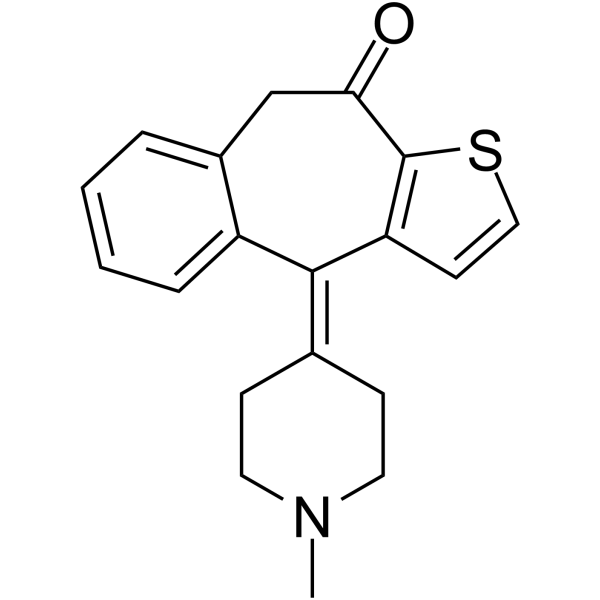
Physicochemical Properties
| Molecular Formula | C19H19NOS |
| Molecular Weight | 309.426 |
| Exact Mass | 309.119 |
| CAS # | 34580-13-7 |
| Related CAS # | Ketotifen fumarate;34580-14-8;Ketotifen-13C,d3;2748522-40-7 |
| PubChem CID | 3827 |
| Appearance | Crystals from ethyl acetate |
| Density | 1.236g/cm3 |
| Boiling Point | 488.9ºC at 760mmHg |
| Melting Point | 152-153ºC |
| Flash Point | 249.5ºC |
| LogP | 3.952 |
| Hydrogen Bond Donor Count | 0 |
| Hydrogen Bond Acceptor Count | 3 |
| Rotatable Bond Count | 0 |
| Heavy Atom Count | 22 |
| Complexity | 476 |
| Defined Atom Stereocenter Count | 0 |
| SMILES | S1C=CC2=C1C(CC1C=CC=CC=1/C/2=C1/CCN(C)CC/1)=O |
| InChi Key | ZCVMWBYGMWKGHF-UHFFFAOYSA-N |
| InChi Code | InChI=1S/C19H19NOS/c1-20-9-6-13(7-10-20)18-15-5-3-2-4-14(15)12-17(21)19-16(18)8-11-22-19/h2-5,8,11H,6-7,9-10,12H2,1H3 |
| Chemical Name | 2-(1-methylpiperidin-4-ylidene)-6-thiatricyclo[8.4.0.03,7]tetradeca-1(14),3(7),4,10,12-pentaen-8-one |
| HS Tariff Code | 2934.99.9001 |
| Storage |
Powder-20°C 3 years 4°C 2 years In solvent -80°C 6 months -20°C 1 month |
| Shipping Condition | Room temperature (This product is stable at ambient temperature for a few days during ordinary shipping and time spent in Customs) |
Biological Activity
| ln Vitro | Ketotifen (0-100 μM; 2 or 4 days) suppresses SARS-CoV-2 with an EC50 of 48.9 μM; the percentages of SARS-CoV-2 inhibition that increase to 79%, 83%, and 93% when coadministered with 25, 50, and 100 μM indomethacin, respectively[3]. Ketotifen (0-50 μM; 24 h) demonstrates comparatively moderate cytotoxicity in MDCK cells (EC50=291 μM), with inhibitory efficacy against PR8, pH1N1, and H3N2 (EC50 of 5.9 μM, 33.7 μM, and 48.5 μM, respectively) [4]. |
| ln Vivo | Ketotifen (80 mg/kg; injectable; given daily for 3 days) lowers end-organ damage and mortality in mice infected with influenza virus [4]. Ketotifen (0.4 mg/kg; intraperitoneally; given daily for 10 days) lowers the prevalence and severity of encephalomyelitis (EAE) [5]. |
| Animal Protocol |
Animal/Disease Models: Female C57BL/6 mice (4-6 weeks; PR8 intranasally infected with 1×10³ TCID50 in 30 μL DMEM) [4] Doses: 80 mg/kg Route of Administration: ig; one time/day for 3 Day Experimental Results: diminished end-organ damage and mortality in infected mice. Animal/Disease Models: Female C57BL/6 mice (5-6 weeks old; immunized subcutaneously (sc) (sc) with 150 μg of MOG35-55 peptide containing 4 mg/mL of Mycobacterium tuberculosis) [5] Doses: 0.4 mg/kg Route of Administration: intraperitoneal (ip) injection; one time/day for 10 days (starting on day 7 of infection) Experimental Results: diminished prevalence and severity of EAE; diminished oxidative stress state and inflammasome activation in the central nervous system; diminished T cell activation in the central nervous system numbers, especially Th1; downregulates local mRNA expression of mast cell enzymes and maintains blood-CNS barrier permeability; triggers lymphocyte accumulation in draining lymph nodes. |
| ADME/Pharmacokinetics |
Absorption, Distribution and Excretion Following oral administration, absorption is relatively quick (with a Tmax of ~3 hours) and nearly complete as judged by plasma concentrations and urinary excretion levels - despite this, oral bioavailability is only ~50% due to a significant first-pass effect in the liver. More than 60% of an administered dose is excreted in the urine, primarily as metabolites - of this material, <1% is found as unchanged drug, while the glucuronide and pharmacologically active nor-ketotifen metabolites account for 50% and 10%, respectively. Within 48 hours, urinary excretion amounts to 1% as unchanged drug and 60% to 70% as metabolites. Clearance is higher in children. /Ketotifen fumarate/ Following oral administration absorption is at least 60% ... The rate of absorption is rapid with an absorption half life of 1 hour. Bioavailability is about 50%, due to a large first pass effect. Bioavailability is not affected by the intake of food. /Ketotifen fumarate/ ... A study conducted with 15 healthy volunteers dosed bilaterally with ketotifen fumarate ophthalmic solution twice daily for 14 days demonstrated plasma concentrations generally below the quantitation limit of assay (< 20 pg/mL). /Ketotifen fumarate/ It is not known whether ophthalmic ketotifen is absorbed in sufficient quantities to be distributed into human breast milk. However, it has been found in the milk of nursing rats following oral administration. /Ketotifen fumarate/ For more Absorption, Distribution and Excretion (Complete) data for KETOTIFEN (7 total), please visit the HSDB record page. Metabolism / Metabolites Ketotifen is extensively metabolized in humans and three distinct metabolites have been detected in human urine. The main metabolite is the N-glucuronide, comprising roughly 50% of urinary drug product, with the N-demethylated nor-ketotifen and the 10-hydroxyl derivative comprising 2% and <1%, respectively. Nor-ketotifen appears to be equally as active as its parent drug, though the clinical relevance of this is unclear given the relatively small proportion in which nor-ketotifen is found in the plasma. Formation of the N-glucuronide metabolite is carried out by several UGT enzymes, including UGT1A3, UGT1A4, and UGT2B10. The main metabolite found in both plasma and urine is the inactive ketotifen-N-glucuronide. Nor-ketotifen, the N-demethylated metabolite, and the 10-hydroxyl derivative are the only other metabolites detectable in human urine. Both the 10-hydroxyl derivative and N-glucuronide conjugate may reform the intact product by in vivo reversibility. The pattern of metabolism in children over the age of 3 years is the same as in adults, but the clearance is higher in children. /Ketotifen fumarate (systemic)/ Ketotifen has known human metabolites that include (2S,3S,4S,5R)-3,4,5-trihydroxy-6-[1-methyl-4-(8-oxo-6-thiatricyclo[8.4.0.03,7]tetradeca-1(14),3(7),4,10,12-pentaen-2-ylidene)piperidin-1-ium-1-yl]oxane-2-carboxylic acid and Ketotifen N-glucuronide. Biological Half-Life Ketotifen clearance is biphasic - the half-life of the distribution phase is approximately 3-5 hours and the half-life of the elimination phase is 22 hours. Distribution: 3 to 5 hours. Elimination: 21 hours. /Ketotifen fumarate (systemic)/ ... The rate of absorption /following oral administration/ is rapid with an absorption half life of 1 hour. |
| Toxicity/Toxicokinetics |
Effects During Pregnancy and Lactation ◉ Summary of Use during Lactation Because absorption from the eye is limited, ketotifen would not be expected to cause any adverse effects in breastfed infants after maternal use of ketotifen eye drops. To substantially diminish the amount of drug that reaches the breastmilk after using eye drops, place pressure over the tear duct by the corner of the eye for 1 minute or more, then remove the excess solution with an absorbent tissue. ◉ Effects in Breastfed Infants Relevant published information was not found as of the revision date. ◉ Effects on Lactation and Breastmilk Relevant published information was not found as of the revision date. Protein Binding Ketotifen is 75% protein-bound in plasma, though the specific proteins to which it binds are unclear. Interactions Concurrent use /of alcohol, antihistamines, hypnotics, or sedatives/ with /oral/ ketotifen may potentiate the CNS depressant effects of these medications. /Ketotifen fumarate/ Concomitant use /of oral antidiabetic agents/ with /oral/ ketotifen may result in reversible thrombocytopenia ... /Ketotifen fumarate/ ... Ketotifen (4 mg/kg) co-administered with conventional antiepileptic drugs impaired motor coordination in mice treated with valproate, phenobarbital or diphenylhydantoin. ...Ketotifen reduced the protection offered by carbamazepine and elevated the adverse activity of diphenylhydantoin, phenobarbital and valproate /in mice/. |
| References |
[1]. The mast cell stabiliser ketotifen decreases visceral hypersensitivity and improves intestinal symptoms in patients with irritable bowel syndrome. Gut. 2010 Sep;59(9):1213-21. [2]. Advances in the discovery of exosome inhibitors in cancer. J Enzyme Inhib Med Chem. 2020;35(1):1322-1330. [3]. In Vitro Assessment of the Antiviral Activity of Ketotifen, Indomethacin and Naproxen, Alone and in Combination, against SARS-CoV-2. Viruses. 2021 Mar 26;13(4):558. [4]. Identification and in vivo Efficacy Assessment of Approved Orally Bioavailable Human Host Protein-Targeting Drugs With Broad Anti-influenza A Activity. Front Immunol. 2019 Jun 5;10:1097. [5]. Calming Down Mast Cells with Ketotifen: A Potential Strategy for Multiple Sclerosis Therapy? Neurotherapeutics. 2020 Jan;17(1):218-234. |
| Additional Infomation |
Therapeutic Uses Oral ketotifen is indicated as an add-on medication in the chronic treatment of mild atopic asthmatic children. Ketotifen is a prophylactic agent to be used on a continuous basis and is not effective in the acute prevention or treatment of acute asthma attacks. /Not commercially available in US/ Ophthalmic ketotifen is indicated for the temporary prevention of itching of the eye due to allergic conjunctivitis. /Included in US product labeling/ Drug Warnings Ketotifen should not be used to treat contact lens related irritation. /Ketotifen fumarate/ Pregnancy risk category: C /RISK CANNOT BE RULED OUT. Adequate, well controlled human studies are lacking, and animal studies have shown risk to the fetus or are lacking as well. There is a chance of fetal harm if the drug is given during pregnancy; but the potential benefits may outweigh the potential risk./ Symptoms of central nervous system stimulation, such as excitation, irritability, insomnia, and nervousness have been observed, particularly in children. /Ketotifen fumarate (systemic)/ For patients with diabetes: Recognizing that ketotifen syrup contains 4 g of carbohydrate in every 5 mL; glucose concentrations may be affected. /Ketotifen fumarate (systemic)/ For more Drug Warnings (Complete) data for KETOTIFEN (9 total), please visit the HSDB record page. Pharmacodynamics Ketotifen is a non-competitive histamine antagonist and mast cell stabilizer. Administered orally, it functions as a non-bronchodilator antiasthmatic drug by inhibiting the effects of endogenous substances known to be inflammatory mediators. While effects can take 6 to 12 weeks to become apparent, the use of ketotifen has been demonstrated to reduce the frequency, severity, and duration of asthma symptoms, and may allow for a reduction in the use of other asthma therapies. |
Solubility Data
| Solubility (In Vitro) | May dissolve in DMSO (in most cases), if not, try other solvents such as H2O, Ethanol, or DMF with a minute amount of products to avoid loss of samples |
| Solubility (In Vivo) |
Note: Listed below are some common formulations that may be used to formulate products with low water solubility (e.g. < 1 mg/mL), you may test these formulations using a minute amount of products to avoid loss of samples. Injection Formulations (e.g. IP/IV/IM/SC) Injection Formulation 1: DMSO : Tween 80: Saline = 10 : 5 : 85 (i.e. 100 μL DMSO stock solution → 50 μL Tween 80 → 850 μL Saline) *Preparation of saline: Dissolve 0.9 g of sodium chloride in 100 mL ddH ₂ O to obtain a clear solution. Injection Formulation 2: DMSO : PEG300 :Tween 80 : Saline = 10 : 40 : 5 : 45 (i.e. 100 μL DMSO → 400 μLPEG300 → 50 μL Tween 80 → 450 μL Saline) Injection Formulation 3: DMSO : Corn oil = 10 : 90 (i.e. 100 μL DMSO → 900 μL Corn oil) Example: Take the Injection Formulation 3 (DMSO : Corn oil = 10 : 90) as an example, if 1 mL of 2.5 mg/mL working solution is to be prepared, you can take 100 μL 25 mg/mL DMSO stock solution and add to 900 μL corn oil, mix well to obtain a clear or suspension solution (2.5 mg/mL, ready for use in animals). Injection Formulation 4: DMSO : 20% SBE-β-CD in saline = 10 : 90 [i.e. 100 μL DMSO → 900 μL (20% SBE-β-CD in saline)] *Preparation of 20% SBE-β-CD in Saline (4°C,1 week): Dissolve 2 g SBE-β-CD in 10 mL saline to obtain a clear solution. Injection Formulation 5: 2-Hydroxypropyl-β-cyclodextrin : Saline = 50 : 50 (i.e. 500 μL 2-Hydroxypropyl-β-cyclodextrin → 500 μL Saline) Injection Formulation 6: DMSO : PEG300 : castor oil : Saline = 5 : 10 : 20 : 65 (i.e. 50 μL DMSO → 100 μLPEG300 → 200 μL castor oil → 650 μL Saline) Injection Formulation 7: Ethanol : Cremophor : Saline = 10: 10 : 80 (i.e. 100 μL Ethanol → 100 μL Cremophor → 800 μL Saline) Injection Formulation 8: Dissolve in Cremophor/Ethanol (50 : 50), then diluted by Saline Injection Formulation 9: EtOH : Corn oil = 10 : 90 (i.e. 100 μL EtOH → 900 μL Corn oil) Injection Formulation 10: EtOH : PEG300:Tween 80 : Saline = 10 : 40 : 5 : 45 (i.e. 100 μL EtOH → 400 μLPEG300 → 50 μL Tween 80 → 450 μL Saline) Oral Formulations Oral Formulation 1: Suspend in 0.5% CMC Na (carboxymethylcellulose sodium) Oral Formulation 2: Suspend in 0.5% Carboxymethyl cellulose Example: Take the Oral Formulation 1 (Suspend in 0.5% CMC Na) as an example, if 100 mL of 2.5 mg/mL working solution is to be prepared, you can first prepare 0.5% CMC Na solution by measuring 0.5 g CMC Na and dissolve it in 100 mL ddH2O to obtain a clear solution; then add 250 mg of the product to 100 mL 0.5% CMC Na solution, to make the suspension solution (2.5 mg/mL, ready for use in animals). Oral Formulation 3: Dissolved in PEG400 Oral Formulation 4: Suspend in 0.2% Carboxymethyl cellulose Oral Formulation 5: Dissolve in 0.25% Tween 80 and 0.5% Carboxymethyl cellulose Oral Formulation 6: Mixing with food powders Note: Please be aware that the above formulations are for reference only. InvivoChem strongly recommends customers to read literature methods/protocols carefully before determining which formulation you should use for in vivo studies, as different compounds have different solubility properties and have to be formulated differently. (Please use freshly prepared in vivo formulations for optimal results.) |
| Preparing Stock Solutions | 1 mg | 5 mg | 10 mg | |
| 1 mM | 3.2317 mL | 16.1587 mL | 32.3175 mL | |
| 5 mM | 0.6463 mL | 3.2317 mL | 6.4635 mL | |
| 10 mM | 0.3232 mL | 1.6159 mL | 3.2317 mL |