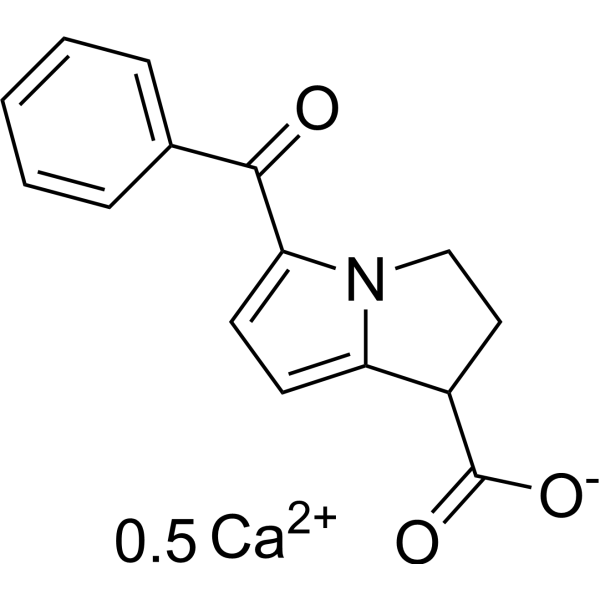
Physicochemical Properties
| Molecular Formula | C30H24CAN2O6 |
| Molecular Weight | 548.599367141724 |
| Exact Mass | 548.126 |
| CAS # | 167105-81-9 |
| Related CAS # | Ketorolac;74103-06-3;(S)-Ketorolac;66635-92-5;(R)-Ketorolac;66635-93-6;Ketorolac-d5;1215767-66-0 |
| PubChem CID | 71587565 |
| Appearance | Typically exists as solid at room temperature |
| LogP | 1.912 |
| Hydrogen Bond Donor Count | 0 |
| Hydrogen Bond Acceptor Count | 6 |
| Rotatable Bond Count | 4 |
| Heavy Atom Count | 39 |
| Complexity | 370 |
| Defined Atom Stereocenter Count | 0 |
| SMILES | [Ca+2].[O-]C(C1C2=CC=C(C(C3C=CC=CC=3)=O)N2CC1)=O.[O-]C(C1C2=CC=C(C(C3C=CC=CC=3)=O)N2CC1)=O |
| InChi Key | NPCGTDZMTWNBDA-UHFFFAOYSA-L |
| InChi Code | InChI=1S/2C15H13NO3.Ca/c2*17-14(10-4-2-1-3-5-10)13-7-6-12-11(15(18)19)8-9-16(12)13;/h2*1-7,11H,8-9H2,(H,18,19);/q;;+2/p-2 |
| Chemical Name | calcium;5-benzoyl-2,3-dihydro-1H-pyrrolizine-1-carboxylate |
| HS Tariff Code | 2934.99.9001 |
| Storage |
Powder-20°C 3 years 4°C 2 years In solvent -80°C 6 months -20°C 1 month |
| Shipping Condition | Room temperature (This product is stable at ambient temperature for a few days during ordinary shipping and time spent in Customs) |
Biological Activity
| ln Vitro | In 48 hours, ketorolac (RS37619) salt (0–30 μM) efficiently destroys oral cancer cells [4]. In H357 cells, ketorolat (0–5 μM; 48 h) causes apoptosis and suppresses the production of the DDX3 protein [4]. The growth of oral cancer cells is inhibited by ketorolat (0-2.5 μM; 0-16 hours) [4]. Ketorolat (0-50 μM) decreases ATPase activity by directly interacting with DDX3 [4]. |
| ln Vivo | Rabbits treated with ketorolac (RS37619) (0.4% Ketorolac Tromethamine Eye Drops) demonstrated strong ocular anti-inflammatory effects [1]. There are no negative effects of ketorolac (4 mg/kg/day orally; 2 weeks) on the volume fraction of trabecular bone formed in the rats' alveolar sockets [2]. In rats, intrathecal injection of ketorolac (60 μg) once reduces damage from spinal cord ischemia [3]. Oral cancer incidence in mice is decreased by ketorolat (20 and 30 mg/kg; intraperitoneal injection; twice weekly for 3 weeks) [4]. |
| Cell Assay |
Cell viability assay [4] Cell Types: HOK, SCC4, SCC9 and H357 Cell Tested Concentrations: 0-30 μM Incubation Duration: 48 hrs (hours) Experimental Results: Inhibitory effect on H357, SCC4 and SCC9 cells, IC50 are 2.6, 7.1 and 8.1 μM respectively . The normal HOK cell line did not show any cell death effect. Cell proliferation experiment [4] Cell Types: H357 Tested Concentrations: 0.5, 1.0, 1.5, 2.0 and 2.5 μM Incubation Duration: 0, 8 and 16 h Experimental Results: Proliferation was inhibited. Western Blot Analysis[4] Cell Types: H357 Tested Concentrations: 1, 2.5 and 5 μM Incubation Duration: 48 hrs (hours) Experimental Results: DDX3 protein expression levels were Dramatically diminished, but not completely eliminated, compared to DMSO-treated cells. Upregulates the expression of E-cadherin. Apoptosis analysis[4] Cell Types: H357 Tested Concentrations: 2.5 and 5 μM Incubation Duration: 48 hrs (hours) Experimental Results: Induction of apoptosis. |
| Animal Protocol |
Animal/Disease Models: New Zealand white rabbit (2.0–2.7 kg), ocular inflammation caused by LPS endotoxin [1] Doses: 50 μL ketorolac trometamol eye drops 0.4% Route of Administration: two times before LPS challenge, 2 hour and 1 hour intraocular Experimental Results: Almost complete inhibition (98.7%) of LPS endotoxin-induced increase in anterior chamber FITC (fluorescein isothiocyanate)-dextran and resulted in almost complete inhibition (97.5%) of LPS endotoxin Induced aqueous phase PGE2 concentration increases in aqueous humor. Animal/Disease Models: Male Wistar rat (400-450 g), spinal cord ischemia model [3] Doses: 30 and 60 μg Route of Administration: intrathecal injection, once 1 hour before ischemia induction Experimental Results:Dramatically alleviated movement disorders , the rate of improving survival rate is 60 μg. Animal/Disease Models: balb/c (Bagg ALBino) mouse, oral carcinogenesis model [4] Doses: 20 mg/kg and 30 mg/kg Route of Administration: IP injection, twice a week for 3 weeks Experimental Results: Tumor load reduction, DDX3 and anti- diminished exp |
| References |
[1]. Waterbury LD, et al. Comparison of cyclooxygenase inhibitory activity and ocular anti-inflammatory effects of ketorolac tromethamine and bromfenac sodium. Curr Med Res Opin. 2006 Jun;22(6):1133-40. [2]. Fracon RN, et al. Treatment with paracetamol, ketorolac or etoricoxib did not hinder alveolar bone healing: a histometric study in rats. J Appl Oral Sci. 2010 Dec;18(6):630-4. [3]. Hsieh YC, et al. Intrathecal ketorolac pretreatment reduced spinal cord ischemic injury in rats. Anesth Analg. 2005 Apr;100(4):1134-9. [4]. Samal SK, et al. Ketorolac salt is a newly discovered DDX3 inhibitor to treat oral cancer. Sci Rep. 2015 Apr 28;5:9982. |
Solubility Data
| Solubility (In Vitro) | May dissolve in DMSO (in most cases), if not, try other solvents such as H2O, Ethanol, or DMF with a minute amount of products to avoid loss of samples |
| Solubility (In Vivo) |
Note: Listed below are some common formulations that may be used to formulate products with low water solubility (e.g. < 1 mg/mL), you may test these formulations using a minute amount of products to avoid loss of samples. Injection Formulations (e.g. IP/IV/IM/SC) Injection Formulation 1: DMSO : Tween 80: Saline = 10 : 5 : 85 (i.e. 100 μL DMSO stock solution → 50 μL Tween 80 → 850 μL Saline) *Preparation of saline: Dissolve 0.9 g of sodium chloride in 100 mL ddH ₂ O to obtain a clear solution. Injection Formulation 2: DMSO : PEG300 :Tween 80 : Saline = 10 : 40 : 5 : 45 (i.e. 100 μL DMSO → 400 μLPEG300 → 50 μL Tween 80 → 450 μL Saline) Injection Formulation 3: DMSO : Corn oil = 10 : 90 (i.e. 100 μL DMSO → 900 μL Corn oil) Example: Take the Injection Formulation 3 (DMSO : Corn oil = 10 : 90) as an example, if 1 mL of 2.5 mg/mL working solution is to be prepared, you can take 100 μL 25 mg/mL DMSO stock solution and add to 900 μL corn oil, mix well to obtain a clear or suspension solution (2.5 mg/mL, ready for use in animals). Injection Formulation 4: DMSO : 20% SBE-β-CD in saline = 10 : 90 [i.e. 100 μL DMSO → 900 μL (20% SBE-β-CD in saline)] *Preparation of 20% SBE-β-CD in Saline (4°C,1 week): Dissolve 2 g SBE-β-CD in 10 mL saline to obtain a clear solution. Injection Formulation 5: 2-Hydroxypropyl-β-cyclodextrin : Saline = 50 : 50 (i.e. 500 μL 2-Hydroxypropyl-β-cyclodextrin → 500 μL Saline) Injection Formulation 6: DMSO : PEG300 : castor oil : Saline = 5 : 10 : 20 : 65 (i.e. 50 μL DMSO → 100 μLPEG300 → 200 μL castor oil → 650 μL Saline) Injection Formulation 7: Ethanol : Cremophor : Saline = 10: 10 : 80 (i.e. 100 μL Ethanol → 100 μL Cremophor → 800 μL Saline) Injection Formulation 8: Dissolve in Cremophor/Ethanol (50 : 50), then diluted by Saline Injection Formulation 9: EtOH : Corn oil = 10 : 90 (i.e. 100 μL EtOH → 900 μL Corn oil) Injection Formulation 10: EtOH : PEG300:Tween 80 : Saline = 10 : 40 : 5 : 45 (i.e. 100 μL EtOH → 400 μLPEG300 → 50 μL Tween 80 → 450 μL Saline) Oral Formulations Oral Formulation 1: Suspend in 0.5% CMC Na (carboxymethylcellulose sodium) Oral Formulation 2: Suspend in 0.5% Carboxymethyl cellulose Example: Take the Oral Formulation 1 (Suspend in 0.5% CMC Na) as an example, if 100 mL of 2.5 mg/mL working solution is to be prepared, you can first prepare 0.5% CMC Na solution by measuring 0.5 g CMC Na and dissolve it in 100 mL ddH2O to obtain a clear solution; then add 250 mg of the product to 100 mL 0.5% CMC Na solution, to make the suspension solution (2.5 mg/mL, ready for use in animals). Oral Formulation 3: Dissolved in PEG400 Oral Formulation 4: Suspend in 0.2% Carboxymethyl cellulose Oral Formulation 5: Dissolve in 0.25% Tween 80 and 0.5% Carboxymethyl cellulose Oral Formulation 6: Mixing with food powders Note: Please be aware that the above formulations are for reference only. InvivoChem strongly recommends customers to read literature methods/protocols carefully before determining which formulation you should use for in vivo studies, as different compounds have different solubility properties and have to be formulated differently. (Please use freshly prepared in vivo formulations for optimal results.) |
| Preparing Stock Solutions | 1 mg | 5 mg | 10 mg | |
| 1 mM | 1.8228 mL | 9.1141 mL | 18.2282 mL | |
| 5 mM | 0.3646 mL | 1.8228 mL | 3.6456 mL | |
| 10 mM | 0.1823 mL | 0.9114 mL | 1.8228 mL |