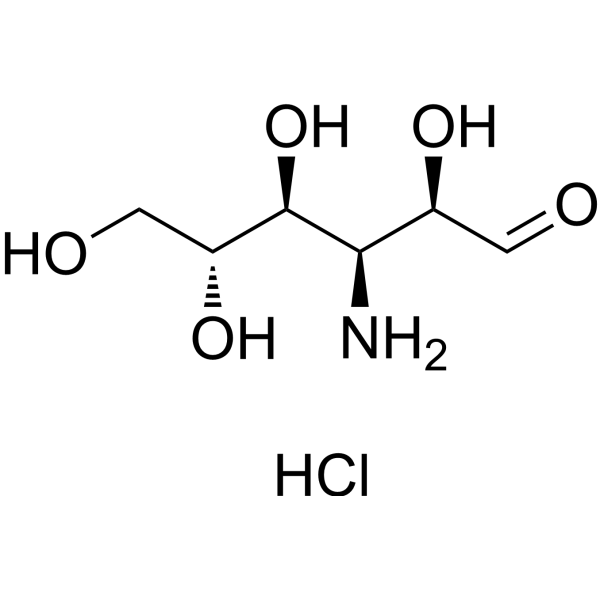
Physicochemical Properties
| Molecular Formula | C6H13NO5.HCL |
| Molecular Weight | 215.63206 |
| Exact Mass | 215.056 |
| CAS # | 57649-10-2 |
| PubChem CID | 198363 |
| Appearance | White to yellow solid powder |
| Hydrogen Bond Donor Count | 6 |
| Hydrogen Bond Acceptor Count | 6 |
| Rotatable Bond Count | 5 |
| Heavy Atom Count | 13 |
| Complexity | 142 |
| Defined Atom Stereocenter Count | 4 |
| SMILES | O=C[C@@H]([C@@H](N)[C@@H]([C@@H](CO)O)O)O.Cl |
| InChi Key | ADFOMBKCPIMCOO-BTVCFUMJSA-N |
| InChi Code | InChI=1S/C6H13NO5.ClH/c7-5(3(10)1-8)6(12)4(11)2-9;/h1,3-6,9-12H,2,7H2;1H/t3-,4+,5+,6+;/m0./s1 |
| Chemical Name | (2R,3S,4S,5R)-3-amino-2,4,5,6-tetrahydroxyhexanal;hydrochloride |
| HS Tariff Code | 2934.99.9001 |
| Storage |
Powder-20°C 3 years 4°C 2 years In solvent -80°C 6 months -20°C 1 month Note: Please store this product in a sealed and protected environment, avoid exposure to moisture. |
| Shipping Condition | Room temperature (This product is stable at ambient temperature for a few days during ordinary shipping and time spent in Customs) |
Biological Activity
| ln Vitro | Carnosamine significantly inhibits the growth of oomycetes that are phytopathogenic. Aphanomyces euteiches WI-98 shown an intermediate degree of sensitivity to carnoamine, whereas Pythium aphanidermatum Pa138 and Pythium torulosum A25a demonstrated lower levels of sensitivity among the strains tested. Phytophthora medicaginis M2913 was the strain most sensitive to the compound. At pH7.0, oomycetes are more susceptible to carnoamine than they are at pH 5.6. A limited range of bacterial species are inhibited by carnosamine. Certain fungi are moderately inhibited by carbosamine. Plant pathogens include all oomycetes and fungi that are inhibited by carnoamine. Bacillus cereus UW85 culture supernatant carnosamine accumulation reaches its peak during sporulation. Phosphate was added to the rich medium to prevent canoamine buildup, but ferric iron increased canoamine accumulation. Additionally, the buildup of carnoamine was boosted by more than 300% by adding alfalfa seedling exudate to the minimum medium [1]. The growth of Saccharomyces cerevisiae and several other human pathogenic fungi, such as Candida albicans, is inhibited by the antibiotic carnosamine. Carnoamine's impact on C. Significant morphological alterations, suppression of septum development, and cell agglutination are caused by albicans cells [2]. |
| References |
[1]. Milner JL, et al. Production of kanosamine by Bacillus cereus UW85. Appl Environ Microbiol. 1996 Aug;62(8):3061-5. [2]. Janiak AM, et al. Mechanism of antifungal action of kanosamine. Med Mycol. 2001 Oct;39(5):401-8 |
Solubility Data
| Solubility (In Vitro) | May dissolve in DMSO (in most cases), if not, try other solvents such as H2O, Ethanol, or DMF with a minute amount of products to avoid loss of samples |
| Solubility (In Vivo) |
Note: Listed below are some common formulations that may be used to formulate products with low water solubility (e.g. < 1 mg/mL), you may test these formulations using a minute amount of products to avoid loss of samples. Injection Formulations (e.g. IP/IV/IM/SC) Injection Formulation 1: DMSO : Tween 80: Saline = 10 : 5 : 85 (i.e. 100 μL DMSO stock solution → 50 μL Tween 80 → 850 μL Saline) *Preparation of saline: Dissolve 0.9 g of sodium chloride in 100 mL ddH ₂ O to obtain a clear solution. Injection Formulation 2: DMSO : PEG300 :Tween 80 : Saline = 10 : 40 : 5 : 45 (i.e. 100 μL DMSO → 400 μLPEG300 → 50 μL Tween 80 → 450 μL Saline) Injection Formulation 3: DMSO : Corn oil = 10 : 90 (i.e. 100 μL DMSO → 900 μL Corn oil) Example: Take the Injection Formulation 3 (DMSO : Corn oil = 10 : 90) as an example, if 1 mL of 2.5 mg/mL working solution is to be prepared, you can take 100 μL 25 mg/mL DMSO stock solution and add to 900 μL corn oil, mix well to obtain a clear or suspension solution (2.5 mg/mL, ready for use in animals). Injection Formulation 4: DMSO : 20% SBE-β-CD in saline = 10 : 90 [i.e. 100 μL DMSO → 900 μL (20% SBE-β-CD in saline)] *Preparation of 20% SBE-β-CD in Saline (4°C,1 week): Dissolve 2 g SBE-β-CD in 10 mL saline to obtain a clear solution. Injection Formulation 5: 2-Hydroxypropyl-β-cyclodextrin : Saline = 50 : 50 (i.e. 500 μL 2-Hydroxypropyl-β-cyclodextrin → 500 μL Saline) Injection Formulation 6: DMSO : PEG300 : castor oil : Saline = 5 : 10 : 20 : 65 (i.e. 50 μL DMSO → 100 μLPEG300 → 200 μL castor oil → 650 μL Saline) Injection Formulation 7: Ethanol : Cremophor : Saline = 10: 10 : 80 (i.e. 100 μL Ethanol → 100 μL Cremophor → 800 μL Saline) Injection Formulation 8: Dissolve in Cremophor/Ethanol (50 : 50), then diluted by Saline Injection Formulation 9: EtOH : Corn oil = 10 : 90 (i.e. 100 μL EtOH → 900 μL Corn oil) Injection Formulation 10: EtOH : PEG300:Tween 80 : Saline = 10 : 40 : 5 : 45 (i.e. 100 μL EtOH → 400 μLPEG300 → 50 μL Tween 80 → 450 μL Saline) Oral Formulations Oral Formulation 1: Suspend in 0.5% CMC Na (carboxymethylcellulose sodium) Oral Formulation 2: Suspend in 0.5% Carboxymethyl cellulose Example: Take the Oral Formulation 1 (Suspend in 0.5% CMC Na) as an example, if 100 mL of 2.5 mg/mL working solution is to be prepared, you can first prepare 0.5% CMC Na solution by measuring 0.5 g CMC Na and dissolve it in 100 mL ddH2O to obtain a clear solution; then add 250 mg of the product to 100 mL 0.5% CMC Na solution, to make the suspension solution (2.5 mg/mL, ready for use in animals). Oral Formulation 3: Dissolved in PEG400 Oral Formulation 4: Suspend in 0.2% Carboxymethyl cellulose Oral Formulation 5: Dissolve in 0.25% Tween 80 and 0.5% Carboxymethyl cellulose Oral Formulation 6: Mixing with food powders Note: Please be aware that the above formulations are for reference only. InvivoChem strongly recommends customers to read literature methods/protocols carefully before determining which formulation you should use for in vivo studies, as different compounds have different solubility properties and have to be formulated differently. (Please use freshly prepared in vivo formulations for optimal results.) |
| Preparing Stock Solutions | 1 mg | 5 mg | 10 mg | |
| 1 mM | 4.6376 mL | 23.1879 mL | 46.3757 mL | |
| 5 mM | 0.9275 mL | 4.6376 mL | 9.2751 mL | |
| 10 mM | 0.4638 mL | 2.3188 mL | 4.6376 mL |