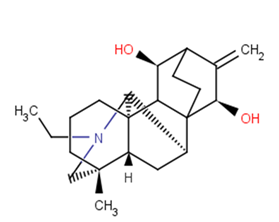
Bullatine A is a naturally occurring diterpenoid alkaloid of the genus Aconitum with anti-rheumatic, anti-inflammatory and anti-nociceptive effects, and thus has the potential to be used for the treatment of neurodegenerative diseases such as arthritis.
Physicochemical Properties
| Molecular Formula | C22H33NO2 |
| Molecular Weight | 343.5029 |
| Exact Mass | 343.251 |
| CAS # | 1354-84-3 |
| PubChem CID | 71300866 |
| Appearance | White to off-white solid powder |
| Density | 1.2±0.1 g/cm3 |
| Boiling Point | 488.2±45.0 °C at 760 mmHg |
| Flash Point | 242.3±27.4 °C |
| Vapour Pressure | 0.0±2.8 mmHg at 25°C |
| Index of Refraction | 1.620 |
| LogP | 3.07 |
| Hydrogen Bond Donor Count | 2 |
| Hydrogen Bond Acceptor Count | 3 |
| Rotatable Bond Count | 1 |
| Heavy Atom Count | 25 |
| Complexity | 662 |
| Defined Atom Stereocenter Count | 5 |
| SMILES | CCN1C[C@@]2(CCCC34[C@@H]2CC(C31)C56[C@@H]4[C@H](C(CC5)C(=C)[C@H]6O)O)C |
| InChi Key | OVXLNQAYPUEDSI-LVIQKLEBSA-N |
| InChi Code | InChI=1S/C22H33NO2/c1-4-23-11-20(3)7-5-8-22-15(20)10-14(18(22)23)21-9-6-13(12(2)19(21)25)16(24)17(21)22/h13-19,24-25H,2,4-11H2,1,3H3/t13?,14?,15-,16+,17+,18?,19-,20+,21?,22?/m1/s1 |
| Chemical Name | (5R,11R,14S,15R,16R)-7-ethyl-5-methyl-12-methylidene-7-azahexacyclo[7.6.2.210,13.01,8.05,16.010,15]nonadecane-11,14-diol |
| HS Tariff Code | 2934.99.9001 |
| Storage |
Powder-20°C 3 years 4°C 2 years In solvent -80°C 6 months -20°C 1 month Note: This product requires protection from light (avoid light exposure) during transportation and storage. |
| Shipping Condition | Room temperature (This product is stable at ambient temperature for a few days during ordinary shipping and time spent in Customs) |
Biological Activity
| Targets |
P2X7 receptor – selectively antagonizes the ATP-induced up-regulation of P2X7 receptor mRNA. [1] Bullatine A stimulates spinal microglial dynorphin A expression, which then acts on kappa-opioid receptors to produce anti-hypersensitivity. It also antagonizes P2X7 receptors (EC50 for dynorphin A expression in microglia: 3.2 µM). |
| ln Vitro |
Bullatine A (1–50 µM) dose-dependently inhibits ATP (500 µM)-induced cytotoxicity in BV-2 microglial cells after 24 hours of incubation, as assessed by MTT assay. [1] Bullatine A (1–50 µM) up-regulates the ratio of Bcl-2/Bax mRNA in ATP-stimulated BV-2 cells, indicating an anti-apoptotic effect. The effect was most pronounced at 10 µM. [1] Bullatine A (1–50 µM) significantly down-regulates the mRNA levels of pro-inflammatory cytokines IL-6, IL-1β, and inducible nitric oxide synthase (iNOS) in ATP-stimulated BV-2 cells in a dose-dependent manner. [1] Bullatine A (1–50 µM) dose-dependently inhibits ATP-induced production of nitric oxide (NO) and interleukin-6 (IL-6) in BV-2 microglial cells after 24 hours. [1] Bullatine A (1–50 µM) selectively inhibits ATP-induced up-regulation of P2X7 receptor mRNA, but has no obvious effect on P2X4 receptor mRNA levels in BV-2 cells. [1] Bullatine A stimulates prodynorphin gene expression in cultured primary microglia in a concentration-dependent manner (EC50 = 3.2 µM), but not in astrocytes or neurons. It does not inhibit LPS-induced pro-inflammatory cytokine (TNF-α, IL-1β, IL-6) expression in microglia. [2] |
| ln Vivo |
Subcutaneous injection of Bullatine A (0.3–30 mg/kg) dose-dependently attenuates mechanical allodynia and thermal hyperalgesia in rat models of neuropathic pain (ED50 = 1.9 mg/kg for mechanical allodynia, 0.7 mg/kg for thermal hyperalgesia), inflammatory pain (ED50 = 1.4 mg/kg for mechanical allodynia, 0.6 mg/kg for thermal hyperalgesia), diabetic neuropathic pain (ED50 = 1.2 mg/kg), and bone cancer pain (ED50 = 0.9 mg/kg). Intrathecal injection also shows dose-dependent anti-allodynic effects (ED50 = 1.1 µg). The anti-nociceptive effects are blocked by minocycline, dynorphin A antiserum, and kappa-opioid receptor antagonist GNTI. [2] |
| Cell Assay |
Cell viability assay (MTT): BV-2 microglial cells were cultured in DMEM supplemented with 10% fetal bovine serum, penicillin, and streptomycin at 37°C in a humidified incubator with 5% CO2. Cells were treated with ATP (25–1500 µM) for 1, 24, or 48 hours to determine the cytotoxic concentration. For inhibitor testing, cells were pre-treated or co-treated with Bullatine A (1–50 µM) or the non-selective P2X antagonist TNP-ATP (10–100 nM) for 24 hours prior to or concurrently with ATP (500 µM) exposure. After treatment, MTT reagent was added, and the formazan crystals formed were dissolved. Absorbance was measured using a microplate reader at a specific wavelength (not specified). Cell viability was expressed as a percentage of the control (untreated) group. [1] Real-time reverse transcription polymerase chain reaction (RT-PCR): Total RNA was isolated from treated BV-2 cells using a Trizol reagent. RNA was reverse transcribed to cDNA using a commercial reverse transcription kit. Quantitative real-time PCR was performed using SYBR Green-based chemistry on a real-time PCR system. Primer sequences for target genes (P2X4, P2X7, IL-6, IL-1β, iNOS, Bcl-2, Bax) and the reference gene (β-actin) were provided. Relative gene expression was calculated using the 2^(-ΔΔCt) method and normalized to β-actin. [1] Measurement of nitric oxide (NO) production: The supernatant of cultured BV-2 cells was collected after treatment. NO production was measured indirectly by detecting nitrite concentration using a Griess reagent system kit according to the manufacturer's instructions. [1] Measurement of interleukin-6 (IL-6) production: The supernatant of cultured BV-2 cells was collected. IL-6 concentration was measured using a commercial enzyme-linked immunosorbent assay (ELISA) kit according to the manufacturer's instructions. [1] Primary microglial cells were isolated from neonatal rat cortex and cultured in DMEM with fetal bovine serum. Cells were treated with Bullatine A (1–100 µM) for 6 h, and prodynorphin mRNA expression was measured by real-time PCR. Minocycline (60 µM) was used as a microglial inhibitor. Cell viability was assessed by MTT assay. [2] |
| Animal Protocol |
Neuropathic pain was induced by L5/L6 spinal nerve ligation in adult male rats. Inflammatory pain was induced by CFA injection into the tibiotarsal joint. Diabetic neuropathic pain was induced by streptozotocin (40 mg/kg, i.v.). Bone cancer pain was induced by injection of Walker 256 carcinoma cells into the tibia. Bullatine A was dissolved in 0.9% saline and administered subcutaneously (0.3–30 mg/kg) or intrathecally (0.3–30 µg). Mechanical allodynia and thermal hyperalgesia were assessed using electronic von Frey hairs and plantar test apparatus. [2] |
| Toxicity/Toxicokinetics |
Bullatine A (1–50 µM) showed no significant cytotoxicity on BV-2 microglial cells after 24 hours of exposure, as determined by MTT assay. [1] The authors state that Bullatine A "has little toxicity and is much safer than other alkaloids isolated from the genus Aconitum." However. [1] Bullatine A exhibits significantly lower toxicity compared to other diterpenoid alkaloids like aconitine (oral LD50 in mice: 754 mg/kg for Bullatine A vs. 1.8 mg/kg for aconitine). No apparent sedation or motor side effects were observed during the study. [2] |
| References |
[1]. Bullatine A, a diterpenoid alkaloid of the genus Aconitum, could attenuate ATP-induced BV-2 microglia death/apoptosis via P2X receptor pathways. Brain Res Bull. 2013 Aug;97:81-5. [2]. Bullatine A stimulates spinal microglial dynorphin A expression to produce anti-hypersensitivity in a variety of rat pain models. J Neuroinflammation. 2016 Aug 30;13(1):214. |
| Additional Infomation |
Bullatine A is a diterpenoid alkaloid isolated from Aconiti brachypodii Radix (Family Ranunculaceae). [1] It possesses traditionally recognized anti-rheumatic, anti-inflammatory, and anti-nociceptive effects. [1] The study proposes that Bullatine A attenuates ATP-induced microglial cell death/apoptosis and inflammatory responses by selectively antagonizing the P2X7 receptor and modulating downstream pro-inflammatory gene expression. [1] The authors suggest that due to its P2X7 antagonistic activity, Bullatine A may be a potential candidate for the treatment of neuropathic pain, inflammation, and neurodegenerative diseases associated with microglial activation. [1] Bullatine A is a C20-diterpenoid alkaloid extracted from Aconiti brachypodii Radix, used traditionally for chronic pain and arthritis. It specifically attenuates pain hypersensitivity without affecting acute nociceptive responses in normal rats. Its anti-hypersensitivity is mediated through spinal microglial dynorphin A expression and kappa-opioid receptor activation. [2] |
Solubility Data
| Solubility (In Vitro) | DMSO : ~12.5 mg/mL (~36.39 mM) |
| Solubility (In Vivo) |
Note: Listed below are some common formulations that may be used to formulate products with low water solubility (e.g. < 1 mg/mL), you may test these formulations using a minute amount of products to avoid loss of samples. Injection Formulations (e.g. IP/IV/IM/SC) Injection Formulation 1: DMSO : Tween 80: Saline = 10 : 5 : 85 (i.e. 100 μL DMSO stock solution → 50 μL Tween 80 → 850 μL Saline) *Preparation of saline: Dissolve 0.9 g of sodium chloride in 100 mL ddH ₂ O to obtain a clear solution. Injection Formulation 2: DMSO : PEG300 :Tween 80 : Saline = 10 : 40 : 5 : 45 (i.e. 100 μL DMSO → 400 μLPEG300 → 50 μL Tween 80 → 450 μL Saline) Injection Formulation 3: DMSO : Corn oil = 10 : 90 (i.e. 100 μL DMSO → 900 μL Corn oil) Example: Take the Injection Formulation 3 (DMSO : Corn oil = 10 : 90) as an example, if 1 mL of 2.5 mg/mL working solution is to be prepared, you can take 100 μL 25 mg/mL DMSO stock solution and add to 900 μL corn oil, mix well to obtain a clear or suspension solution (2.5 mg/mL, ready for use in animals). Injection Formulation 4: DMSO : 20% SBE-β-CD in saline = 10 : 90 [i.e. 100 μL DMSO → 900 μL (20% SBE-β-CD in saline)] *Preparation of 20% SBE-β-CD in Saline (4°C,1 week): Dissolve 2 g SBE-β-CD in 10 mL saline to obtain a clear solution. Injection Formulation 5: 2-Hydroxypropyl-β-cyclodextrin : Saline = 50 : 50 (i.e. 500 μL 2-Hydroxypropyl-β-cyclodextrin → 500 μL Saline) Injection Formulation 6: DMSO : PEG300 : castor oil : Saline = 5 : 10 : 20 : 65 (i.e. 50 μL DMSO → 100 μLPEG300 → 200 μL castor oil → 650 μL Saline) Injection Formulation 7: Ethanol : Cremophor : Saline = 10: 10 : 80 (i.e. 100 μL Ethanol → 100 μL Cremophor → 800 μL Saline) Injection Formulation 8: Dissolve in Cremophor/Ethanol (50 : 50), then diluted by Saline Injection Formulation 9: EtOH : Corn oil = 10 : 90 (i.e. 100 μL EtOH → 900 μL Corn oil) Injection Formulation 10: EtOH : PEG300:Tween 80 : Saline = 10 : 40 : 5 : 45 (i.e. 100 μL EtOH → 400 μLPEG300 → 50 μL Tween 80 → 450 μL Saline) Oral Formulations Oral Formulation 1: Suspend in 0.5% CMC Na (carboxymethylcellulose sodium) Oral Formulation 2: Suspend in 0.5% Carboxymethyl cellulose Example: Take the Oral Formulation 1 (Suspend in 0.5% CMC Na) as an example, if 100 mL of 2.5 mg/mL working solution is to be prepared, you can first prepare 0.5% CMC Na solution by measuring 0.5 g CMC Na and dissolve it in 100 mL ddH2O to obtain a clear solution; then add 250 mg of the product to 100 mL 0.5% CMC Na solution, to make the suspension solution (2.5 mg/mL, ready for use in animals). Oral Formulation 3: Dissolved in PEG400 Oral Formulation 4: Suspend in 0.2% Carboxymethyl cellulose Oral Formulation 5: Dissolve in 0.25% Tween 80 and 0.5% Carboxymethyl cellulose Oral Formulation 6: Mixing with food powders Note: Please be aware that the above formulations are for reference only. InvivoChem strongly recommends customers to read literature methods/protocols carefully before determining which formulation you should use for in vivo studies, as different compounds have different solubility properties and have to be formulated differently. (Please use freshly prepared in vivo formulations for optimal results.) |
| Preparing Stock Solutions | 1 mg | 5 mg | 10 mg | |
| 1 mM | 2.9112 mL | 14.5560 mL | 29.1121 mL | |
| 5 mM | 0.5822 mL | 2.9112 mL | 5.8224 mL | |
| 10 mM | 0.2911 mL | 1.4556 mL | 2.9112 mL |