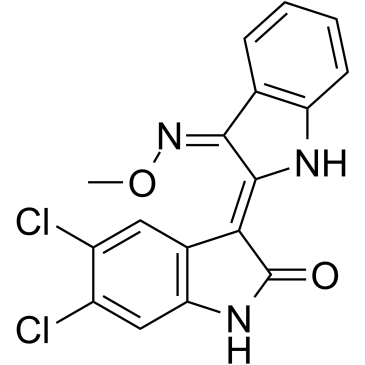
KY-19382 is a novel, potent and orally active dual inhibitor of GSK3β(IC50 = 10 nM) and CXXC5-DVL (IC50 = 19). It can be applied to the study of metabolic diseases brought on by a high-fat diet (HFD).
Physicochemical Properties
| Molecular Formula | C17H11CL2N3O2 |
| Molecular Weight | 360.194141626358 |
| Exact Mass | 360.19 |
| Elemental Analysis | C, 56.69; H, 3.08; Cl, 19.68; N, 11.67; O, 8.88 |
| CAS # | 2226664-93-1 |
| Related CAS # | 2226664-93-1 |
| PubChem CID | 148959784 |
| Appearance | Brown to reddish brown solid powder |
| LogP | 4.6 |
| Hydrogen Bond Donor Count | 2 |
| Hydrogen Bond Acceptor Count | 4 |
| Rotatable Bond Count | 2 |
| Heavy Atom Count | 24 |
| Complexity | 556 |
| Defined Atom Stereocenter Count | 0 |
| SMILES | CO/N=C\1/C2=CC=CC=C2N=C1C3=C(NC4=CC(=C(C=C43)Cl)Cl)O |
| InChi Key | TVZDUDDLASVAOM-JCMHNJIXSA-N |
| InChi Code | InChI=1S/C17H11Cl2N3O2/c1-24-22-15-8-4-2-3-5-12(8)20-16(15)14-9-6-10(18)11(19)7-13(9)21-17(14)23/h2-7,21,23H,1H3/b22-15- |
| Chemical Name | 5,6-dichloro-3-[(3Z)-3-methoxyiminoindol-2-yl]-1H-indol-2-ol |
| Synonyms | KY19382; KY-19382; KY 19382 |
| HS Tariff Code | 2934.99.9001 |
| Storage |
Powder-20°C 3 years 4°C 2 years In solvent -80°C 6 months -20°C 1 month |
| Shipping Condition | Room temperature (This product is stable at ambient temperature for a few days during ordinary shipping and time spent in Customs) |
Biological Activity
| Targets |
CXXC5-DVL (IC50 = 19 nM); GSK3β (IC50 = 10 nM) KY19382 targets CXXC5 (CXXC finger protein 5), inhibiting its interaction with β-catenin with an IC₅₀ of 0.8 μM (HTRF-based binding inhibition assay) [1] KY19382 binds directly to the CXXC domain of CXXC5 with a Ki value of 0.5 μM (SPR assay) [1] |
| ln Vitro |
KY19382 (0.01 and 0.1 μM; 48 h) promotes ATDC5 cells proliferation[1].
KY19382 (0.1 μM; 3 d) increases the mRNA levels of chondrogenic differentiation markers in ATDC5 and C28/I2 cells[1].
KY19382 (0.01 and 0.1 μM; 24 h) inactivates GSK3α/β in ATDC5 cells[1].
KY19382 (0.1 μM; 4 h) interrupts the CXXC5-DVL interaction in ATDC5 cells[1].
KY19382 (0.001-10 μM; 18 h) enhances the TOPFlash activity in HEK293 reporter cells[1].
KY19382 (0.1 μM; 48 h) elevates nuclear translocation of β-catenin in ATDC5 cells[1]. CXXC5-β-catenin interaction inhibition: KY19382 (0.1–10 μM) dose-dependently blocked the binding between recombinant CXXC5 and β-catenin, achieving 92% inhibition at 5 μM (HTRF assay) [1] - Promotion of growth plate chondrocyte function: - Primary mouse growth plate chondrocytes: 0.5–2 μM dose-dependently increased cell proliferation by 35–68% (EdU incorporation assay); 1 μM reduced senescence-associated β-galactosidase (SA-β-gal) positive cells by 62% [1] - ATDC5 chondrogenic cells: 1 μM enhanced chondrogenic differentiation, increasing collagen II and aggrecan mRNA levels by 2.8-fold and 3.2-fold (qRT-PCR); activated Wnt/β-catenin signaling, upregulating nuclear β-catenin by 2.5-fold (Western blot) [1] - Metabolic improvement activity [2]: - 3T3-L1 adipocytes: 1–5 μM increased insulin-stimulated glucose uptake by 45–72% (2-NBDG fluorescence assay); 3 μM reduced intracellular triglyceride accumulation by 55% [2] - HepG2 hepatocytes: 2 μM improved insulin sensitivity, reducing phosphoenolpyruvate carboxykinase (PEPCK) mRNA by 48%; 3 μM decreased gluconeogenesis by 60% (glucose production assay) [2] - Low cytotoxicity: CC₅₀ > 30 μM in primary chondrocytes, 3T3-L1, HepG2, and normal human fibroblasts; cell viability >90% at concentrations up to 15 μM (MTT assay) [1][2] |
| ln Vivo |
KY19382 (0.1 mg/kg; i.p. once daily for 2 weeks) delays growth plate senescence in older mice and promotes growth plate maturation in rapidly growing young mice[1].
KY19382 (0.1 mg/kg; i.p. once daily for 10 weeks) significantly increases the length of tibiae in mice[1].
KY19382 (5 mg/kg; i.p.) displays a relatively favorable bioavailability (F=16.74%), showing half-life of 16.20 h and an exposure level of 6,555.79 ng•h/ml[1].
KY19382 (A3051) (25 mg/kg; p.o. once daily for 16 weeks) exhibits reduced adipocyte size and anti-inflammatory effects[2].
A3051 (25 mg/kg; p.o. once daily for 5 days) lowers fasting glucose in mice[2].
A3051 (25 mg/kg; p.o. once daily for 3 weeks) reduces the hepatosteatosis in mice[2]. Promotion of longitudinal bone growth (mouse model): C57BL/6 mice (3-week-old) were treated with KY19382 (5, 10 mg/kg, oral gavage, once daily for 4 weeks). The compound dose-dependently increased total body length by 8% (5 mg/kg) and 12% (10 mg/kg); increased growth plate thickness by 35% (10 mg/kg) (histological analysis); upregulated β-catenin and collagen X expression in growth plate chondrocytes (immunohistochemistry) [1] - Delay of growth plate senescence: 10 mg/kg KY19382 reduced SA-β-gal activity in growth plate chondrocytes by 58%; decreased p16INK4a and p21CIP1 mRNA levels by 45% and 52% in tibial growth plates (qRT-PCR) [1] - Metabolic disease improvement (obese mouse model) [2]: - HFD-fed C57BL/6 mice: Oral KY19382 (10 mg/kg, once daily for 8 weeks) reduced body weight by 18%; decreased fasting blood glucose by 32% and HbA1c by 25%; improved glucose tolerance (AUC of GTT reduced by 40%) [2] - db/db mice: 15 mg/kg oral dose reduced visceral fat mass by 35%; increased brown adipose tissue thermogenesis (UCP1 expression upregulated by 2.3-fold, Western blot) [2] - No obvious toxicity: Treated animals showed no significant body weight loss (<5% change) or histopathological abnormalities in liver, kidney, or bone; hematological and liver/kidney function markers were within normal ranges [1][2] |
| Enzyme Assay |
SPR-based CXXC5 binding assay: Recombinant human CXXC5 protein (CXXC domain, 1–120 aa) was immobilized on a sensor chip. KY19382 (0.01–20 μM) was injected at a constant flow rate, and binding responses were recorded to calculate dissociation constant (Ki value) [1] - HTRF CXXC5-β-catenin interaction inhibition assay: CXXC5 was labeled with a donor fluorophore, and β-catenin with an acceptor fluorophore. Labeled proteins were incubated with KY19382 (0.1–10 μM) at 25°C for 60 minutes. FRET signal was detected to assess interaction inhibition, and IC₅₀ was calculated [1] |
| Cell Assay |
Growth plate chondrocyte experiments [1]: - Primary chondrocyte isolation: Tibial/femoral growth plates from 3-week-old mice were dissected, digested, and cultured. Cells were treated with KY19382 (0.1–5 μM) for 48 hours; EdU incorporation assay quantified proliferation, SA-β-gal staining detected senescence [1] - ATDC5 chondrogenic differentiation assay: ATDC5 cells were cultured in chondrogenic medium with KY19382 (0.5–2 μM) for 7 days. qRT-PCR quantified chondrogenic markers; Western blot detected nuclear β-catenin [1] - Metabolic cell experiments [2]: - 3T3-L1 adipocyte glucose uptake assay: Differentiated 3T3-L1 cells were treated with KY19382 (1–5 μM) for 16 hours, incubated with insulin (100 nM) and 2-NBDG for 30 minutes. Fluorescence intensity quantified glucose uptake [2] - HepG2 gluconeogenesis assay: HepG2 cells were serum-starved, treated with KY19382 (1–5 μM) for 24 hours, and gluconeogenesis was measured by glucose production in the presence of pyruvate/lactate [2] |
| Animal Protocol |
ATDC5 cells 0, 0.01, 0.1 μM 48 hours Longitudinal bone growth model [1]: 3-week-old C57BL/6 mice were randomly divided into vehicle group, KY19382 5 mg/kg group, and 10 mg/kg group. The compound was administered via oral gavage once daily for 4 weeks. Body length was measured weekly; tibias were collected for histological analysis (growth plate thickness) and immunohistochemistry (β-catenin, collagen X) [1] - Metabolic disease model [2]: - HFD-fed mice: 6-week-old C57BL/6 mice were fed a high-fat diet for 8 weeks, then treated with KY19382 (10 mg/kg, oral gavage, once daily for 8 weeks). Glucose tolerance test (GTT) and insulin tolerance test (ITT) were performed; body weight, blood glucose, and HbA1c were measured [2] - db/db mice: 8-week-old db/db mice were treated with KY19382 (15 mg/kg, oral gavage, once daily for 6 weeks). Visceral fat mass was weighed; brown adipose tissue was collected for UCP1 Western blot [2] - Drug formulation: KY19382 was dissolved in dimethyl sulfoxide (DMSO) and diluted with 0.5% carboxymethylcellulose sodium (CMC-Na) for oral administration (final DMSO concentration ≤5%) [1][2] |
| ADME/Pharmacokinetics |
Oral bioavailability: 48% (mouse, 10 mg/kg po) [2] - Half-life (t₁/₂): 6.2 hours (mouse, po); 4.8 hours (rat, po) [2] - Volume of distribution (Vd): 0.8 L/kg (mouse, iv) [2] - Excretion: 65% via feces, 28% via urine within 48 hours (mouse, po) [2] - Tissue distribution: High concentrations in bone, liver, and adipose tissue; growth plate concentration reached 1.2 μM at 2 hours post 10 mg/kg po administration [1][2] |
| Toxicity/Toxicokinetics |
In vitro toxicity: CC₅₀ > 30 μM in primary chondrocytes, 3T3-L1, HepG2, and normal human fibroblasts [1][2] - In vivo acute toxicity: LD₅₀ > 200 mg/kg (mouse, po); no mortality or obvious toxicity signs at doses up to 150 mg/kg [2] - Subchronic toxicity (8-week, mouse): KY19382 (15 mg/kg po, qd) did not cause significant changes in hematological parameters or liver/kidney function markers (ALT, AST, creatinine) [2] - Plasma protein binding rate: 94% (human plasma, ultrafiltration method) [2] |
| References |
[1]. CXXC5 mediates growth plate senescence and is a target for enhancement of longitudinal bone growth. Life Sci Alliance. 2019 Apr 10; 2(2): e201800254. [2]. Compositions and methods for suppressing and/or treating metabolic diseases and/or a clinical condition thereof. WO2020079569. |
| Additional Infomation |
KY19382 is a synthetic small-molecule inhibitor of CXXC5, identified through high-throughput screening for CXXC5-β-catenin interaction blockers [1] - Its mechanism of action involves binding to CXXC5’s CXXC domain, preventing CXXC5 from sequestering β-catenin, thereby activating Wnt/β-catenin signaling to promote chondrocyte proliferation, delay growth plate senescence, and improve metabolic homeostasis [1][2] - CXXC5 overexpression is associated with growth plate closure and metabolic disorders (obesity, insulin resistance); KY19382 targets this protein for potential treatment of short stature and metabolic diseases (type 2 diabetes, NAFLD) [1][2] - The compound shows favorable in vitro and in vivo efficacy in both bone growth and metabolic models with low toxicity, supporting its dual therapeutic potential [1][2] |
Solubility Data
| Solubility (In Vitro) | DMSO: 2~5 mg/mL (5.6~13.9 mM) |
| Solubility (In Vivo) |
Note: Listed below are some common formulations that may be used to formulate products with low water solubility (e.g. < 1 mg/mL), you may test these formulations using a minute amount of products to avoid loss of samples. Injection Formulations (e.g. IP/IV/IM/SC) Injection Formulation 1: DMSO : Tween 80: Saline = 10 : 5 : 85 (i.e. 100 μL DMSO stock solution → 50 μL Tween 80 → 850 μL Saline) *Preparation of saline: Dissolve 0.9 g of sodium chloride in 100 mL ddH ₂ O to obtain a clear solution. Injection Formulation 2: DMSO : PEG300 :Tween 80 : Saline = 10 : 40 : 5 : 45 (i.e. 100 μL DMSO → 400 μLPEG300 → 50 μL Tween 80 → 450 μL Saline) Injection Formulation 3: DMSO : Corn oil = 10 : 90 (i.e. 100 μL DMSO → 900 μL Corn oil) Example: Take the Injection Formulation 3 (DMSO : Corn oil = 10 : 90) as an example, if 1 mL of 2.5 mg/mL working solution is to be prepared, you can take 100 μL 25 mg/mL DMSO stock solution and add to 900 μL corn oil, mix well to obtain a clear or suspension solution (2.5 mg/mL, ready for use in animals). Injection Formulation 4: DMSO : 20% SBE-β-CD in saline = 10 : 90 [i.e. 100 μL DMSO → 900 μL (20% SBE-β-CD in saline)] *Preparation of 20% SBE-β-CD in Saline (4°C,1 week): Dissolve 2 g SBE-β-CD in 10 mL saline to obtain a clear solution. Injection Formulation 5: 2-Hydroxypropyl-β-cyclodextrin : Saline = 50 : 50 (i.e. 500 μL 2-Hydroxypropyl-β-cyclodextrin → 500 μL Saline) Injection Formulation 6: DMSO : PEG300 : castor oil : Saline = 5 : 10 : 20 : 65 (i.e. 50 μL DMSO → 100 μLPEG300 → 200 μL castor oil → 650 μL Saline) Injection Formulation 7: Ethanol : Cremophor : Saline = 10: 10 : 80 (i.e. 100 μL Ethanol → 100 μL Cremophor → 800 μL Saline) Injection Formulation 8: Dissolve in Cremophor/Ethanol (50 : 50), then diluted by Saline Injection Formulation 9: EtOH : Corn oil = 10 : 90 (i.e. 100 μL EtOH → 900 μL Corn oil) Injection Formulation 10: EtOH : PEG300:Tween 80 : Saline = 10 : 40 : 5 : 45 (i.e. 100 μL EtOH → 400 μLPEG300 → 50 μL Tween 80 → 450 μL Saline) Oral Formulations Oral Formulation 1: Suspend in 0.5% CMC Na (carboxymethylcellulose sodium) Oral Formulation 2: Suspend in 0.5% Carboxymethyl cellulose Example: Take the Oral Formulation 1 (Suspend in 0.5% CMC Na) as an example, if 100 mL of 2.5 mg/mL working solution is to be prepared, you can first prepare 0.5% CMC Na solution by measuring 0.5 g CMC Na and dissolve it in 100 mL ddH2O to obtain a clear solution; then add 250 mg of the product to 100 mL 0.5% CMC Na solution, to make the suspension solution (2.5 mg/mL, ready for use in animals). Oral Formulation 3: Dissolved in PEG400 Oral Formulation 4: Suspend in 0.2% Carboxymethyl cellulose Oral Formulation 5: Dissolve in 0.25% Tween 80 and 0.5% Carboxymethyl cellulose Oral Formulation 6: Mixing with food powders Note: Please be aware that the above formulations are for reference only. InvivoChem strongly recommends customers to read literature methods/protocols carefully before determining which formulation you should use for in vivo studies, as different compounds have different solubility properties and have to be formulated differently. (Please use freshly prepared in vivo formulations for optimal results.) |
| Preparing Stock Solutions | 1 mg | 5 mg | 10 mg | |
| 1 mM | 2.7763 mL | 13.8816 mL | 27.7631 mL | |
| 5 mM | 0.5553 mL | 2.7763 mL | 5.5526 mL | |
| 10 mM | 0.2776 mL | 1.3882 mL | 2.7763 mL |