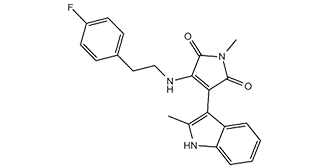
IM-12, an indolylmaleimide analog, is a novel, potent, cell-permeable and selective inhibitor of GSK-3β (glycogen synthase kinase-3β) with potential neuroprotective effects. With an IC50 of 53 nM, it inhibits GSK-3β. An increase in neuronal cells was observed after IM-12 treatment of human neural progenitor cells. By inhibiting the vital enzyme GSK-3beta, IM-12 works through the traditional Wnt signaling pathway. The Wnt pathway participates in cellular functions related to either proliferation or differentiation.
Physicochemical Properties
| Molecular Formula | C22H20FN3O2 |
| Molecular Weight | 377.4115 |
| Exact Mass | 377.153 |
| Elemental Analysis | C, 70.01; H, 5.34; F, 5.03; N, 11.13; O, 8.48 |
| CAS # | 1129669-05-1 |
| Related CAS # | 1129669-05-1 |
| PubChem CID | 25209788 |
| Appearance | Light yellow to yellow solid powder |
| Density | 1.3±0.1 g/cm3 |
| Boiling Point | 600.2±55.0 °C at 760 mmHg |
| Flash Point | 316.8±31.5 °C |
| Vapour Pressure | 0.0±1.7 mmHg at 25°C |
| Index of Refraction | 1.675 |
| LogP | 4.02 |
| Hydrogen Bond Donor Count | 2 |
| Hydrogen Bond Acceptor Count | 4 |
| Rotatable Bond Count | 5 |
| Heavy Atom Count | 28 |
| Complexity | 656 |
| Defined Atom Stereocenter Count | 0 |
| SMILES | FC1C([H])=C([H])C(=C([H])C=1[H])C([H])([H])C([H])([H])N([H])C1C(N(C([H])([H])[H])C(C=1C1=C(C([H])([H])[H])N([H])C2=C([H])C([H])=C([H])C([H])=C12)=O)=O |
| InChi Key | ZKJAZFUFPPSFCO-UHFFFAOYSA-N |
| InChi Code | InChI=1S/C22H20FN3O2/c1-13-18(16-5-3-4-6-17(16)25-13)19-20(22(28)26(2)21(19)27)24-12-11-14-7-9-15(23)10-8-14/h3-10,24-25H,11-12H2,1-2H3 |
| Chemical Name | 3-[2-(4-fluorophenyl)ethylamino]-1-methyl-4-(2-methyl-1H-indol-3-yl)pyrrole-2,5-dione |
| Synonyms | IM-12; IM 12; IM12 |
| HS Tariff Code | 2934.99.9001 |
| Storage |
Powder-20°C 3 years 4°C 2 years In solvent -80°C 6 months -20°C 1 month |
| Shipping Condition | Room temperature (This product is stable at ambient temperature for a few days during ordinary shipping and time spent in Customs) |
Biological Activity
| Targets |
GSK-3β (IC50 = 53 nM) Glycogen Synthase Kinase 3β (GSK-3β): IC₅₀ = 53 nM (in vitro binding assay) [1] |
| ln Vitro |
IM-12 inhibits GSK-3β in ReNcell VM cells, with I50 of 3.8 μM. IM-12 (3 μM) enhances the β-catenin amount, with no further effect at lower or higher concentration. The growth of ReNCell VM cells is also inhibited by IM-12 (3 μM. IM-12 boosts ReNcell VM's TCF-activity[1]. 1. In human neural progenitor cells (hNPCs), IM-12 (0.1-10 μM) dose-dependently inhibited GSK-3β activity with an IC₅₀ of 3.8 μM, significantly increased β-catenin concentration, and enhanced Wnt signaling pathway activation [1] 2. In ReNcell VM cells, IM-12 (3 μM) increased total β-catenin by 27% and was most effective at this concentration. It inhibited GSK-3β to a remaining activity of 27 ± 5% at 3 μM concentration [2] 3. In ReNcell VM cells, IM-12 (3 μM) attenuated cell proliferation, increased TCF transcriptional activity, and promoted neuronal differentiation [3] |
| ln Vivo |
1. In Sprague-Dawley rats with middle cerebral artery occlusion (MCAO) model of ischemic stroke, intraperitoneal administration of IM-12 (10 mg/kg) at 4 hours after stroke induction significantly reduced rtPA-induced hemorrhagic transformation (HT), improved neurological deficits, and reduced brain edema and blood-brain barrier disruption [4] 2. In the same stroke model, IM-12 (10 mg/kg) increased β-catenin and downstream proteins expression while suppressing GSK-3β expression, suggesting the neuroprotective effect is mediated through Wnt-β-catenin pathway activation [4] |
| Enzyme Assay |
Protease and phosphatase inhibitors are added after the cells have been lysed in RIPA buffer, and the mixture is centrifuged at 15,000 rpm for 5 min. GSK-3β is immunoprecipitated using a specific mouse monoclonal anti GSK-3β [G8] antibody at a concentration of 5 g/sample for two hours at 4°C. Protein A/G-Plus agarose beads (10 L beads per sample) are used to precipitate the bound protein. A reaction mixture containing final concentrations of 4 mM MOPS pH 7.2, 0.4 mM EDTA, 1 mM EGTA, 2.5 mM β-glycerophosphate, 4 mM MgCl2, 40 μM BSA, and 0.05 mM DTT is used to measure the GSK-3β kinase activity. The pGS-2 peptide substrate (10 g/sample) is employed[1]. 1. GSK-3β kinase activity assay: Recombinant human GSK-3β (20 ng) was incubated with pGS-2 peptide substrate (10 μg/sample) in reaction buffer containing 4 mM MOPS (pH 7.2), 0.4 mM EDTA, 1 mM EGTA, 2.5 mM β-glycerophosphate, 4 mM MgCl₂, 40 μM BSA, and 0.05 mM DTT. IM-12 (1 nM-10 μM) was added, and the mixture was incubated at 30°C for 30 minutes. The reaction was stopped by adding KinaseGlo reagent, and luminescence was measured after 10 minutes using a Glomax® 96 Microplate Luminometer to determine IC₅₀ [1] |
| Cell Assay |
A cell suspension of 50–100 μL is examined using CASY technology and the appropriate program to determine the number of viable cells. ReNcell VM cells are sown at a specific cell number and multiplied for 24 hours. Then the medium is changed to a proliferation medium with the additional ingredients added at the indicated concentrations. Every twenty-four hours, the cell number is determined. The media is changed every 24 hours, but cells are exposed to the added drugs for the duration of the experiment[1]. 1. ReNcell VM cell viability assay: Cells were seeded at defined cell number and allowed to proliferate for 24 hours. Medium was then replaced with proliferation medium containing IM-12 (0.1-10 μM). Cell number was determined every 24 hours using CASY technology to analyze 50-100 μL of cell suspension. Cells were exposed to IM-12 throughout the experiment, with medium changed every 24 hours [1] 2. β-catenin expression assay: ReNcell VM cells were treated with IM-12 (0.1-10 μM) for 24-72 hours. Cells were lysed and total protein was extracted for Western blot analysis to determine β-catenin levels [2] 3. TCF transcriptional activity assay: ReNcell VM cells were transfected with a TCF-responsive reporter construct and treated with IM-12 (0.1-10 μM) for 24 hours. Luciferase activity was measured using a dual-luciferase assay system to determine TCF activity [3] |
| Animal Protocol |
1. MCAO stroke model in rats: Sprague-Dawley rats (250-300 g) were anesthetized and subjected to middle cerebral artery occlusion for 90 minutes. At 4 hours after stroke induction, rats were administered IM-12 (10 mg/kg) or vehicle (PBS + 5% DMSO) via intraperitoneal injection. Neurological function was assessed at 24 hours after treatment. Rats were sacrificed at 48 hours for brain tissue collection to measure infarct volume, hemorrhagic transformation, and protein expression [4] |
| References |
[1]. Novel indolylmaleimide acts as GSK-3beta inhibitor in human neural progenitor cells. Bioorg Med Chem. 2010 Sep 15;18(18):6785-95. |
| Additional Infomation |
3-[2-(4-fluorophenyl)ethylamino]-1-methyl-4-(2-methyl-1H-indol-3-yl)pyrrole-2,5-dione is an organonitrogen compound, an organooxygen compound and a member of maleimides. It is functionally related to an alpha-amino acid. 1. IM-12 (3-(4-fluorophenylethylamino)-1-methyl-4-(2-methyl-1H-indol-3-yl)-1H-pyrrole-2,5-dione) is a novel, asymmetrically substituted indolylmaleimide compound designed as a selective GSK-3β inhibitor [1] 2. The compound has a molecular formula of C₂₂H₂₀FN₃O₂, molecular weight of 377.41, and CAS number of 1129669-05-1 [5] 3. IM-12 is soluble in DMSO (75 mg/mL), ethanol (10 mg/mL), but insoluble in water [5] 4. The compound shows good stability: stored as powder at -20°C for at least 3 years; in DMSO solution at -80°C for at least 2 years [6] 5. IM-12 has a topological polar surface area of 65.2, XLogP of 4.06, and does not violate Lipinski's rules, suggesting good drug-like properties [7] 6. The neuroprotective effect of IM-12 in stroke models is mediated through the Wnt-β-catenin pathway by inhibition of GSK-3β, which increases β-catenin levels and subsequent neuroprotection [4] 7. In neural progenitor cells, IM-12 promotes neuronal differentiation while attenuating proliferation, suggesting potential therapeutic applications in neurodegenerative diseases [1] |
Solubility Data
| Solubility (In Vitro) |
DMSO: ~75 mg/mL (~198.7 mM) Water: <1 mg/mL Ethanol: ~10 mg/mL (~26.5 mM) |
| Solubility (In Vivo) |
Solubility in Formulation 1: ≥ 2.5 mg/mL (6.62 mM) (saturation unknown) in 10% DMSO + 40% PEG300 +5% Tween-80 + 45% Saline (add these co-solvents sequentially from left to right, and one by one), clear solution. For example, if 1 mL of working solution is to be prepared, you can add 100 μL of 25.0 mg/mL clear DMSO stock solution to 400 μL PEG300 and mix evenly; then add 50 μL Tween-80 + to the above solution and mix evenly; then add 450 μL normal saline to adjust the volume to 1 mL. Preparation of saline: Dissolve 0.9 g of sodium chloride in 100 mL ddH₂ O to obtain a clear solution. (Please use freshly prepared in vivo formulations for optimal results.) |
| Preparing Stock Solutions | 1 mg | 5 mg | 10 mg | |
| 1 mM | 2.6496 mL | 13.2482 mL | 26.4964 mL | |
| 5 mM | 0.5299 mL | 2.6496 mL | 5.2993 mL | |
| 10 mM | 0.2650 mL | 1.3248 mL | 2.6496 mL |