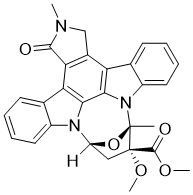
KT5823 (KT-5823), a staurosporine-related analog, is a selective inhibitor of protein kinase G (PKG) with anticancer activity. It inhibits protein kinases with Ki values of 0.23, 4 and > 10 μM for PKG, PKC and PKA respectively. KT5823 has been shown to increase thyroid-stimulating hormone-induced NIS expression, and thus iodide uptake, in thyroid cells. In this study, we found that KT5823 does not increase but decreases iodide uptake within 0.5 h of treatment in trans-retinoic acid and hydrocortisone-treated MCF-7 breast cancer cells. Moreover, KT5823 accumulates hypoglycosylated NIS, and this effect is much more evident in breast cancer cells than thyroid cells. The hypoglycosylated NIS is core glycosylated, has not been processed through the Golgi apparatus, but is capable of trafficking to the cell surface. KT5823 impedes complex NIS glycosylation at a regulatory point similar to brefeldin A along the N-linked glycosylation pathway, rather than targeting a specific N-glycosylated site of NIS. KT5823-mediated effects on NIS activity and glycosylation are also observed in other breast cancer cells as well as human embryonic kidney cells expressing exogenous NIS. Taken together, KT5823 will serve as a valuable pharmacological reagent to uncover mechanisms underlying differential NIS regulation between thyroid and breast cancer cells at multiple levels.
Physicochemical Properties
| Molecular Formula | C29H25N3O5 | |
| Molecular Weight | 495.5259 | |
| Exact Mass | 495.179 | |
| Elemental Analysis | C, 70.29; H, 5.09; N, 8.48; O, 16.14 | |
| CAS # | 126643-37-6 | |
| Related CAS # |
|
|
| PubChem CID | 108152 | |
| Appearance | White to off-white solid powder | |
| Density | 1.52g/cm3 | |
| Boiling Point | 629.2ºC at 760mmHg | |
| Flash Point | 334.3ºC | |
| Vapour Pressure | 9.67E-16mmHg at 25°C | |
| Index of Refraction | 1.763 | |
| LogP | 4.589 | |
| Hydrogen Bond Donor Count | 0 | |
| Hydrogen Bond Acceptor Count | 5 | |
| Rotatable Bond Count | 3 | |
| Heavy Atom Count | 37 | |
| Complexity | 1020 | |
| Defined Atom Stereocenter Count | 3 | |
| SMILES | C[C@]12[C@](C[C@H](N3C4=CC=CC=C4C5=C3C6=C(C7=CC=CC=C7N61)C8=C5C(=O)N(C)C8)O2)(C(=O)OC)OC |
|
| InChi Key | QTYMDECKVKSGSM-YMUMJAELSA-N | |
| InChi Code | InChI=1S/C29H25N3O5/c1-28-29(36-4,27(34)35-3)13-20(37-28)31-18-11-7-5-9-15(18)22-23-17(14-30(2)26(23)33)21-16-10-6-8-12-19(16)32(28)25(21)24(22)31/h5-12,20H,13-14H2,1-4H3/t20-,28+,29+/m1/s1 | |
| Chemical Name |
|
|
| Synonyms |
|
|
| HS Tariff Code | 2934.99.9001 | |
| Storage |
Powder-20°C 3 years 4°C 2 years In solvent -80°C 6 months -20°C 1 month |
|
| Shipping Condition | Room temperature (This product is stable at ambient temperature for a few days during ordinary shipping and time spent in Customs) |
Biological Activity
| Targets | PKA (Ki = 10 μM); PKC (Ki = 4 μM) |
| ln Vitro |
KT5823 inhibits cGMP-dependent protein kinase.[1] The effectiveness of the cGMP-dependent protein kinase inhibitor, KT5823, was investigated in human neutrophils. KT5823 did not inhibit the cGMP-dependent protein kinase mediated in vitro, or in situ phosphorylation of vimentin, a known substrate for this enzyme in activated neutrophils. In addition, KT5823 was shown to induce dramatic shape changes in neutrophils, suggesting it has an activating effect upon the cells.[2] Inhibiting basal PKG activity with KT5823 increased apoptotic DNA fragmentation by 9.8-fold. [3] These Bay 60-7550's effects were prevented by pretreatment with the PKG inhibitor KT5823. Moreover, the Bay 60-7550-induced downstream phosphorylation of cyclic AMP response element binding (pCREB) and brain-derived neurotrophic factor (BDNF) expression was also prevented (or partially prevented) byKT5823or the PKA inhibitor H89. [4] Many signal transduction pathways are mediated by the second messengers cGMP and cAMP, cGMP- and cAMP-dependent protein kinases (cGK and PKA), phosphodiesterases, and ion channels. To distinguish among the different cGMP effectors, inhibitors of cGK and PKA have been developed including the K-252 compound KT5823 and the isoquinolinesulfonamide H89. KT5823, an in vitro inhibitor of cGK, has also been used in numerous studies with intact cells to implicate or rule out the involvement of this protein kinase in a given cellular response. However, the efficacy and specificity of KT5823 as cGK inhibitor in intact cells or tissues have never been demonstrated. Here, we analyzed the effects of both KT5823 and H89 on cyclic-nucleotide-mediated phosphorylation of vasodilator-stimulated phosphoprotein (VASP) in intact human platelets and rat mesangial cells. These two cell types both express high levels of cGK. KT5823 inhibited purified cGK. However, with both intact human platelets and rat mesangial cells, KT5823 failed to inhibit cGK-mediated serine 157 and serine 239 phosphorylation of VASP induced by nitric oxide, atrial natriuretic peptide, or the membrane-permeant cGMP analog, 8-pCPT-cGMP. KT5823 enhanced 8-pCPT-cGMP-stimulated VASP phosphorylation in platelets and did not inhibit forskolin-stimulated VASP phosphorylation in either platelets or mesangial cells. In contrast H89, an inhibitor of both PKA and cGK, clearly inhibited 8-pCPT-cGMP and forskolin-stimulated VASP phosphorylation in the two cell types. The data indicate that KT5823 inhibits purified cGK but does not affect a cGK-mediated response in the two different cell types expressing cGK I. These observations indicate that data that interpret the effects of KT5823 in intact cells as the major or only criteria supporting the involvement of cGK clearly need to be reconsidered[5]. |
| ln Vivo |
However, these results of Bay 60-7550 on memory acquisition were suppressed by PKG inhibitor KT5823 and PKA inhibitor H89, both of which were managed 30 min prior to Bay 60-7550 (Figure 2B). Furthermore, PKG inhibitor KT5823 or PKA inhibitor H89 that used alone had no effect on acquisition ability in block 6 in Aβ1–42-treated mice (Figure 2C).[4] The ameliorating results of high-dose Bay 60-7550 (3.0 mg/kg) both in long-term and short memories were blocked by pretreatment with KT5823 (Figure 3). H89 prevented high-dose Bay 60-7550 (3.0 mg/kg)-induced long-term memory retention (24 h after the training session) (Figures 3C,D), but not short-term memory retrieval (1 h after the training session) in the water maze test (p > 0.05, Figures 3A,B), while neither H89 nor KT5823 used alone impacted the learning and memory abilities in Aβ1–42-treated mice (Figure 3).[4] PKG inhibitor KT5823 significantly prevented the effects of Bay 60-7550 on step-down latency both 1 and 3 h after the training session (Figures 4A,B). PKA inhibitor H89 significantly prevented the effects of Bay 60-7550 on step-down latency 3 h after the training session (Figure 4B), but not step-down latency 1 h after the training session (Figure 4A). Neither H89 nor KT5823 used alone impacted the memory ability in Aβ1–42-treated mice (Figures 4A,B).[4] PKG inhibitor KT5823 blocked Bay 60-7550’s effects on BDNF expression in these two brain regions[4]. |
| Cell Assay |
Apoptotic DNA fragmentation induced by the PKG inhibitorKT5823 in unstressed HRE‐H9 cells[3] We suspected that the anti‐apoptotic effects of cGMP (at basal levels) were mediated by partial activation of PKG (i.e. basal PKG activity) in HRE‐H9 cells. To test this, we used a potent and highly selective PKG inhibitor, KT5823. Exposure of HRE‐H9 cells to KT5823 in a wide range of concentrations for 24 h caused dose‐dependent increases in apoptotic DNA fragmentation, measured by CE‐LIF (Figure 10). Because normal medium (with serum) was used, the HRE‐H9 cells were under unstressed conditions (except for the exposure to KT5823). While KT5823 at 1 nmol/l and 10 nmol/l did not affect the levels of apoptotic DNA fragmentation, KT5823 at 100 nmol/l and 1 µmol/l (concentrations expected to selectively inhibit PKG; Ki = 234 nmol/l, Calbiochem catalogue 2003/2004) substantially increased DNA fragmentation, compared with controls (Figure 10). KT5823 at 100 nmol/l and 1 µmol/l caused 5.9‐ and 9.8‐fold increases in the DNA fragmentation levels respectively (Figure 11). The statistical significance of these effects was high (P < 0.001), due to the large pro‐apoptotic effects of this PKG inhibitor. The data suggest that the low‐level activation of PKG that occurs under normal culturing conditions, presumably because of the basal cGMP levels, may play an essential role in preventing spontaneous development of apoptosis in unstressed HRE‐H9 cells. |
| Animal Protocol | The mice were treated with different doses of Bay 60-7550 (0.5, 1.0, 3.0 mg/kg/day, i.p.) or vehicle for 14 days after microinjection of Aβ1–42. PKG inhibitor KT5823 and PKA inhibitor H89 were microinjected bilaterally into the cerebroventricular, 30 min prior to treatment with Bay 60-7550. Antibodies against CRF, GR, p-CREB, CREB, and BDNF were obtained from Abcam[4]. |
| References |
[1]. Multiple kinase arrest points in the G1 phase of nontransformed mammalian cells are absent in transformed cells. Proc Natl Acad Sci U S A. 1992 Sep 15;89(18):8626-30. [2]. KT5823 activates human neutrophils and fails to inhibit cGMP-dependent protein kinase phosphorylation of vimentin. Res Commun Chem Pathol Pharmacol. 1991 Oct;74(1):3-14. [3]. Guanylyl cyclase inhibitors NS2028 and ODQ and protein kinase G (PKG) inhibitor KT5823 trigger apoptotic DNA fragmentation in immortalized uterine epithelial cells: anti-apoptotic effects of basal cGMP/PKG. Mol Hum Reprod. 2003 Dec;9(12):775-83. [4]. Ruan L, et al. Phosphodiesterase-2 Inhibitor Bay 60-7550 Ameliorates Aβ-Induced Cognitive and Memory Impairment via Regulation of the HPA Axis. Front Cell Neurosci. 2019 Oct 2;13:432. [5]. KT5823 inhibits cGMP-dependent protein kinase activity in vitro but not in intact human platelets and rat mesangial cells. J Biol Chem. 2000 Oct 27;275(43):33536-41. |
| Additional Infomation |
KT 5823 is an organic heterooctacyclic compound that is 1H,1'H-2,2'-biindole in which the nitrogens have undergone formal oxidative coupling to positions 2 and 5 of methyl (3R)-3-methoxy-2-methyltetrahydrofuran-3-carboxylate (the 2S,3R,5R product), and in which the 3 and 3' positions of the biindole moiety have also undergone formal oxidative coupling to positions 3 and 4 of 1-methyl-1,5-dihydro-2H-pyrrol-2-one. It has a role as an EC 2.7.11.12 (cGMP-dependent protein kinase) inhibitor. It is a gamma-lactam, an organic heterooctacyclic compound, a methyl ester, a hemiaminal and an indolocarbazole. Many signal transduction pathways are mediated by the second messengers cGMP and cAMP, cGMP- and cAMP-dependent protein kinases (cGK and PKA), phosphodiesterases, and ion channels. To distinguish among the different cGMP effectors, inhibitors of cGK and PKA have been developed including the K-252 compound KT5823 and the isoquinolinesulfonamide H89. KT5823, an in vitro inhibitor of cGK, has also been used in numerous studies with intact cells to implicate or rule out the involvement of this protein kinase in a given cellular response. However, the efficacy and specificity of KT5823 as cGK inhibitor in intact cells or tissues have never been demonstrated. Here, we analyzed the effects of both KT5823 and H89 on cyclic-nucleotide-mediated phosphorylation of vasodilator-stimulated phosphoprotein (VASP) in intact human platelets and rat mesangial cells. These two cell types both express high levels of cGK. KT5823 inhibited purified cGK. However, with both intact human platelets and rat mesangial cells, KT5823 failed to inhibit cGK-mediated serine 157 and serine 239 phosphorylation of VASP induced by nitric oxide, atrial natriuretic peptide, or the membrane-permeant cGMP analog, 8-pCPT-cGMP. KT5823 enhanced 8-pCPT-cGMP-stimulated VASP phosphorylation in platelets and did not inhibit forskolin-stimulated VASP phosphorylation in either platelets or mesangial cells. In contrast H89, an inhibitor of both PKA and cGK, clearly inhibited 8-pCPT-cGMP and forskolin-stimulated VASP phosphorylation in the two cell types. The data indicate that KT5823 inhibits purified cGK but does not affect a cGK-mediated response in the two different cell types expressing cGK I. These observations indicate that data that interpret the effects of KT5823 in intact cells as the major or only criteria supporting the involvement of cGK clearly need to be reconsidered.[5] |
Solubility Data
| Solubility (In Vitro) |
|
|||
| Solubility (In Vivo) |
Note: Listed below are some common formulations that may be used to formulate products with low water solubility (e.g. < 1 mg/mL), you may test these formulations using a minute amount of products to avoid loss of samples. Injection Formulations (e.g. IP/IV/IM/SC) Injection Formulation 1: DMSO : Tween 80: Saline = 10 : 5 : 85 (i.e. 100 μL DMSO stock solution → 50 μL Tween 80 → 850 μL Saline) *Preparation of saline: Dissolve 0.9 g of sodium chloride in 100 mL ddH ₂ O to obtain a clear solution. Injection Formulation 2: DMSO : PEG300 :Tween 80 : Saline = 10 : 40 : 5 : 45 (i.e. 100 μL DMSO → 400 μLPEG300 → 50 μL Tween 80 → 450 μL Saline) Injection Formulation 3: DMSO : Corn oil = 10 : 90 (i.e. 100 μL DMSO → 900 μL Corn oil) Example: Take the Injection Formulation 3 (DMSO : Corn oil = 10 : 90) as an example, if 1 mL of 2.5 mg/mL working solution is to be prepared, you can take 100 μL 25 mg/mL DMSO stock solution and add to 900 μL corn oil, mix well to obtain a clear or suspension solution (2.5 mg/mL, ready for use in animals). Injection Formulation 4: DMSO : 20% SBE-β-CD in saline = 10 : 90 [i.e. 100 μL DMSO → 900 μL (20% SBE-β-CD in saline)] *Preparation of 20% SBE-β-CD in Saline (4°C,1 week): Dissolve 2 g SBE-β-CD in 10 mL saline to obtain a clear solution. Injection Formulation 5: 2-Hydroxypropyl-β-cyclodextrin : Saline = 50 : 50 (i.e. 500 μL 2-Hydroxypropyl-β-cyclodextrin → 500 μL Saline) Injection Formulation 6: DMSO : PEG300 : castor oil : Saline = 5 : 10 : 20 : 65 (i.e. 50 μL DMSO → 100 μLPEG300 → 200 μL castor oil → 650 μL Saline) Injection Formulation 7: Ethanol : Cremophor : Saline = 10: 10 : 80 (i.e. 100 μL Ethanol → 100 μL Cremophor → 800 μL Saline) Injection Formulation 8: Dissolve in Cremophor/Ethanol (50 : 50), then diluted by Saline Injection Formulation 9: EtOH : Corn oil = 10 : 90 (i.e. 100 μL EtOH → 900 μL Corn oil) Injection Formulation 10: EtOH : PEG300:Tween 80 : Saline = 10 : 40 : 5 : 45 (i.e. 100 μL EtOH → 400 μLPEG300 → 50 μL Tween 80 → 450 μL Saline) Oral Formulations Oral Formulation 1: Suspend in 0.5% CMC Na (carboxymethylcellulose sodium) Oral Formulation 2: Suspend in 0.5% Carboxymethyl cellulose Example: Take the Oral Formulation 1 (Suspend in 0.5% CMC Na) as an example, if 100 mL of 2.5 mg/mL working solution is to be prepared, you can first prepare 0.5% CMC Na solution by measuring 0.5 g CMC Na and dissolve it in 100 mL ddH2O to obtain a clear solution; then add 250 mg of the product to 100 mL 0.5% CMC Na solution, to make the suspension solution (2.5 mg/mL, ready for use in animals). Oral Formulation 3: Dissolved in PEG400 Oral Formulation 4: Suspend in 0.2% Carboxymethyl cellulose Oral Formulation 5: Dissolve in 0.25% Tween 80 and 0.5% Carboxymethyl cellulose Oral Formulation 6: Mixing with food powders Note: Please be aware that the above formulations are for reference only. InvivoChem strongly recommends customers to read literature methods/protocols carefully before determining which formulation you should use for in vivo studies, as different compounds have different solubility properties and have to be formulated differently. (Please use freshly prepared in vivo formulations for optimal results.) |
| Preparing Stock Solutions | 1 mg | 5 mg | 10 mg | |
| 1 mM | 2.0180 mL | 10.0902 mL | 20.1804 mL | |
| 5 mM | 0.4036 mL | 2.0180 mL | 4.0361 mL | |
| 10 mM | 0.2018 mL | 1.0090 mL | 2.0180 mL |