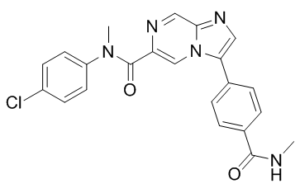
KDU691 is a Plasmodium PI4 kinase (PI4K) inhibitor. It has been tested in vivo as a causal prophylactic and radical-cure agent for Plasmodium cynomolgi sporozoite-infected rhesus macaques, based on its in vitro activity against liver stages. KDU691 was administered orally after P. cynomolgi sporozoites were used to infect the animals. When used prophylactically, KDU691 was completely protective. On the other hand, when KDU691 was tested for radical cure, five daily doses of 20 mg/kg did not stop relapse because all animals developed a secondary infection as a result of the liver's hypnozoites being reactivated. These results suggest that Plasmodium PI4K may be a drug target for malaria prophylaxis but not for a radical treatment. It will take longer in vitro culture systems to evaluate KDU691's activity on mature hypnozoites and forecast radical cure in vivo.
Physicochemical Properties
| Molecular Formula | C₂₂H₁₈CLN₅O₂ | |
| Molecular Weight | 419.86 | |
| Exact Mass | 419.114 | |
| Elemental Analysis | C, 62.93; H, 4.32; Cl, 8.44; N, 16.68; O, 7.62 | |
| CAS # | 1513879-19-0 | |
| Related CAS # |
|
|
| PubChem CID | 90157166 | |
| Appearance | White to off-white solid powder | |
| Density | 1.4±0.1 g/cm3 | |
| Index of Refraction | 1.676 | |
| LogP | 1.47 | |
| Hydrogen Bond Donor Count | 1 | |
| Hydrogen Bond Acceptor Count | 4 | |
| Rotatable Bond Count | 4 | |
| Heavy Atom Count | 30 | |
| Complexity | 619 | |
| Defined Atom Stereocenter Count | 0 | |
| SMILES | N12C=C(C(=O)N(C3C=CC(Cl)=CC=3)C)N=CC1=NC=C2C1C=CC(C(NC)=O)=CC=1 |
|
| InChi Key | TYMFFISSODJRDV-UHFFFAOYSA-N | |
| InChi Code | InChI=1S/C22H18ClN5O2/c1-24-21(29)15-5-3-14(4-6-15)19-11-26-20-12-25-18(13-28(19)20)22(30)27(2)17-9-7-16(23)8-10-17/h3-13H,1-2H3,(H,24,29) | |
| Chemical Name | N-(4-chlorophenyl)-N-methyl-3-[4-(methylcarbamoyl)phenyl]imidazo[1,2-a]pyrazine-6-carboxamide | |
| Synonyms |
|
|
| HS Tariff Code | 2934.99.03.00 | |
| Storage |
Powder-20°C 3 years 4°C 2 years In solvent -80°C 6 months -20°C 1 month |
|
| Shipping Condition | Room temperature (This product is stable at ambient temperature for a few days during ordinary shipping and time spent in Customs) |
Biological Activity
| Targets |
Plasmodium; PI4K
Plasmodium falciparum phosphatidylinositol 4-kinase (PfPI(4)K) [1] - Plasmodium vivax phosphatidylinositol 4-kinase (PvPI(4)K) [2] |
| ln Vitro |
In vitro activity: KDU691 is a Plasmodium PI4 kinase (PI4K) inhibitor. It has been tested in vivo as a causal prophylactic and radical-cure agent for Plasmodium cynomolgi sporozoite-infected rhesus macaques, based on its in vitro activity against liver stages. Animals were infected with P. cynomolgi sporozoites, and KDU691 was dosed orally. KDU691 was fully protective when administered prophylactically. In contrast, when tested for radical cure, five daily doses of 20 mg/kg of KDU691 did not prevent relapse, as all animals experienced a secondary infection due to the reactivation of hypnozoites in the liver. These findings indicate that Plasmodium PI4K is a potential drug target for malaria prophylaxis but not radical cure. Longer in vitro culture systems will be required to assess KDU691s activity on established hypnozoites and predict radical cure in vivo. Kinase Assay: In vitro infections of primary rhesus hepatocytes with P. cynomolgi sporozoites were performed according to methods described previously by Zeeman et al. At day 6 postinfection (p.i.), the assay mixtures were fixed and stained with anti-P. cynomolgi Hsp70 rabbit antiserum and a fluorescein isothiocyanate (FITC)-labeled secondary antibody (goat anti-rabbit). Plates were analyzed with the Operetta high-content imaging system, differentially counting hypnozoites and developing extraerythrocytic forms (EEFs), based on parasite size. Cell Assay: Sporozoites were harvested from P. cynomolgi-infected mosquitoes, washed with phosphate-buffered saline (PBS), and diluted to 100,000 sporozoites (spz)/ml in PBS. One-milliliter aliquots of sporozoites were prepared and injected into monkeys via intravenous (i.v.) injection. KDU691 is a selective inhibitor of Plasmodium PI(4)K, with potent activity against dihydroartemisinin (DHA)-pretreated Plasmodium falciparum ring-stage parasites. For DHA-pretreated 3D7 (chloroquine-sensitive) and Dd2 (chloroquine-resistant) P. falciparum ring-stage parasites, the EC₅₀ values of KDU691 are 0.12 μM and 0.15 μM, respectively. In contrast, the EC₅₀ values against untreated ring-stage parasites are >10 μM for both strains, indicating selectivity for DHA-primed parasites [1] - It exhibits no significant inhibitory activity against P. falciparum trophozoite-stage parasites (untreated or DHA-pretreated) at concentrations up to 10 μM [1] - KDU691 inhibits P. vivax liver-stage hypnozoites (the dormant form responsible for relapse) in vitro. Treatment of P. vivax hypnozoites with 1 μM KDU691 for 7 days results in a 70% reduction in hypnozoite viability, as assessed by luciferase reporter assay. However, it shows no activity against P. vivax blood-stage schizonts at concentrations up to 10 μM [2] - The compound does not inhibit the growth of human hepatoma HepG2 cells at concentrations up to 20 μM, indicating low in vitro cytotoxicity to host cells [2] |
| ln Vivo |
The animals that receive KDU691 as prophylactic treatment (group 691-proph) show no significant weight changes over the course of the 5 days of dosing. The animals given KDU691 treatment start to exhibit a fleeting yellow skin tone on the fourth day of dosing. At 31.8 days post-injection (range, 31–32 days), the KDU691 radical-cure group (group 691-RC) resumes blood-stage positivity. Bilirubin levels increase during the 5-day KDU691 radical-cure treatment, according to a clinical chemistry analysis of group 691-RC monkeys[2]. In a P. berghei ANKA mouse model of malaria (used as a surrogate for P. vivax liver-stage infection), KDU691 shows prophylactic activity. Oral administration of 100 mg/kg KDU691 once daily for 3 days before sporozoite challenge results in 100% inhibition of liver-stage parasite development, as determined by quantitative PCR (qPCR) of liver parasite load. However, it fails to eliminate established liver-stage hypnozoites when administered after sporozoite challenge, with no significant reduction in relapse rate compared to vehicle control [2] |
| Enzyme Assay |
In vitro infections of primary rhesus hepatocytes with P. cynomolgi sporozoites were performed according to methods described previously by Zeeman et al. At day 6 postinfection (p.i.), the assay mixtures were fixed and stained with anti-P. cynomolgi Hsp70 rabbit antiserum and a fluorescein isothiocyanate (FITC)-labeled secondary antibody (goat anti-rabbit). Plates were analyzed with the Operetta high-content imaging system, differentially counting hypnozoites and developing extraerythrocytic forms (EEFs), based on parasite size. Plasmodium PI(4)K kinase activity assay: Prepare reaction mixtures containing recombinant PfPI(4)K or PvPI(4)K, phosphatidylinositol (PI) substrate, and ATP. Add different concentrations of KDU691 to the reaction mixtures and incubate at 37°C for a specified time. Detect the formation of phosphatidylinositol 4-phosphate (PI(4)P) using a specific detection system to quantify kinase activity. Calculate the inhibitory rate of KDU691 on PI(4)K activity and determine selectivity relative to human PI(4)K isoforms [1][2] |
| Cell Assay |
Sporozoites were harvested from P. cynomolgi-infected mosquitoes, washed with phosphate-buffered saline (PBS), and diluted to 100,000 sporozoites (spz)/ml in PBS. One-milliliter aliquots of sporozoites were prepared and injected into monkeys via intravenous (i.v.) injection. P. falciparum ring-stage parasite assay: Culture 3D7 and Dd2 P. falciparum strains in human red blood cells (RBCs) at 2% hematocrit. Synchronize parasites to ring stage using sorbitol treatment. Pretreat ring-stage parasites with 10 nM DHA for 6 hours, then add serial dilutions of KDU691 (0.01–10 μM). Incubate for 48 hours, stain with SYBR Green I, and measure fluorescence intensity to assess parasite viability. Calculate EC₅₀ values for DHA-pretreated and untreated parasites [1] - P. vivax hypnozoite viability assay: Infect HepG2 cells with P. vivax sporozoites and culture for 14 days to allow hypnozoite formation. Treat hypnozoites with KDU691 (0.1–10 μM) for 7 days. Measure hypnozoite viability using a luciferase reporter assay (based on parasite-specific luciferase expression) and calculate the percentage reduction in viability compared to untreated controls [2] - Host cell cytotoxicity assay: Seed HepG2 cells in 96-well plates and treat with KDU691 (0.1–20 μM) for 7 days. Assess cell viability using a cell proliferation assay (e.g., MTT or CCK-8) and calculate the 50% cytotoxic concentration (CC₅₀) to evaluate host cell toxicity [2] |
| Animal Protocol |
Female CD-1 mice (25 to 30g) are used for in vivo PK studies, and cage placement is random. Before the experiments begin, mice are given time to acclimate. Water and food are available at all times. In order to achieve doses of 25 mg/kg and 2.5 mg/kg, respectively, KDU691 is formulated at concentrations of 2.5 mg/mL and 0.25 mg/mL. Methyl cellulose and Tween 80 are each present in a concentration of 0.5% in the suspension formulation for p.o. dosing. Blood and liver samples are taken from mice after oral administration between 0.08 and 24 hours later. For each time point, three mice are grouped together. Plasma is extracted from the blood and stored at -20°C pending analysis after being centrifuged at 13,000 rpm for 7 minutes at 4°C. P. berghei ANKA mouse prophylactic assay: Use female C57BL/6 mice (n=5 per group). Administer KDU691 (100 mg/kg) or vehicle (10% DMSO + 90% corn oil) via oral gavage once daily for 3 days before intravenous injection of 1×10⁶ P. berghei ANKA sporozoites. On day 4 post-challenge, euthanize mice, dissect livers, and extract genomic DNA. Perform qPCR to quantify the copy number of P. berghei 18S rRNA relative to mouse GAPDH to determine liver parasite load [2] - P. berghei ANKA hypnozoite relapse assay: Infect female C57BL/6 mice with P. berghei ANKA sporozoites via intravenous injection. On day 7 post-challenge (after liver-stage development), administer KDU691 (100 mg/kg) or vehicle via oral gavage once daily for 5 days. Monitor mice for blood-stage parasitemia using Giemsa-stained blood smears for 30 days. Record the relapse rate (percentage of mice developing blood-stage infection) to evaluate the ability of KDU691 to eliminate hypnozoites [2] |
| Toxicity/Toxicokinetics |
In vitro, KDU691 shows low cytotoxicity to human HepG2 cells with a CC₅₀ >20 μM, resulting in a therapeutic index (CC₅₀/EC₅₀) >200 for P. vivax hypnozoites [2] - In vivo, oral administration of 100 mg/kg KDU691 to mice for up to 5 days causes no significant weight loss or overt toxicity (e.g., changes in behavior, organ pathology) [2] |
| References |
[1]. The Plasmodium PI(4)K inhibitor KDU691 selectively inhibits dihydroartemisinin-pretreated Plasmodium falciparum ring-stage parasites. Sci Rep. 2017;7(1):2325. Published 2017 May 24. [2]. PI4 Kinase Is a Prophylactic but Not Radical Curative Target in Plasmodium vivax-Type Malaria Parasites. Antimicrob Agents Chemother. 2016;60(5):2858-2863. Published 2016 Apr 22. |
| Additional Infomation |
KDU691 is a small-molecule inhibitor designed to target Plasmodium PI(4)K, a key enzyme involved in phosphatidylinositol metabolism and parasite membrane biogenesis [1][2] - The selectivity of KDU691 for DHA-pretreated P. falciparum ring-stage parasites suggests potential utility in combination therapy with artemisinin derivatives to prevent artemisinin resistance, as ring-stage parasites are the main reservoir of resistance [1] - P. vivax hypnozoites are resistant to most antimalarial drugs, leading to relapse. KDU691 is one of the few compounds shown to inhibit hypnozoite viability in vitro, highlighting its potential as a prophylactic agent for P. vivax malaria. However, its failure to eliminate established hypnozoites in vivo indicates limitations for radical cure [2] |
Solubility Data
| Solubility (In Vitro) |
DMSO: 84~150 mg/mL (200.1~357.3 mM) Ethanol: ~10 mg/mL (~23.8 mM) |
| Solubility (In Vivo) |
Solubility in Formulation 1: ≥ 2.5 mg/mL (5.95 mM) (saturation unknown) in 10% DMSO + 40% PEG300 + 5% Tween80 + 45% Saline (add these co-solvents sequentially from left to right, and one by one), clear solution. For example, if 1 mL of working solution is to be prepared, you can add 100 μL of 25.0 mg/mL clear DMSO stock solution to 400 μL PEG300 and mix evenly; then add 50 μL Tween-80 to the above solution and mix evenly; then add 450 μL normal saline to adjust the volume to 1 mL. Preparation of saline: Dissolve 0.9 g of sodium chloride in 100 mL ddH₂ O to obtain a clear solution. Solubility in Formulation 2: ≥ 2.5 mg/mL (5.95 mM) (saturation unknown) in 10% DMSO + 90% (20% SBE-β-CD in Saline) (add these co-solvents sequentially from left to right, and one by one), clear solution. For example, if 1 mL of working solution is to be prepared, you can add 100 μL of 25.0 mg/mL clear DMSO stock solution to 900 μL of 20% SBE-β-CD physiological saline solution and mix evenly. Preparation of 20% SBE-β-CD in Saline (4°C,1 week): Dissolve 2 g SBE-β-CD in 10 mL saline to obtain a clear solution. Solubility in Formulation 3: ≥ 2.5 mg/mL (5.95 mM) (saturation unknown) in 10% DMSO + 90% Corn Oil (add these co-solvents sequentially from left to right, and one by one), clear solution. For example, if 1 mL of working solution is to be prepared, you can add 100 μL of 25.0 mg/mL clear DMSO stock solution to 900 μL of corn oil and mix evenly. (Please use freshly prepared in vivo formulations for optimal results.) |
| Preparing Stock Solutions | 1 mg | 5 mg | 10 mg | |
| 1 mM | 2.3817 mL | 11.9087 mL | 23.8175 mL | |
| 5 mM | 0.4763 mL | 2.3817 mL | 4.7635 mL | |
| 10 mM | 0.2382 mL | 1.1909 mL | 2.3817 mL |